LEADER 03388nam a22005295i 4500
001 609610
003 TR_AnAIT
005 20250627065321
007 cr nn 008mamaa
008 171215s2018 sz | s |||| 0|eng d
020 |a9783319629292|9978-3-319-62929-2
024 7 |a10.1007/978-3-319-62929-2|2doi
041 |aeng
049 |aTürk Tarih Kurumu Kütüphanesi
050 4|aQ124.6-127.2
072 7|aPDX|2bicssc
072 7|aSCI034000|2bisacsh
072 7|aPDX|2thema
082 04|a509|223
090 |aDK/2282
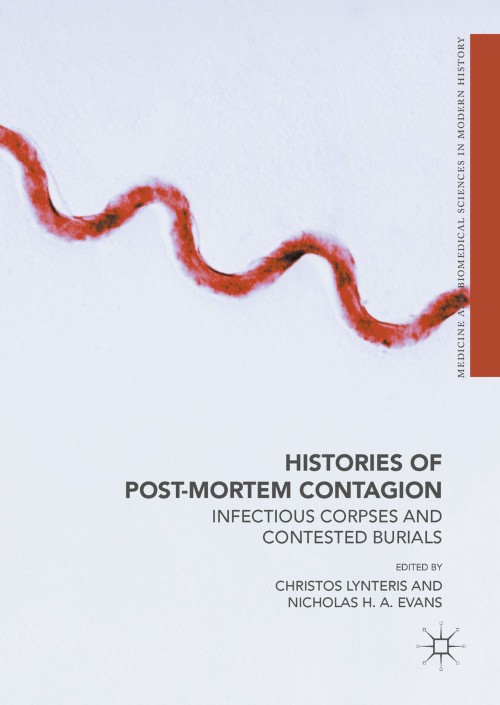
245 10|aHistories of Post-Mortem Contagion|h[electronic resource] :|bInfectious Corpses and Contested Burials /|cedited by Christos Lynteris, Nicholas H A Evans.
250 |a1st ed. 2018.
264 1|aCham :|bSpringer International Publishing :|bImprint: Palgrave Macmillan,|c2018.
300 |aXVII, 230 p. 8 illus.|bonline resource.
336 |atext|btxt|2rdacontent
337 |acomputer|bc|2rdamedia
338 |aonline resource|bcr|2rdacarrier
347 |atext file|bPDF|2rda
490 1 |aMedicine and Biomedical Sciences in Modern History,|x2947-9150
505 0 |a1. Introduction: The Challenge of the Epidemic Corpse, Christos Lynteris & Nicholas H A Evans -- 2. Failed Ritual? Medieval Papal Funerals and the Death of Clement VI (1352), Joëlle Rollo-Koster -- 3. Fear and the Corpse: Cholera and Plague Riots Compared, Samuel Cohn -- 4.Bloeming-typhoidtein: Epidemic Jingoism and the Typhoid Corpse in South Africa, Jacob Steere-Williams -- 5. Suspicious Corpses: Body Dumping and Plague in Colonial Hong Kong, Christos Lynteris -- 6. Composing and Decomposing Bodies: Visualizing Death and Disease in an Era of Global War, Pestilence, and Famine, 1913-23, Michael Anton Budd -- 7. Shrouded Corpses, Walking Cadavers: The Shifting of “the Choleras” in Depictions of Southeastern Captivity.
520 |aThis edited volume draws historians and anthropologists together to explore the contested worlds of epidemic corpses and their disposal. Why are burials so frequently at the center of disagreement, recrimination and protest during epidemics? Why are the human corpses produced in the course of infectious disease outbreaks seen as dangerous, not just to the living, but also to the continued existence of society and civilization? Examining cases from the Black Death to Ebola, contributors challenge the predominant idea that a single, universal framework of contagion can explain the political, social and cultural importance and impact of the epidemic corpse. .
650 0|aScience|xHistory.
650 0|aWorld history.
650 0|aMedicine|xHistory.
650 14|aHistory of Science.
650 24|aWorld History, Global and Transnational History.
650 24|aHistory of Medicine.
700 1 |aLynteris, Christos.|eeditor.|4edt|4http://id.loc.gov/vocabulary/relators/edt
700 1 |aEvans, Nicholas H A.|eeditor.|4edt|4http://id.loc.gov/vocabulary/relators/edt
773 0 |tSpringer Nature eBook
776 08|iPrinted edition:|z9783319629285
776 08|iPrinted edition:|z9783319629308
776 08|iPrinted edition:|z9783319874319
830 0|aMedicine and Biomedical Sciences in Modern History,|x2947-9150
856 40|uhttps://doi.org/10.1007/978-3-319-62929-2
912 |aZDB-2-HTY
912 |aZDB-2-SXH
950 |aHistory (SpringerNature-41172)
950 |aHistory (R0) (SpringerNature-43722)