LEADER 04141nam a22005895i 4500
001 609713
003 TR_AnAIT
005 20250627064943
007 cr nn 008mamaa
008 170626s2017 sz | s |||| 0|eng d
020 |a9783319518800|9978-3-319-51880-0
024 7 |a10.1007/978-3-319-51880-0|2doi
041 |aeng
049 |aTürk Tarih Kurumu Kütüphanesi
050 4|aD203.2-475
072 7|aHBL|2bicssc
072 7|aHIS037030|2bisacsh
072 7|aNH|2thema
082 04|a909.08|223
090 |aDK/2385
100 1 |aCraig, Malcolm M.|eauthor.|4aut|4http://id.loc.gov/vocabulary/relators/aut
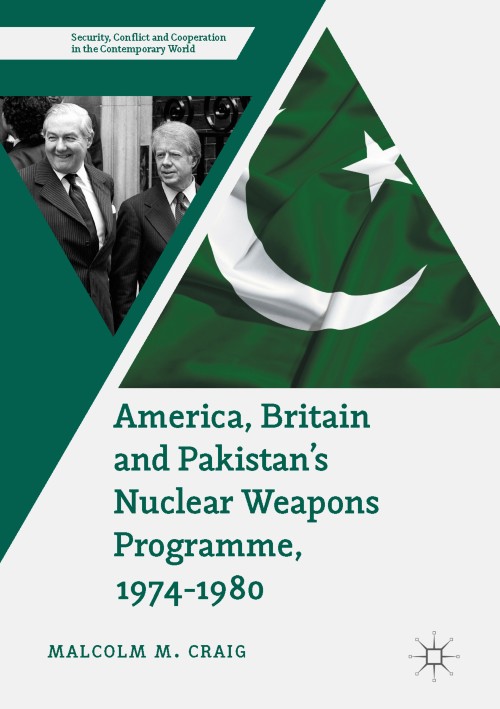
245 10|aAmerica, Britain and Pakistan’s Nuclear Weapons Programme, 1974-1980|h[electronic resource] :|bA Dream of Nightmare Proportions /|cby Malcolm M. Craig.
250 |a1st ed. 2017.
264 1|aCham :|bSpringer International Publishing :|bImprint: Palgrave Macmillan,|c2017.
300 |aX, 319 p.|bonline resource.
336 |atext|btxt|2rdacontent
337 |acomputer|bc|2rdamedia
338 |aonline resource|bcr|2rdacarrier
347 |atext file|bPDF|2rda
490 1 |aSecurity, Conflict and Cooperation in the Contemporary World,|x2731-6815
505 0 |aChapter 1: Introduction -- Chapter 2:“No hope of preventing proliferation” From the Indian Nuclear Test to the Politics of Limited Choice, May 1974 to December 1975 -- Chapter 3: “An end to the first ‘easy’ phase” Pakistan’s Nuclear Reprocessing Plant Deal and the Clandestine Programme’s Discovery, January 1976 to January 1977 -- Chapter 4:“The omens are scarcely encouraging” Jimmy Carter, Nuclear Reprocessing, and the Clandestine Programme, February 1977 to March 1978 -- Chapter 5:“We do find this statement of intentions to be disuieting” The US-UK Diplomatic Campaign Against Pakistan, March 1978 to December 1978 -- Chapter 6: “A dream of nightmare proportions” The ‘Islamic bomb’ and the ‘Khan Affair’, January 1979 to December 1979 -- Chapter 7: “Dead end” The Failure of Political Solutions to Pakistan’s Nuclear Ambitions, January 1979 to December 1979 -- Chapter 8: “Peanuts” The Cold War and the Death of Non-proliferation, January 1980 to January 1981 -- Chapter 9:Conclusion.
520 |aThis book analyses US and UK efforts to shut down Pakistan’s nuclear programme in the 1970s, between the catalytic Indian nuclear test of May 1974 and the decline of sustained non-proliferation activity from mid-1979 onwards. It is a tale of cooperation between Washington and London, but also a story of divisions and disputes. The brutal economic realities of the decade, globalisation, and wider geopolitical challenges all complicated this relationship. Policy and action were also affected by changes elsewhere in the world. Iran’s 1979 revolution brought a new form of political Islamic radicalism to prominence. The fears engendered by the Ayatollah and his followers, coupled to the blustering rhetoric of Pakistani leaders, gave rise to the ‘Islamic bomb’, a nuclear weapon supposedly created by Pakistan to be shared amongst the Muslim ummah. This study thus combines cultural, diplomatic, economic, and political history to offer a rigorous, deeply researched account of a critical moment in nuclear history. .
650 0|aHistory, Modern.
650 0|aAsia|xHistory.
650 0|aUnited States|xHistory.
650 0|aMilitary history.
650 0|aScience|xHistory.
650 0|aWorld politics.
650 14|aModern History.
650 24|aHistory of South Asia.
650 24|aUS History.
650 24|aMilitary History.
650 24|aHistory of Science.
650 24|aPolitical History.
773 0 |tSpringer Nature eBook
776 08|iPrinted edition:|z9783319518794
776 08|iPrinted edition:|z9783319518817
776 08|iPrinted edition:|z9783319847689
830 0|aSecurity, Conflict and Cooperation in the Contemporary World,|x2731-6815
856 40|uhttps://doi.org/10.1007/978-3-319-51880-0
912 |aZDB-2-HTY
912 |aZDB-2-SXH
950 |aHistory (SpringerNature-41172)
950 |aHistory (R0) (SpringerNature-43722)