LEADER 03495nam a22005775i 4500
001 609761
003 TR_AnAIT
005 20250627064802
007 cr nn 008mamaa
008 170822s2017 sz | s |||| 0|eng d
020 |a9783319600369|9978-3-319-60036-9
024 7 |a10.1007/978-3-319-60036-9|2doi
041 |aeng
049 |aTürk Tarih Kurumu Kütüphanesi
050 4|aDK1-949.5
050 4|aDJK1-77
072 7|aHBJ|2bicssc
072 7|aHIS032000|2bisacsh
072 7|aNHQ|2thema
082 04|a947|223
090 |aDK/2433
100 1 |aKamusella, Tomasz.|eauthor.|4aut|4http://id.loc.gov/vocabulary/relators/aut
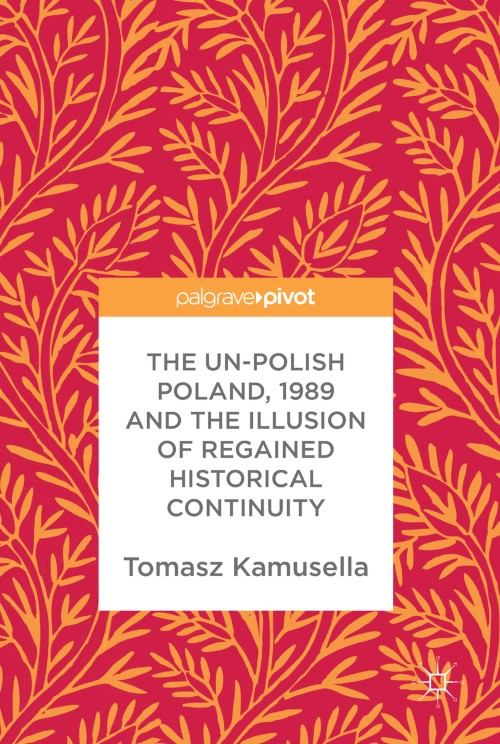
245 14|aThe Un-Polish Poland, 1989 and the Illusion of Regained Historical Continuity|h[electronic resource] /|cby Tomasz Kamusella.
250 |a1st ed. 2017.
264 1|aCham :|bSpringer International Publishing :|bImprint: Palgrave Macmillan,|c2017.
300 |aXXIX, 133 p. 5 illus. in color.|bonline resource.
336 |atext|btxt|2rdacontent
337 |acomputer|bc|2rdamedia
338 |aonline resource|bcr|2rdacarrier
347 |atext file|bPDF|2rda
505 0 |aFrom the First to the Third Republic -- Remembering and Forgetting -- ‘The Republic of Nobles’ -- The Polish or Noble Uprisings? -- The Second Republic: A New Poland-Lithuania or a Nation-State? -- Conclusion: A Third Republic?.
520 |aThis book discusses historical continuities and discontinuities between the Polish-Lithuanian Commonwealth, interwar Poland, the Polish People’s Republic, and contemporary Poland. The year 1989 is seen as a clear point-break that allowed the Poles and their country to regain a ‘natural historical continuity’ with the ‘Second Republic,’ as interwar Poland is commonly referred to in the current Polish national master narrative. In this pattern of thinking about the past, Poland-Lithuania (nowadays roughly coterminous with Belarus, Latvia, Lithuania, Poland, Russia’s Kaliningrad Region and Ukraine) is seen as the ‘First Republic.’ However, in spite of this ‘politics of memory’ (Geschichtspolitik) – regarding its borders, institutions, law, language, or ethnic and social makeup – present-day Poland, in reality, is the direct successor to and the continuation of communist Poland. Ironically, today’s Poland is very different, in all the aforementioned aspects, from the Firstand Second Republics. Hence, contemporary Poland is quite un-Polish, indeed, from the perspective of Polishness defined as a historical (that is, legal, social, cultural, ethnic and political) continuity of Poland-Lithuania and interwar Poland.
650 0|aRussia|xHistory.
650 0|aEurope, Eastern|xHistory.
650 0|aSoviet Union|xHistory.
650 0|aCivilization|xHistory.
650 0|aWorld politics.
650 0|aEurope, Central|xHistory.
650 0|aWorld history.
650 14|aRussian, Soviet, and East European History.
650 24|aCultural History.
650 24|aPolitical History.
650 24|aHistory of Germany and Central Europe.
650 24|aWorld History, Global and Transnational History.
773 0 |tSpringer Nature eBook
776 08|iPrinted edition:|z9783319600352
776 08|iPrinted edition:|z9783319600376
776 08|iPrinted edition:|z9783319867649
856 40|uhttps://doi.org/10.1007/978-3-319-60036-9
912 |aZDB-2-HTY
912 |aZDB-2-SXH
950 |aHistory (SpringerNature-41172)
950 |aHistory (R0) (SpringerNature-43722)