LEADER 03672nam a22005655i 4500
001 609873
003 TR_AnAIT
005 20250627064429
007 cr nn 008mamaa
008 200203s2019 sz | s |||| 0|eng d
020 |a9783030244675|9978-3-030-24467-5
024 7 |a10.1007/978-3-030-24467-5|2doi
041 |aeng
049 |aTürk Tarih Kurumu Kütüphanesi
050 4|aHN
072 7|aHBTB|2bicssc
072 7|aHIS054000|2bisacsh
072 7|aNHTB|2thema
082 04|a306.09|223
090 |aDK/2545
100 1 |aStevenson, Ana.|eauthor.|4aut|4http://id.loc.gov/vocabulary/relators/aut
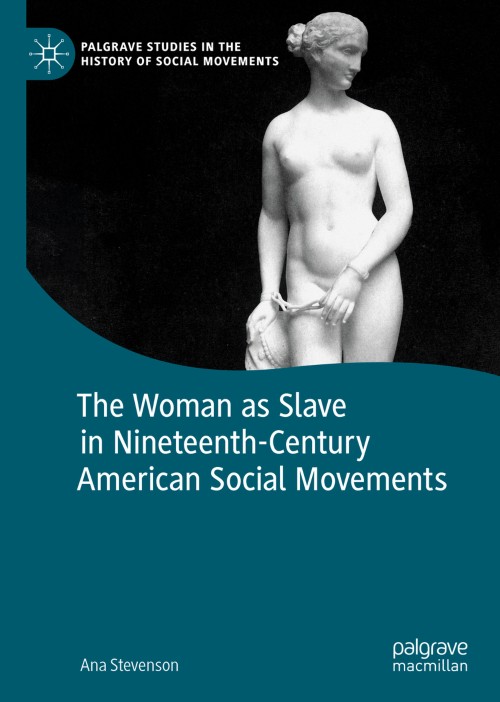
245 14|aThe Woman as Slave in Nineteenth-Century American Social Movements|h[electronic resource] /|cby Ana Stevenson.
250 |a1st ed. 2019.
264 1|aCham :|bSpringer International Publishing :|bImprint: Palgrave Macmillan,|c2019.
300 |aXX, 362 p. 17 illus., 12 illus. in color.|bonline resource.
336 |atext|btxt|2rdacontent
337 |acomputer|bc|2rdamedia
338 |aonline resource|bcr|2rdacarrier
347 |atext file|bPDF|2rda
490 1 |aPalgrave Studies in the History of Social Movements,|x2634-6567
505 0 |a1. Women’s Rights, Feminism, and the Politics of Analogy -- Part 1: Transatlantic Social Movements -- 2. “All Women are Born Slaves”: Abolitionism and Women’s Transatlantic Reform Networks -- 3. “Bought and Sold”: Antislavery, Women’s Rights, and Marriage -- Part II: Between Public and Private -- 4. “Tyrant Chains”: Fashion, Anti-Fashion, and Dress Reform -- 5. “Degrading Servitude”: Free Labor, Chattel Slavery, and the Politics of Domesticity -- Part III: Political Slavery and White Slavery -- 6. “Political Slaves”: Suffrage, Anti-Suffrage, and Tyranny -- 7. “Slavery Redivivus”: Free Love, Racial Uplift, and Remembering Chattel Slavery -- 8. “Lady Emancipators”: Conclusion -- .
520 |aThis book is the first to develop a history of the analogy between woman and slave, charting its changing meanings and enduring implications across the social movements of the long nineteenth century. Looking beyond its foundations in the antislavery and women’s rights movements, this book examines the influence of the woman-slave analogy in popular culture along with its use across the dress reform, labor, suffrage, free love, racial uplift, and anti-vice movements. At once provocative and commonplace, the woman-slave analogy was used to exceptionally varied ends in the era of chattel slavery and slave emancipation. Yet, as this book reveals, a more diverse assembly of reformers both accepted and embraced a woman-as-slave worldview than has previously been appreciated. One of the most significant yet controversial rhetorical strategies in the history of feminism, the legacy of the woman-slave analogy continues to underpin the debates that shape feminist theory today.
650 0|aSocial history.
650 0|aUnited States|xHistory.
650 0|aEthnology.
650 0|aSociolinguistics.
650 0|aRace.
650 14|aSocial History.
650 24|aUS History.
650 24|aSociocultural Anthropology.
650 24|aSociolinguistics.
650 24|aRace and Ethnicity Studies.
773 0 |tSpringer Nature eBook
776 08|iPrinted edition:|z9783030244668
776 08|iPrinted edition:|z9783030244682
776 08|iPrinted edition:|z9783030244699
830 0|aPalgrave Studies in the History of Social Movements,|x2634-6567
856 40|uhttps://doi.org/10.1007/978-3-030-24467-5
912 |aZDB-2-HTY
912 |aZDB-2-SXH
950 |aHistory (SpringerNature-41172)
950 |aHistory (R0) (SpringerNature-43722)