LEADER 03756nam a22005535i 4500
001 609893
003 TR_AnAIT
005 20250627064349
007 cr nn 008mamaa
008 211118s2021 si | s |||| 0|eng d
020 |a9789811533549|9978-981-15-3354-9
024 7 |a10.1007/978-981-15-3354-9|2doi
041 |aeng
049 |aTürk Tarih Kurumu Kütüphanesi
050 4|aGN49-298
072 7|aJHM|2bicssc
072 7|aSOC002020|2bisacsh
072 7|aJHM|2thema
082 04|a599.9|223
090 |aDK/2565
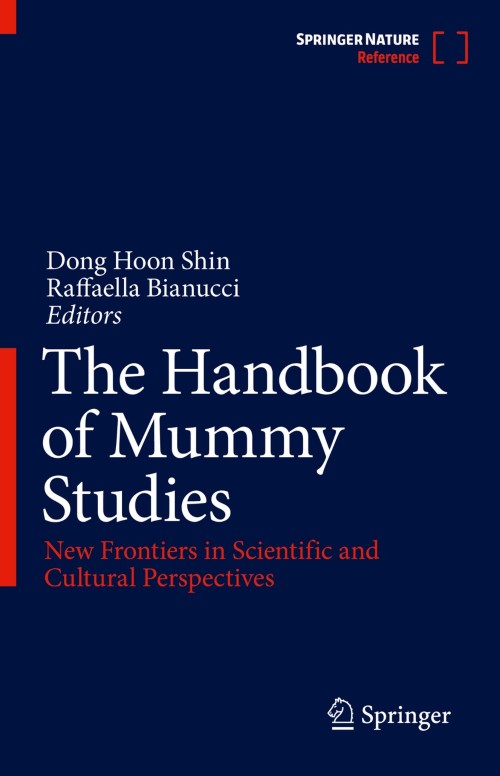
245 14|aThe Handbook of Mummy Studies|h[electronic resource] :|bNew Frontiers in Scientific and Cultural Perspectives /|cedited by Dong Hoon Shin, Raffaella Bianucci.
250 |a1st ed. 2021.
264 1|aSingapore :|bSpringer Nature Singapore :|bImprint: Springer,|c2021.
300 |a368 illus., 290 illus. in color. eReference.|bonline resource.
336 |atext|btxt|2rdacontent
337 |acomputer|bc|2rdamedia
338 |aonline resource|bcr|2rdacarrier
347 |atext file|bPDF|2rda
505 0 |aPart 1: Mummy Studies in General -- Part 2: Techniques and Current Trends in Mummy Studies -- Part 3: Mummies of the World -- Part 4: Museology of Mummies.
520 |aOwing to their unique state of preservation, mummies provide us with significant historical and scientific knowledge of humankind’s past. This handbook, written by prominent international experts in mummy studies, offers readers a comprehensive guide to new understandings of the field’s most recent trends and developments. It provides invaluable information on the health states and pathologies of historic populations and civilizations, as well as their socio-cultural and religious characteristics. Addressing the developments in mummy studies that have taken place over the past two decades – which have been neglected for as long a time – the authors excavate the ground-breaking research that has transformed scientific and cultural knowledge of our ancient predecessors. The handbook investigates the many new biotechnological tools that are routinely applied in mummy studies, ranging from morphological inspection and endoscopy to minimally invasive radiological techniques that are used to assess states of preservation. It also looks at the paleoparasitological and pathological approaches that have been employed to reconstruct the lifestyles and pathologic conditions of ancient populations, and considers the techniques that have been applied to enhance biomedical knowledge, such as craniofacial reconstruction, chemical analysis, stable isotope analysis and ancient DNA analysis. This interdisciplinary handbook will appeal to academics in historical, anthropological, archaeological and biological sciences, and will serve as an indispensable companion to researchers and students interested in worldwide mummy studies. .
650 0|aPhysical anthropology.
650 0|aHistory.
650 0|aAnatomy.
650 0|aArchaeology.
650 0|aBiotechnology.
650 14|aPhysical-Biological Anthropology.
650 24|aHistory.
650 24|aAnatomy.
650 24|aArchaeology.
650 24|aBiotechnology.
700 1 |aShin, Dong Hoon.|eeditor.|4edt|4http://id.loc.gov/vocabulary/relators/edt
700 1 |aBianucci, Raffaella.|eeditor.|4edt|4http://id.loc.gov/vocabulary/relators/edt
773 0 |tSpringer Nature eReference
776 08|iPrinted edition:|z9789811533532
856 40|uhttps://doi.org/10.1007/978-981-15-3354-9
912 |aZDB-2-HTY
912 |aZDB-2-SXRH
912 |aZDB-2-SXMH
950 |aHistory (SpringerNature-41172)
950 |aReference Module Humanities and Social Sciences (SpringerNature-43749)
950 |aReference Module Humanities (SpringerNature-85197)