LEADER 03356nam a22005775i 4500
001 609985
003 TR_AnAIT
005 20250627064053
007 cr nn 008mamaa
008 191018s2019 sz | s |||| 0|eng d
020 |a9783030265342|9978-3-030-26534-2
024 7 |a10.1007/978-3-030-26534-2|2doi
041 |aeng
049 |aTürk Tarih Kurumu Kütüphanesi
050 4|aD203.2-475
072 7|aHBL|2bicssc
072 7|aHIS037030|2bisacsh
072 7|aNH|2thema
082 04|a909.08|223
090 |aDK/2657
100 1 |aCampbell, Bruce B.|eauthor.|4aut|4http://id.loc.gov/vocabulary/relators/aut
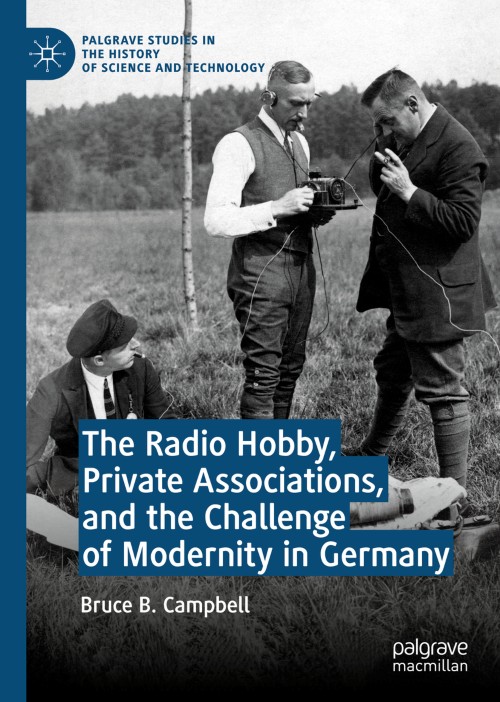
245 14|aThe Radio Hobby, Private Associations, and the Challenge of Modernity in Germany|h[electronic resource] /|cby Bruce B. Campbell.
250 |a1st ed. 2019.
264 1|aCham :|bSpringer International Publishing :|bImprint: Palgrave Macmillan,|c2019.
300 |aVIII, 369 p.|bonline resource.
336 |atext|btxt|2rdacontent
337 |acomputer|bc|2rdamedia
338 |aonline resource|bcr|2rdacarrier
347 |atext file|bPDF|2rda
490 1 |aPalgrave Studies in the History of Science and Technology,|x2730-9738
505 0 |a1. Introduction -- 2. The Beginnings: Radio in the 1920s -- 3. German Radio Before Broadcasting: Scientists, War, and Imperialism -- 4. Technology and the Radio Hobby Mature, 1927–1929 -- 5. The Nazification of the Radio Clubs, 1929–1935 -- 6. The Radio Hobby in the Service of National Socialism, 1935–1945 -- 7. The Radio Hobby Comes in from the Cold, 1945–1955 -- 8. Conclusions and Questions.
520 |aIn the early twentieth century, the magic of radio was new, revolutionary, and poorly understood. A powerful symbol of modernity, radio was a site where individuals wrestled and came to terms with an often frightening wave of new mass technologies. Radio was the object of scientific investigation, but more importantly, it was the domain of tinkerers, “hackers,” citizen scientists, and hobbyists. This book shows how this wild and mysterious technology was appropriated by ordinary individuals in Germany in the first half of the twentieth century as a leisure activity. Clubs and hobby organizations became the locus of this process, providing many of the social structures within which individuals could come to grips with radio, apart from any media institution or government framework. In so doing, this book uncovers the vital but often overlooked social context in which technological revolutions unfold.
650 0|aHistory, Modern.
650 0|aEurope, Central|xHistory.
650 0|aScience|xHistory.
650 0|aTechnology.
650 0|aHistory.
650 0|aCivilization|xHistory.
650 14|aModern History.
650 24|aHistory of Germany and Central Europe.
650 24|aHistory of Science.
650 24|aHistory of Technology.
650 24|aCultural History.
773 0 |tSpringer Nature eBook
776 08|iPrinted edition:|z9783030265335
776 08|iPrinted edition:|z9783030265359
776 08|iPrinted edition:|z9783030265366
830 0|aPalgrave Studies in the History of Science and Technology,|x2730-9738
856 40|uhttps://doi.org/10.1007/978-3-030-26534-2
912 |aZDB-2-HTY
912 |aZDB-2-SXH
950 |aHistory (SpringerNature-41172)
950 |aHistory (R0) (SpringerNature-43722)