LEADER 04089nam a22005655i 4500
001 609999
003 TR_AnAIT
005 20250627064026
007 cr nn 008mamaa
008 200721s2020 sz | s |||| 0|eng d
020 |a9783030425951|9978-3-030-42595-1
024 7 |a10.1007/978-3-030-42595-1|2doi
041 |aeng
049 |aTürk Tarih Kurumu Kütüphanesi
050 4|aD17-24.5
072 7|aHBG|2bicssc
072 7|aHIS037000|2bisacsh
072 7|aNHB|2thema
082 04|a909|223
090 |aDK/2671
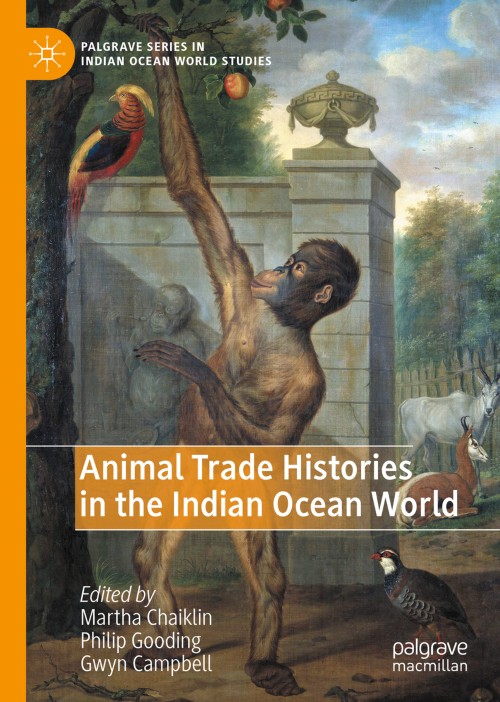
245 10|aAnimal Trade Histories in the Indian Ocean World|h[electronic resource] /|cedited by Martha Chaiklin, Philip Gooding, Gwyn Campbell.
250 |a1st ed. 2020.
264 1|aCham :|bSpringer International Publishing :|bImprint: Palgrave Macmillan,|c2020.
300 |aXVII, 324 p. 27 illus., 19 illus. in color.|bonline resource.
336 |atext|btxt|2rdacontent
337 |acomputer|bc|2rdamedia
338 |aonline resource|bcr|2rdacarrier
347 |atext file|bPDF|2rda
490 1 |aPalgrave Series in Indian Ocean World Studies,|x2730-9711
505 0 |aChapter 1. Introduction: Investigating Animals, their products, and their trades in the Indian Ocean World by Martha Chaiklin and Philip Gooding -- Chapter 2: The Dutch East India Company and the transport of live exotic animals in the seventeenth and eighteenth century by Ria Winters -- Chapter 3: Can the Oyster Speak? Pearling Empires and the Marine Environments of South India and Sri Lanka, c. 1600-1900 by Samuel Ostroff -- Chapter 4: Chank Fishing in South India under the English East India Company, 1800-1840 by Sundar Vadlamudi -- Chapter 5: Horses and Power in the Southern Red Sea Region Since the Seventeenth Century by Steven Serels -- Chapter 6: The donkey trade of the Indian Ocean World in the long nineteenth century by William G. Clarence-Smith -- Chapter 7: Commercialisation of Cattle in Imperial Madagascar, 1795-1895 by Gwyn Campbell -- Chapter 8: Ayutthaya’s Seventeenth-Century Deerskin Trade in the Extended Eastern Indian Ocean and South China Sea by Ilicia J. Sprey and KennethR. Hall -- Chapter 9: The Ivory Trade and Political Power in Nineteenth-Century East Africa by Philip Gooding -- Chapter 10: The Flight of the Peacock, or how Peacocks became Japanese by Martha Chaiklin.
520 |aThis book examines trades in animals and animal products in the history of the Indian Ocean World (IOW). An international array of established and emerging scholars investigate how the roles of equines, ungulates, sub-ungulates, mollusks, and avians expand our understandings of commerce, human societies, and world systems. Focusing primarily on the period 1500-1900, they explore how animals and their products shaped the relationships between populations in the IOW and Europeans arriving by maritime routes. By elucidating this fundamental yet under-explored aspect of encounters and exchanges in the IOW, these interdisciplinary essays further our understanding of the region, the environment, and the material, political and economic history of the world.
650 0|aWorld history.
650 0|aAfrica|xHistory.
650 0|aAsia|xHistory.
650 0|aEnvironment.
650 14|aWorld History, Global and Transnational History.
650 24|aAfrican History.
650 24|aAsian History.
650 24|aEnvironmental Sciences.
700 1 |aChaiklin, Martha.|eeditor.|4edt|4http://id.loc.gov/vocabulary/relators/edt
700 1 |aGooding, Philip.|eeditor.|4edt|4http://id.loc.gov/vocabulary/relators/edt
700 1 |aCampbell, Gwyn.|eeditor.|4edt|4http://id.loc.gov/vocabulary/relators/edt
773 0 |tSpringer Nature eBook
776 08|iPrinted edition:|z9783030425944
776 08|iPrinted edition:|z9783030425968
776 08|iPrinted edition:|z9783030425975
830 0|aPalgrave Series in Indian Ocean World Studies,|x2730-9711
856 40|uhttps://doi.org/10.1007/978-3-030-42595-1
912 |aZDB-2-HTY
912 |aZDB-2-SXH
950 |aHistory (SpringerNature-41172)
950 |aHistory (R0) (SpringerNature-43722)