

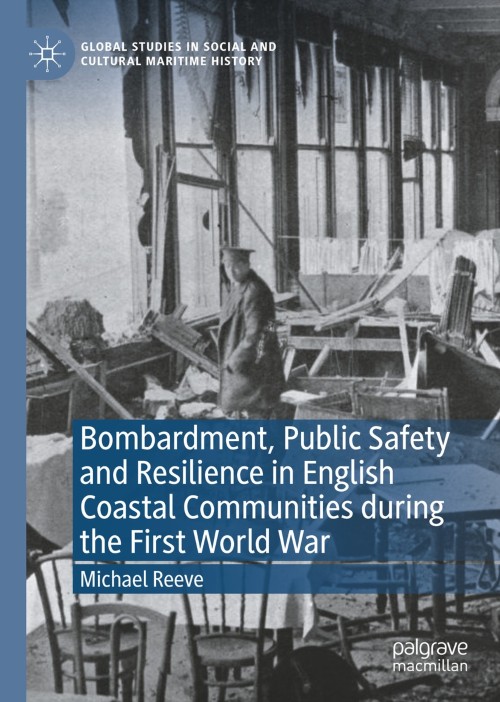
Bombardment, Public Safety and Resilience in English Coastal Communities during the First World War [electronic resource] / by Michael Reeve.
Erişim Adresi
ISBN
9783030868512
Dil Kodu
İngilizce
Yer Numarası
DK/2691
Yazar
Basım Bildirimi
1st ed. 2021.
Yayın Bilgisi
Cham : Springer International Publishing : Imprint: Palgrave Macmillan, 2021.
Fiziksel Niteleme
XV, 390 p. 16 illus. online resource.
Dizi
Global Studies in Social and Cultural Maritime History
İçindekiler Notu
1. Introduction -- 2 Constructing Fear of Invasion and Bombardment -- 3. Public Safety and Home Defence: The Defence of the Realm Act (DORA) and Central Government Policy -- 4. Local Interpretation and Implementation of Central Government Policy on Home and Civil Defence -- 5. Policing DORA -- 6. Representing War Damage and Destruction Following Bombardment -- 7. The Wartime and Post-war Legacies of Civilian Bombardment -- 8. Conclusion.
Özet, vb.
“This book is a fascinating novel project researching the effects of bombardment during the First World War on four north-east coastal towns. It makes a much-needed contribution to the history of police work, a developing area of historical research. The book outlines the destruction to the buildings and infrastructure and provides the context of local and national events with the advice and instructions given to the local population. By showing the role of Special Constables, it provides a real insight into the Home Front at this critical time in British history.” —Mary Fraser, University of Glasgow, UK “The First World War is both distant and close – our knowledge intimately familiar yet somehow incomplete. Nowhere is this truer than for the unique coastal-urban experience of that conflict explored by Michael Reeve in this book. Focusing on morale, endurance, and public safety, we see and understand new aspects of Britain’s coastal zone through German navaland aerial bombardment and destruction in Hull, Hartlepool, West Hartlepool, and Whitby. Local popular culture confronted and framed the tragic aftermaths, with nearby Scarborough’s 1915 ‘Bombardment Museum’ housing relics and souvenirs of the attacks, and Hartlepool’s ‘Bombardment Thank-offering Days’ fundraising for hospitalized victims of the December 1914 attack. Shifting between the detail of objects and the grander narratives of context, the author makes a powerful and convincing case for looking afresh at how conflict creates as well as destroys by reconfiguring the people and places of our historic coastline.” —Nicholas J. Saunders, University of Bristol, UK This book makes the case for a unique coastal-urban experience of war on the home front during the First World War, focusing on case studies from the north-east of England. The use of case studies from this region problematises an often assumed national or generalised experience of civilian life during the war, by shifting the frame of analysis away from the metropolis. This book begins with chapters related to wartime resilience, including analysis of pre-war fear of invasion and bombardment, and government policy on public safety. It then moves on to a discussion of power relations and the local implementation of policy related to bombardment, including policing. Finally, the book explores the ‘coastal-urban’ environment, focusing on depictions of war damage in popular culture, and the wartime and post-war commemoration of civilian bombardment. This work provides a multi-faceted perspective on civilian resilience, while responding to a recent call for new histories of the ‘coastal zone’. Michael Reeve is a Lecturer in History at Bishop Grosseteste University, Lincoln, UK. He received his PhD in History from the University of Hull, UK, in 2019, funded by the Arts and Humanities Research Council.
Konu
Military history.
Great Britain __ History.
History, Modern.
Military History.
History of Britain and Ireland.
Modern History.
Great Britain __ History.
History, Modern.
Military History.
History of Britain and Ireland.
Modern History.
Eseri Alıntıla
Referansları kullanmadan önce gözden geçirmeniz ve varsa gerekli düzeltmeleri yapmanız önerilir.
Dijital Kaynak
MARC Görünümü
LEADER 05214nam a22005295i 4500
001 610019
003 TR_AnAIT
005 20250627063942
007 cr nn 008mamaa
008 211210s2021 sz | s |||| 0|eng d
020 |a9783030868512|9978-3-030-86851-2
024 7 |a10.1007/978-3-030-86851-2|2doi
041 |aeng
049 |aTürk Tarih Kurumu Kütüphanesi
050 4|aD25-25.9
072 7|aHBW|2bicssc
072 7|aHIS027000|2bisacsh
072 7|aNHW|2thema
082 04|a355.009|223
082 04|a909|223
090 |aDK/2691
100 1 |aReeve, Michael.|eauthor.|4aut|4http://id.loc.gov/vocabulary/relators/aut
245 10|aBombardment, Public Safety and Resilience in English Coastal Communities during the First World War|h[electronic resource] /|cby Michael Reeve.
250 |a1st ed. 2021.
264 1|aCham :|bSpringer International Publishing :|bImprint: Palgrave Macmillan,|c2021.
300 |aXV, 390 p. 16 illus.|bonline resource.
336 |atext|btxt|2rdacontent
337 |acomputer|bc|2rdamedia
338 |aonline resource|bcr|2rdacarrier
347 |atext file|bPDF|2rda
490 1 |aGlobal Studies in Social and Cultural Maritime History
505 0 |a1. Introduction -- 2 Constructing Fear of Invasion and Bombardment -- 3. Public Safety and Home Defence: The Defence of the Realm Act (DORA) and Central Government Policy -- 4. Local Interpretation and Implementation of Central Government Policy on Home and Civil Defence -- 5. Policing DORA -- 6. Representing War Damage and Destruction Following Bombardment -- 7. The Wartime and Post-war Legacies of Civilian Bombardment -- 8. Conclusion.
520 |a“This book is a fascinating novel project researching the effects of bombardment during the First World War on four north-east coastal towns. It makes a much-needed contribution to the history of police work, a developing area of historical research. The book outlines the destruction to the buildings and infrastructure and provides the context of local and national events with the advice and instructions given to the local population. By showing the role of Special Constables, it provides a real insight into the Home Front at this critical time in British history.” —Mary Fraser, University of Glasgow, UK “The First World War is both distant and close – our knowledge intimately familiar yet somehow incomplete. Nowhere is this truer than for the unique coastal-urban experience of that conflict explored by Michael Reeve in this book. Focusing on morale, endurance, and public safety, we see and understand new aspects of Britain’s coastal zone through German navaland aerial bombardment and destruction in Hull, Hartlepool, West Hartlepool, and Whitby. Local popular culture confronted and framed the tragic aftermaths, with nearby Scarborough’s 1915 ‘Bombardment Museum’ housing relics and souvenirs of the attacks, and Hartlepool’s ‘Bombardment Thank-offering Days’ fundraising for hospitalized victims of the December 1914 attack. Shifting between the detail of objects and the grander narratives of context, the author makes a powerful and convincing case for looking afresh at how conflict creates as well as destroys by reconfiguring the people and places of our historic coastline.” —Nicholas J. Saunders, University of Bristol, UK This book makes the case for a unique coastal-urban experience of war on the home front during the First World War, focusing on case studies from the north-east of England. The use of case studies from this region problematises an often assumed national or generalised experience of civilian life during the war, by shifting the frame of analysis away from the metropolis. This book begins with chapters related to wartime resilience, including analysis of pre-war fear of invasion and bombardment, and government policy on public safety. It then moves on to a discussion of power relations and the local implementation of policy related to bombardment, including policing. Finally, the book explores the ‘coastal-urban’ environment, focusing on depictions of war damage in popular culture, and the wartime and post-war commemoration of civilian bombardment. This work provides a multi-faceted perspective on civilian resilience, while responding to a recent call for new histories of the ‘coastal zone’. Michael Reeve is a Lecturer in History at Bishop Grosseteste University, Lincoln, UK. He received his PhD in History from the University of Hull, UK, in 2019, funded by the Arts and Humanities Research Council.
650 0|aMilitary history.
650 0|aGreat Britain|xHistory.
650 0|aHistory, Modern.
650 14|aMilitary History.
650 24|aHistory of Britain and Ireland.
650 24|aModern History.
773 0 |tSpringer Nature eBook
776 08|iPrinted edition:|z9783030868505
776 08|iPrinted edition:|z9783030868529
776 08|iPrinted edition:|z9783030868536
830 0|aGlobal Studies in Social and Cultural Maritime History
856 40|uhttps://doi.org/10.1007/978-3-030-86851-2
912 |aZDB-2-HTY
912 |aZDB-2-SXH
950 |aHistory (SpringerNature-41172)
950 |aHistory (R0) (SpringerNature-43722)
001 610019
003 TR_AnAIT
005 20250627063942
007 cr nn 008mamaa
008 211210s2021 sz | s |||| 0|eng d
020 |a9783030868512|9978-3-030-86851-2
024 7 |a10.1007/978-3-030-86851-2|2doi
041 |aeng
049 |aTürk Tarih Kurumu Kütüphanesi
050 4|aD25-25.9
072 7|aHBW|2bicssc
072 7|aHIS027000|2bisacsh
072 7|aNHW|2thema
082 04|a355.009|223
082 04|a909|223
090 |aDK/2691
100 1 |aReeve, Michael.|eauthor.|4aut|4http://id.loc.gov/vocabulary/relators/aut
245 10|aBombardment, Public Safety and Resilience in English Coastal Communities during the First World War|h[electronic resource] /|cby Michael Reeve.
250 |a1st ed. 2021.
264 1|aCham :|bSpringer International Publishing :|bImprint: Palgrave Macmillan,|c2021.
300 |aXV, 390 p. 16 illus.|bonline resource.
336 |atext|btxt|2rdacontent
337 |acomputer|bc|2rdamedia
338 |aonline resource|bcr|2rdacarrier
347 |atext file|bPDF|2rda
490 1 |aGlobal Studies in Social and Cultural Maritime History
505 0 |a1. Introduction -- 2 Constructing Fear of Invasion and Bombardment -- 3. Public Safety and Home Defence: The Defence of the Realm Act (DORA) and Central Government Policy -- 4. Local Interpretation and Implementation of Central Government Policy on Home and Civil Defence -- 5. Policing DORA -- 6. Representing War Damage and Destruction Following Bombardment -- 7. The Wartime and Post-war Legacies of Civilian Bombardment -- 8. Conclusion.
520 |a“This book is a fascinating novel project researching the effects of bombardment during the First World War on four north-east coastal towns. It makes a much-needed contribution to the history of police work, a developing area of historical research. The book outlines the destruction to the buildings and infrastructure and provides the context of local and national events with the advice and instructions given to the local population. By showing the role of Special Constables, it provides a real insight into the Home Front at this critical time in British history.” —Mary Fraser, University of Glasgow, UK “The First World War is both distant and close – our knowledge intimately familiar yet somehow incomplete. Nowhere is this truer than for the unique coastal-urban experience of that conflict explored by Michael Reeve in this book. Focusing on morale, endurance, and public safety, we see and understand new aspects of Britain’s coastal zone through German navaland aerial bombardment and destruction in Hull, Hartlepool, West Hartlepool, and Whitby. Local popular culture confronted and framed the tragic aftermaths, with nearby Scarborough’s 1915 ‘Bombardment Museum’ housing relics and souvenirs of the attacks, and Hartlepool’s ‘Bombardment Thank-offering Days’ fundraising for hospitalized victims of the December 1914 attack. Shifting between the detail of objects and the grander narratives of context, the author makes a powerful and convincing case for looking afresh at how conflict creates as well as destroys by reconfiguring the people and places of our historic coastline.” —Nicholas J. Saunders, University of Bristol, UK This book makes the case for a unique coastal-urban experience of war on the home front during the First World War, focusing on case studies from the north-east of England. The use of case studies from this region problematises an often assumed national or generalised experience of civilian life during the war, by shifting the frame of analysis away from the metropolis. This book begins with chapters related to wartime resilience, including analysis of pre-war fear of invasion and bombardment, and government policy on public safety. It then moves on to a discussion of power relations and the local implementation of policy related to bombardment, including policing. Finally, the book explores the ‘coastal-urban’ environment, focusing on depictions of war damage in popular culture, and the wartime and post-war commemoration of civilian bombardment. This work provides a multi-faceted perspective on civilian resilience, while responding to a recent call for new histories of the ‘coastal zone’. Michael Reeve is a Lecturer in History at Bishop Grosseteste University, Lincoln, UK. He received his PhD in History from the University of Hull, UK, in 2019, funded by the Arts and Humanities Research Council.
650 0|aMilitary history.
650 0|aGreat Britain|xHistory.
650 0|aHistory, Modern.
650 14|aMilitary History.
650 24|aHistory of Britain and Ireland.
650 24|aModern History.
773 0 |tSpringer Nature eBook
776 08|iPrinted edition:|z9783030868505
776 08|iPrinted edition:|z9783030868529
776 08|iPrinted edition:|z9783030868536
830 0|aGlobal Studies in Social and Cultural Maritime History
856 40|uhttps://doi.org/10.1007/978-3-030-86851-2
912 |aZDB-2-HTY
912 |aZDB-2-SXH
950 |aHistory (SpringerNature-41172)
950 |aHistory (R0) (SpringerNature-43722)
Materyaller
Depodan talep edilen materyal sadece kütüphane içerisinde kullanılmaktadır.
Materyal dışarıya ödünç verilmemektedir.
Materyal dışarıya ödünç verilmemektedir.
