

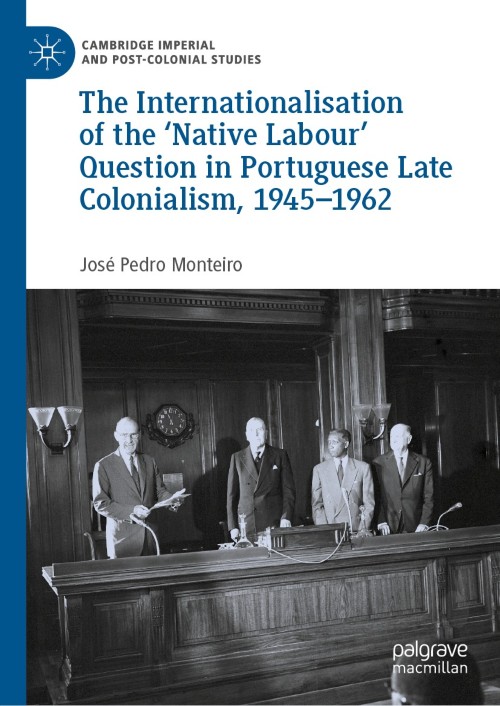
The Internationalisation of the ‘Native Labour' Question in Portuguese Late Colonialism, 1945–1962 [electronic resource] / by José Pedro Monteiro.
Erişim Adresi
ISBN
9783031051401
Dil Kodu
İngilizce
Yer Numarası
DK/2700
Yazar
Basım Bildirimi
1st ed. 2023.
Yayın Bilgisi
Cham : Springer International Publishing : Imprint: Palgrave Macmillan, 2023.
Fiziksel Niteleme
IX, 230 p. 1 illus. online resource.
Dizi
Cambridge Imperial and Post-Colonial Studies, 2635-1641
İçindekiler Notu
Chapter 1: Introduction -- Chapter 2: The Reconfiguration of International Standards and Portuguese “Native Labour” Policies -- Chapter 3: The End of the “Happy Times”: The Renewed Internationalisation of Debates on Labour Freedom -- Chapter 4: A Long and Troubled Process: The Ratification of the 1930 Forced Labour Convention -- Chapter 5 – Portuguese Colonialism and the Expansion of the Internationalisation of the “Native Labour” Question -- Chapter 6: Ghana's Complaint against the Portuguese Empire at the ILO (1961-1962) -- Chapter 7: Conclusion.
Özet, vb.
This volume addresses the ways the ‘native labour’ question in the Portuguese late colonial empire in Africa became a recurrent topic of international and transnational debate and regulation after the Second World War. As other European colonial empires were tentatively transforming their labour and social policies in the aftermath of the war, the Portuguese Empire in Africa resisted significant changes in this domain, preserving a strict dual labour regime. As a result, a growing number of individuals, networks and institutions abroad engaged with labour and social realities in Portuguese African colonies, giving origin to a series of instances of denunciation of labour-related abuses. Portuguese authorities responded to these initiatives by selectively engaging with international norms, languages and mechanisms. However, as global decolonisation gained momentum, international and transnational events and processes would significantly constrain Portuguese imperial and colonial decision-making procedures, with the aim of retaining the empire. Therefore, the ‘native labour’ question became in its own right a crucial political and diplomatic element of the broader struggles over the meaning of Portuguese imperial legitimacy. As this volume argues, these historical processes are critical to properly understanding the history of Portuguese late colonialism and its protracted trajectory of decolonisation. José Pedro Monteiro is a Research Fellow at the Communication and Society Research Centre - University of Minho, Portugal. His current research project focuses on the politics of citizenship in the Portuguese late colonial empire. He has been working, for the last few years, on the intersections between international and imperial histories and historiographies. With Miguel Bandeira Jerónimo, he co-edited Internationalism, Imperialism and the Formation of the Contemporary World (Palgrave, 2017). He is currently the coordinator of the research project “Humanity Internationalized: Cases, Dynamics, Comparisons (1945–1980)”, funded by the Portuguese Foundation for Science and Technology. .
Konu
Imperialism.
Labor.
History.
Africa __ History.
Europe __ History __ 1492-.
World history.
Imperialism and Colonialism.
Labor History.
African History.
History of Modern Europe.
World History, Global and Transnational History.
Labor.
History.
Africa __ History.
Europe __ History __ 1492-.
World history.
Imperialism and Colonialism.
Labor History.
African History.
History of Modern Europe.
World History, Global and Transnational History.
Eseri Alıntıla
Referansları kullanmadan önce gözden geçirmeniz ve varsa gerekli düzeltmeleri yapmanız önerilir.
Dijital Kaynak
MARC Görünümü
LEADER 04747nam a22005775i 4500
001 610028
003 TR_AnAIT
005 20250627063925
007 cr nn 008mamaa
008 221122s2023 sz | s |||| 0|eng d
020 |a9783031051401|9978-3-031-05140-1
024 7 |a10.1007/978-3-031-05140-1|2doi
041 |aeng
049 |aTürk Tarih Kurumu Kütüphanesi
050 4|aJV61-152
072 7|aHBTQ|2bicssc
072 7|aHIS000000|2bisacsh
072 7|aNHTQ|2thema
082 04|a325.3|223
090 |aDK/2700
100 1 |aMonteiro, José Pedro.|eauthor.|4aut|4http://id.loc.gov/vocabulary/relators/aut
245 14|aThe Internationalisation of the ‘Native Labour' Question in Portuguese Late Colonialism, 1945–1962|h[electronic resource] /|cby José Pedro Monteiro.
250 |a1st ed. 2023.
264 1|aCham :|bSpringer International Publishing :|bImprint: Palgrave Macmillan,|c2023.
300 |aIX, 230 p. 1 illus.|bonline resource.
336 |atext|btxt|2rdacontent
337 |acomputer|bc|2rdamedia
338 |aonline resource|bcr|2rdacarrier
347 |atext file|bPDF|2rda
490 1 |aCambridge Imperial and Post-Colonial Studies,|x2635-1641
505 0 |aChapter 1: Introduction -- Chapter 2: The Reconfiguration of International Standards and Portuguese “Native Labour” Policies -- Chapter 3: The End of the “Happy Times”: The Renewed Internationalisation of Debates on Labour Freedom -- Chapter 4: A Long and Troubled Process: The Ratification of the 1930 Forced Labour Convention -- Chapter 5 – Portuguese Colonialism and the Expansion of the Internationalisation of the “Native Labour” Question -- Chapter 6: Ghana's Complaint against the Portuguese Empire at the ILO (1961-1962) -- Chapter 7: Conclusion.
520 |aThis volume addresses the ways the ‘native labour’ question in the Portuguese late colonial empire in Africa became a recurrent topic of international and transnational debate and regulation after the Second World War. As other European colonial empires were tentatively transforming their labour and social policies in the aftermath of the war, the Portuguese Empire in Africa resisted significant changes in this domain, preserving a strict dual labour regime. As a result, a growing number of individuals, networks and institutions abroad engaged with labour and social realities in Portuguese African colonies, giving origin to a series of instances of denunciation of labour-related abuses. Portuguese authorities responded to these initiatives by selectively engaging with international norms, languages and mechanisms. However, as global decolonisation gained momentum, international and transnational events and processes would significantly constrain Portuguese imperial and colonial decision-making procedures, with the aim of retaining the empire. Therefore, the ‘native labour’ question became in its own right a crucial political and diplomatic element of the broader struggles over the meaning of Portuguese imperial legitimacy. As this volume argues, these historical processes are critical to properly understanding the history of Portuguese late colonialism and its protracted trajectory of decolonisation. José Pedro Monteiro is a Research Fellow at the Communication and Society Research Centre - University of Minho, Portugal. His current research project focuses on the politics of citizenship in the Portuguese late colonial empire. He has been working, for the last few years, on the intersections between international and imperial histories and historiographies. With Miguel Bandeira Jerónimo, he co-edited Internationalism, Imperialism and the Formation of the Contemporary World (Palgrave, 2017). He is currently the coordinator of the research project “Humanity Internationalized: Cases, Dynamics, Comparisons (1945–1980)”, funded by the Portuguese Foundation for Science and Technology. .
650 0|aImperialism.
650 0|aLabor.
650 0|aHistory.
650 0|aAfrica|xHistory.
650 0|aEurope|xHistory|x1492-.
650 0|aWorld history.
650 14|aImperialism and Colonialism.
650 24|aLabor History.
650 24|aAfrican History.
650 24|aHistory of Modern Europe.
650 24|aWorld History, Global and Transnational History.
773 0 |tSpringer Nature eBook
776 08|iPrinted edition:|z9783031051395
776 08|iPrinted edition:|z9783031051418
776 08|iPrinted edition:|z9783031051425
830 0|aCambridge Imperial and Post-Colonial Studies,|x2635-1641
856 40|uhttps://doi.org/10.1007/978-3-031-05140-1
912 |aZDB-2-HTY
912 |aZDB-2-SXH
950 |aHistory (SpringerNature-41172)
950 |aHistory (R0) (SpringerNature-43722)
001 610028
003 TR_AnAIT
005 20250627063925
007 cr nn 008mamaa
008 221122s2023 sz | s |||| 0|eng d
020 |a9783031051401|9978-3-031-05140-1
024 7 |a10.1007/978-3-031-05140-1|2doi
041 |aeng
049 |aTürk Tarih Kurumu Kütüphanesi
050 4|aJV61-152
072 7|aHBTQ|2bicssc
072 7|aHIS000000|2bisacsh
072 7|aNHTQ|2thema
082 04|a325.3|223
090 |aDK/2700
100 1 |aMonteiro, José Pedro.|eauthor.|4aut|4http://id.loc.gov/vocabulary/relators/aut
245 14|aThe Internationalisation of the ‘Native Labour' Question in Portuguese Late Colonialism, 1945–1962|h[electronic resource] /|cby José Pedro Monteiro.
250 |a1st ed. 2023.
264 1|aCham :|bSpringer International Publishing :|bImprint: Palgrave Macmillan,|c2023.
300 |aIX, 230 p. 1 illus.|bonline resource.
336 |atext|btxt|2rdacontent
337 |acomputer|bc|2rdamedia
338 |aonline resource|bcr|2rdacarrier
347 |atext file|bPDF|2rda
490 1 |aCambridge Imperial and Post-Colonial Studies,|x2635-1641
505 0 |aChapter 1: Introduction -- Chapter 2: The Reconfiguration of International Standards and Portuguese “Native Labour” Policies -- Chapter 3: The End of the “Happy Times”: The Renewed Internationalisation of Debates on Labour Freedom -- Chapter 4: A Long and Troubled Process: The Ratification of the 1930 Forced Labour Convention -- Chapter 5 – Portuguese Colonialism and the Expansion of the Internationalisation of the “Native Labour” Question -- Chapter 6: Ghana's Complaint against the Portuguese Empire at the ILO (1961-1962) -- Chapter 7: Conclusion.
520 |aThis volume addresses the ways the ‘native labour’ question in the Portuguese late colonial empire in Africa became a recurrent topic of international and transnational debate and regulation after the Second World War. As other European colonial empires were tentatively transforming their labour and social policies in the aftermath of the war, the Portuguese Empire in Africa resisted significant changes in this domain, preserving a strict dual labour regime. As a result, a growing number of individuals, networks and institutions abroad engaged with labour and social realities in Portuguese African colonies, giving origin to a series of instances of denunciation of labour-related abuses. Portuguese authorities responded to these initiatives by selectively engaging with international norms, languages and mechanisms. However, as global decolonisation gained momentum, international and transnational events and processes would significantly constrain Portuguese imperial and colonial decision-making procedures, with the aim of retaining the empire. Therefore, the ‘native labour’ question became in its own right a crucial political and diplomatic element of the broader struggles over the meaning of Portuguese imperial legitimacy. As this volume argues, these historical processes are critical to properly understanding the history of Portuguese late colonialism and its protracted trajectory of decolonisation. José Pedro Monteiro is a Research Fellow at the Communication and Society Research Centre - University of Minho, Portugal. His current research project focuses on the politics of citizenship in the Portuguese late colonial empire. He has been working, for the last few years, on the intersections between international and imperial histories and historiographies. With Miguel Bandeira Jerónimo, he co-edited Internationalism, Imperialism and the Formation of the Contemporary World (Palgrave, 2017). He is currently the coordinator of the research project “Humanity Internationalized: Cases, Dynamics, Comparisons (1945–1980)”, funded by the Portuguese Foundation for Science and Technology. .
650 0|aImperialism.
650 0|aLabor.
650 0|aHistory.
650 0|aAfrica|xHistory.
650 0|aEurope|xHistory|x1492-.
650 0|aWorld history.
650 14|aImperialism and Colonialism.
650 24|aLabor History.
650 24|aAfrican History.
650 24|aHistory of Modern Europe.
650 24|aWorld History, Global and Transnational History.
773 0 |tSpringer Nature eBook
776 08|iPrinted edition:|z9783031051395
776 08|iPrinted edition:|z9783031051418
776 08|iPrinted edition:|z9783031051425
830 0|aCambridge Imperial and Post-Colonial Studies,|x2635-1641
856 40|uhttps://doi.org/10.1007/978-3-031-05140-1
912 |aZDB-2-HTY
912 |aZDB-2-SXH
950 |aHistory (SpringerNature-41172)
950 |aHistory (R0) (SpringerNature-43722)
Materyaller
Depodan talep edilen materyal sadece kütüphane içerisinde kullanılmaktadır.
Materyal dışarıya ödünç verilmemektedir.
Materyal dışarıya ödünç verilmemektedir.
