

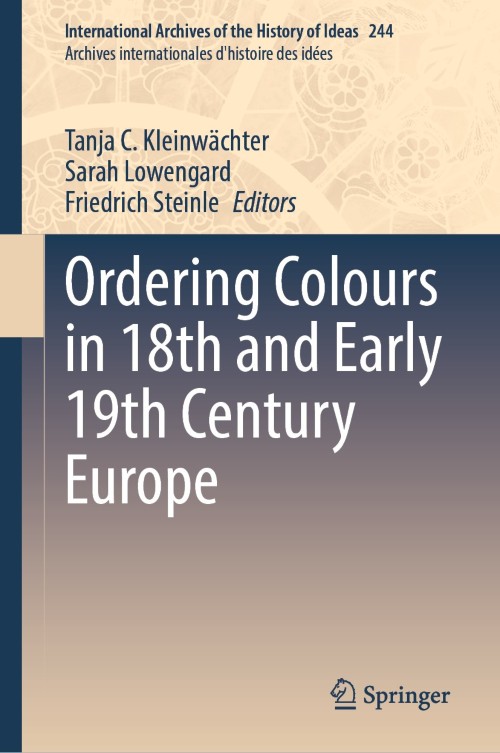
Ordering Colours in 18th and Early 19th Century Europe [electronic resource] / edited by Tanja C. Kleinwächter, Sarah Lowengard, Friedrich Steinle.
Erişim Adresi
ISBN
9783031349560
Dil Kodu
İngilizce
Yer Numarası
DK/2710
Basım Bildirimi
1st ed. 2023.
Yayın Bilgisi
Cham : Springer International Publishing : Imprint: Springer, 2023.
Fiziksel Niteleme
VII, 201 p. 79 illus., 65 illus. in color. online resource.
Dizi
International Archives of the History of Ideas Archives internationales d'histoire des idées, 2215-0307 ; 244
İçindekiler Notu
1. Introduction Kleinwächter, Tanja, Sarah Lowengard and Friedrich Steinle -- Part I Ordering Systems and Standards -- 2 The shape of colour order systems and the evolution of colour theory Caivano, José Luis -- 3 Materialization of vision - Colour standards in the early sciences as a practice transfer from the arts and handicrafts Karliczek, André -- Part II Visual Studies to Prove a Theory -- 4. Jacob Christoff Le Blon and Trichromatic printing: A tale of five cities Stijnman, Ad -- 5. Colour theory by Mikhail Lomonosov: From dyes and mosaics to a trichromatic idea Stanulevich, Nadezhda -- 6. Schiffermüller and Newton in sinter united - Franz Uibelakers two-colour theory (1781) Kleinwächter, Tanja -- Part III Objects in Colours/Objects and Colours -- 7. Calau’s Punic Wax, Lambert’s Farbenpyramide (1772), and prefabricated watercolour cakes Simonini, Giulia -- 8. Testing ground: Colour samples in European porcelain manufactories Szalay, Gabriella -- 9 Fighting for the best pigment! Academic colour discourses in Kassel during the 19thcentury Mävers, Sophie-Luise -- General Bibliography -- Index of Names -- General Index.
Özet, vb.
This book describes the international effort to give order to colours and thus facilitate communication about it, two topics deemed essential to a modernising world that were also recognizably complex. Expert essays will enhance readers' understanding of the struggle to coordinate nature with art at a time when approaches to both were undergoing rapid change. Ordering Colours shows how such seemingly trivial concerns as identifying the basic colours and disseminating appropriate colour diagrams had to meet philosophical, scientific and professional needs across Europe. Contributors detail the many schemes for colour systematization and their real-world applications; questions of concern to both academic- and manufacturing-focused investigators throughout the long 18th century. They bring together original research and new thinking about landmark early modern studies to address important developments as well as neglected historical contributions of European arts, sciences, andeconomies. This collection is an important addition to the libraries of all who are interested in public culture and manufacturing developments in the early modern period and is aimed at historians of art, technology, philosophy and physics.
Konu
Technology.
History.
Philosophy __ History.
Art __ Philosophy.
Ethnology.
Culture.
History of Technology.
History of Philosophy.
Theory of Arts.
Regional Cultural Studies.
History.
Philosophy __ History.
Art __ Philosophy.
Ethnology.
Culture.
History of Technology.
History of Philosophy.
Theory of Arts.
Regional Cultural Studies.
Diğer Yazarlar
Eseri Alıntıla
Referansları kullanmadan önce gözden geçirmeniz ve varsa gerekli düzeltmeleri yapmanız önerilir.
Dijital Kaynak
MARC Görünümü
LEADER 04662nam a22005895i 4500
001 610038
003 TR_AnAIT
005 20250627063904
007 cr nn 008mamaa
008 231004s2023 sz | s |||| 0|eng d
020 |a9783031349560|9978-3-031-34956-0
024 7 |a10.1007/978-3-031-34956-0|2doi
041 |aeng
049 |aTürk Tarih Kurumu Kütüphanesi
050 4|aT14.7-33
072 7|aTBX|2bicssc
072 7|aTEC056000|2bisacsh
072 7|aTBX|2thema
082 04|a600.09|223
090 |aDK/2710
245 10|aOrdering Colours in 18th and Early 19th Century Europe|h[electronic resource] /|cedited by Tanja C. Kleinwächter, Sarah Lowengard, Friedrich Steinle.
250 |a1st ed. 2023.
264 1|aCham :|bSpringer International Publishing :|bImprint: Springer,|c2023.
300 |aVII, 201 p. 79 illus., 65 illus. in color.|bonline resource.
336 |atext|btxt|2rdacontent
337 |acomputer|bc|2rdamedia
338 |aonline resource|bcr|2rdacarrier
347 |atext file|bPDF|2rda
490 1 |aInternational Archives of the History of Ideas Archives internationales d'histoire des idées,|x2215-0307 ;|v244
505 0 |a1. Introduction Kleinwächter, Tanja, Sarah Lowengard and Friedrich Steinle -- Part I Ordering Systems and Standards -- 2 The shape of colour order systems and the evolution of colour theory Caivano, José Luis -- 3 Materialization of vision - Colour standards in the early sciences as a practice transfer from the arts and handicrafts Karliczek, André -- Part II Visual Studies to Prove a Theory -- 4. Jacob Christoff Le Blon and Trichromatic printing: A tale of five cities Stijnman, Ad -- 5. Colour theory by Mikhail Lomonosov: From dyes and mosaics to a trichromatic idea Stanulevich, Nadezhda -- 6. Schiffermüller and Newton in sinter united - Franz Uibelakers two-colour theory (1781) Kleinwächter, Tanja -- Part III Objects in Colours/Objects and Colours -- 7. Calau’s Punic Wax, Lambert’s Farbenpyramide (1772), and prefabricated watercolour cakes Simonini, Giulia -- 8. Testing ground: Colour samples in European porcelain manufactories Szalay, Gabriella -- 9 Fighting for the best pigment! Academic colour discourses in Kassel during the 19thcentury Mävers, Sophie-Luise -- General Bibliography -- Index of Names -- General Index.
520 |aThis book describes the international effort to give order to colours and thus facilitate communication about it, two topics deemed essential to a modernising world that were also recognizably complex. Expert essays will enhance readers' understanding of the struggle to coordinate nature with art at a time when approaches to both were undergoing rapid change. Ordering Colours shows how such seemingly trivial concerns as identifying the basic colours and disseminating appropriate colour diagrams had to meet philosophical, scientific and professional needs across Europe. Contributors detail the many schemes for colour systematization and their real-world applications; questions of concern to both academic- and manufacturing-focused investigators throughout the long 18th century. They bring together original research and new thinking about landmark early modern studies to address important developments as well as neglected historical contributions of European arts, sciences, andeconomies. This collection is an important addition to the libraries of all who are interested in public culture and manufacturing developments in the early modern period and is aimed at historians of art, technology, philosophy and physics.
650 0|aTechnology.
650 0|aHistory.
650 0|aPhilosophy|xHistory.
650 0|aArt|xPhilosophy.
650 0|aEthnology.
650 0|aCulture.
650 14|aHistory of Technology.
650 24|aHistory of Philosophy.
650 24|aTheory of Arts.
650 24|aRegional Cultural Studies.
700 1 |aKleinwächter, Tanja C.|eeditor.|4edt|4http://id.loc.gov/vocabulary/relators/edt
700 1 |aLowengard, Sarah.|eeditor.|4edt|4http://id.loc.gov/vocabulary/relators/edt
700 1 |aSteinle, Friedrich.|eeditor.|4edt|4http://id.loc.gov/vocabulary/relators/edt
773 0 |tSpringer Nature eBook
776 08|iPrinted edition:|z9783031349553
776 08|iPrinted edition:|z9783031349577
776 08|iPrinted edition:|z9783031349584
830 0|aInternational Archives of the History of Ideas Archives internationales d'histoire des idées,|x2215-0307 ;|v244
856 40|uhttps://doi.org/10.1007/978-3-031-34956-0
912 |aZDB-2-HTY
912 |aZDB-2-SXH
950 |aHistory (SpringerNature-41172)
950 |aHistory (R0) (SpringerNature-43722)
001 610038
003 TR_AnAIT
005 20250627063904
007 cr nn 008mamaa
008 231004s2023 sz | s |||| 0|eng d
020 |a9783031349560|9978-3-031-34956-0
024 7 |a10.1007/978-3-031-34956-0|2doi
041 |aeng
049 |aTürk Tarih Kurumu Kütüphanesi
050 4|aT14.7-33
072 7|aTBX|2bicssc
072 7|aTEC056000|2bisacsh
072 7|aTBX|2thema
082 04|a600.09|223
090 |aDK/2710
245 10|aOrdering Colours in 18th and Early 19th Century Europe|h[electronic resource] /|cedited by Tanja C. Kleinwächter, Sarah Lowengard, Friedrich Steinle.
250 |a1st ed. 2023.
264 1|aCham :|bSpringer International Publishing :|bImprint: Springer,|c2023.
300 |aVII, 201 p. 79 illus., 65 illus. in color.|bonline resource.
336 |atext|btxt|2rdacontent
337 |acomputer|bc|2rdamedia
338 |aonline resource|bcr|2rdacarrier
347 |atext file|bPDF|2rda
490 1 |aInternational Archives of the History of Ideas Archives internationales d'histoire des idées,|x2215-0307 ;|v244
505 0 |a1. Introduction Kleinwächter, Tanja, Sarah Lowengard and Friedrich Steinle -- Part I Ordering Systems and Standards -- 2 The shape of colour order systems and the evolution of colour theory Caivano, José Luis -- 3 Materialization of vision - Colour standards in the early sciences as a practice transfer from the arts and handicrafts Karliczek, André -- Part II Visual Studies to Prove a Theory -- 4. Jacob Christoff Le Blon and Trichromatic printing: A tale of five cities Stijnman, Ad -- 5. Colour theory by Mikhail Lomonosov: From dyes and mosaics to a trichromatic idea Stanulevich, Nadezhda -- 6. Schiffermüller and Newton in sinter united - Franz Uibelakers two-colour theory (1781) Kleinwächter, Tanja -- Part III Objects in Colours/Objects and Colours -- 7. Calau’s Punic Wax, Lambert’s Farbenpyramide (1772), and prefabricated watercolour cakes Simonini, Giulia -- 8. Testing ground: Colour samples in European porcelain manufactories Szalay, Gabriella -- 9 Fighting for the best pigment! Academic colour discourses in Kassel during the 19thcentury Mävers, Sophie-Luise -- General Bibliography -- Index of Names -- General Index.
520 |aThis book describes the international effort to give order to colours and thus facilitate communication about it, two topics deemed essential to a modernising world that were also recognizably complex. Expert essays will enhance readers' understanding of the struggle to coordinate nature with art at a time when approaches to both were undergoing rapid change. Ordering Colours shows how such seemingly trivial concerns as identifying the basic colours and disseminating appropriate colour diagrams had to meet philosophical, scientific and professional needs across Europe. Contributors detail the many schemes for colour systematization and their real-world applications; questions of concern to both academic- and manufacturing-focused investigators throughout the long 18th century. They bring together original research and new thinking about landmark early modern studies to address important developments as well as neglected historical contributions of European arts, sciences, andeconomies. This collection is an important addition to the libraries of all who are interested in public culture and manufacturing developments in the early modern period and is aimed at historians of art, technology, philosophy and physics.
650 0|aTechnology.
650 0|aHistory.
650 0|aPhilosophy|xHistory.
650 0|aArt|xPhilosophy.
650 0|aEthnology.
650 0|aCulture.
650 14|aHistory of Technology.
650 24|aHistory of Philosophy.
650 24|aTheory of Arts.
650 24|aRegional Cultural Studies.
700 1 |aKleinwächter, Tanja C.|eeditor.|4edt|4http://id.loc.gov/vocabulary/relators/edt
700 1 |aLowengard, Sarah.|eeditor.|4edt|4http://id.loc.gov/vocabulary/relators/edt
700 1 |aSteinle, Friedrich.|eeditor.|4edt|4http://id.loc.gov/vocabulary/relators/edt
773 0 |tSpringer Nature eBook
776 08|iPrinted edition:|z9783031349553
776 08|iPrinted edition:|z9783031349577
776 08|iPrinted edition:|z9783031349584
830 0|aInternational Archives of the History of Ideas Archives internationales d'histoire des idées,|x2215-0307 ;|v244
856 40|uhttps://doi.org/10.1007/978-3-031-34956-0
912 |aZDB-2-HTY
912 |aZDB-2-SXH
950 |aHistory (SpringerNature-41172)
950 |aHistory (R0) (SpringerNature-43722)
Materyaller
Depodan talep edilen materyal sadece kütüphane içerisinde kullanılmaktadır.
Materyal dışarıya ödünç verilmemektedir.
Materyal dışarıya ödünç verilmemektedir.
