LEADER 04146nam a22005535i 4500
001 610121
003 TR_AnAIT
005 20250627063624
007 cr nn 008mamaa
008 221213s2023 sz | s |||| 0|eng d
020 |a9783031080234|9978-3-031-08023-4
024 7 |a10.1007/978-3-031-08023-4|2doi
041 |aeng
049 |aTürk Tarih Kurumu Kütüphanesi
050 4|aD203.2-475
072 7|aHBL|2bicssc
072 7|aHIS037030|2bisacsh
072 7|aNH|2thema
082 04|a909.08|223
090 |aDK/2793
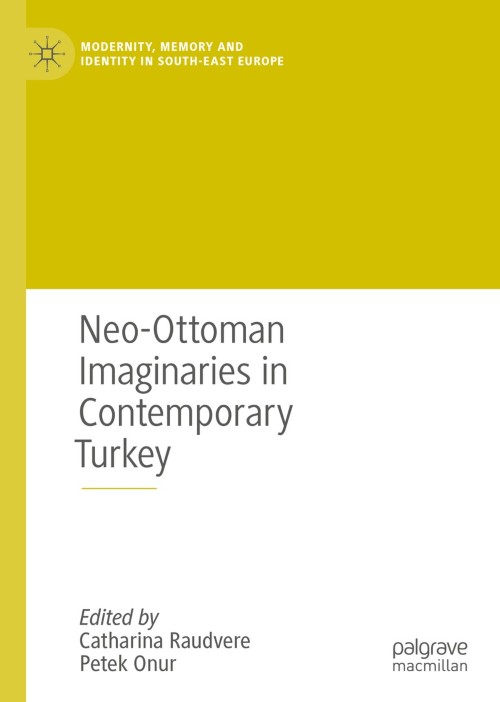
245 10|aNeo-Ottoman Imaginaries in Contemporary Turkey|h[electronic resource] /|cedited by Catharina Raudvere, Petek Onur.
250 |a1st ed. 2023.
264 1|aCham :|bSpringer International Publishing :|bImprint: Palgrave Macmillan,|c2023.
300 |aXVI, 321 p. 65 illus.|bonline resource.
336 |atext|btxt|2rdacontent
337 |acomputer|bc|2rdamedia
338 |aonline resource|bcr|2rdacarrier
347 |atext file|bPDF|2rda
490 1 |aModernity, Memory and Identity in South-East Europe,|x2523-7993
505 0 |aChapter 1: I am the Granddaughter of the Sultan’: Gender, Aesthetics and Agency in Neo-Ottoman Imaginaries -- Chapter 2: Neo-Ottomanism versus Ottomania: Contestation of Gender in Historical Drama -- Chapter 3: Lovers of the Rose: Islamic Affect and the Politics of Commemoration in Turkish Museal Display -- Chapter 4: Between Memory and Forgetting and Purity and Danger: The Case of the Ulucanlar Prison Museum -- Chapter 5: Architectures of Domination? Ideology, Neoliberalism and the Built Environment of ‘New Turkey’ -- Chapter 6: Commemorating the First World War and its Aftermath: Neo-Ottomanism, Gender and the Politics of History in Turkey -- Chapter 7: The New Ottoman Henna Nights and Women in the Palace of Nostalgia -- Chapter 8: Claiming the Neo-Ottoman Mosque: Islamism, Gender, Architecture -- Chapter 9: Post-Truth and Anti-Science in Turkey: Putting it into Perspective -- Chapter 10: Mixed Marriage Patterns of Rum Orthodox, Jewish, and Armenian Communities of Istanbul: Gendering Ethno-Religious Boundaries -- Chapter 11: Epilogue: From the Past to the Future. .
520 |aThis book presents gendered readings of cultural manifestations that relate to the Ottoman era as a preferred past and a model for the future. By means of claims of authenticity and the distribution of imaginaries of a homogenous desirable alternative to everyday concerns, as well as invoking an imperial past at the national level. In this mode of thinking, shaped around a polarised worldview, Republican ideals serve as a counter-image to the promoted splendour and harmony of the Ottomans. Yet, the stereotypical gender roles inextricably linked with this neo-Ottoman imaginary remain largely unacknowledged, dissimulated in the construction of the desire of an idealised past. Our adaption of a cultural studies perspective in this volume puts special emphasis on agency, gender, and authority. It provides a shared ground for the interrogation, through the contributions comprising this project of knowledge production about the past in light of what constitutes acceptable legitimacy in interpreting not only the canonical literature, but history at large. .
650 0|aHistory, Modern.
650 0|aSocial history.
650 0|aWomen|xHistory.
650 0|aEurope|xHistory.
650 14|aModern History.
650 24|aSocial History.
650 24|aWomen's History / History of Gender.
650 24|aEuropean History.
700 1 |aRaudvere, Catharina.|eeditor.|4edt|4http://id.loc.gov/vocabulary/relators/edt
700 1 |aOnur, Petek.|eeditor.|4edt|4http://id.loc.gov/vocabulary/relators/edt
773 0 |tSpringer Nature eBook
776 08|iPrinted edition:|z9783031080227
776 08|iPrinted edition:|z9783031080241
776 08|iPrinted edition:|z9783031080258
830 0|aModernity, Memory and Identity in South-East Europe,|x2523-7993
856 40|uhttps://doi.org/10.1007/978-3-031-08023-4
912 |aZDB-2-HTY
912 |aZDB-2-SXH
950 |aHistory (SpringerNature-41172)
950 |aHistory (R0) (SpringerNature-43722)