

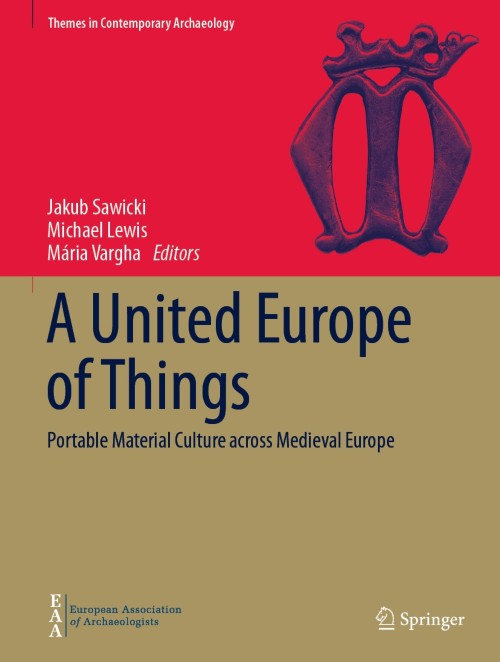
A United Europe of Things [electronic resource] : Portable Material Culture across Medieval Europe / edited by Jakub Sawicki, Michael Lewis, Mária Vargha.
Erişim Adresi
ISBN
9783031483363
Dil Kodu
İngilizce
Yer Numarası
DK/2905
Basım Bildirimi
1st ed. 2023.
Yayın Bilgisi
Cham : Springer International Publishing : Imprint: Springer, 2023.
Fiziksel Niteleme
XIII, 135 p. 1 illus. online resource.
Dizi
Themes in Contemporary Archaeology, 2730-745X
İçindekiler Notu
Chapter 1. Introduction to a United Europe of Things (Sawicki, Lewis & Vargha) -- Chapter 2. United We Play, United We Pray? Connected Networks of Medieval Play and Supernatural Engagement (Hall) -- Chapter 3. Where Globalisation, Commerce and Devotion Meet: Silver and Pewter Spoons in Later Medieval England in a European Context (Jervis) -- Chapter 4. A United Europe of (Religious) Inscriptions (on Medieval Dress Accessories)? (Lewis) -- Chapter 5. Our Lady of Things: The Representation of the Virgin Mary on Jewellery in Medieval Hungary(Stark) -- Chapter 6. ‘The Kings’ Name is a Tower of Strength’: Images of Enthroned Kings on Late Romanesque Mounts from Hungary (Vargha) -- Chapter 7. Bull, Ram and Hare: Pottery Aquamaniles from Upper Maribor Castle (Slovenia) (Jančar and Ravnik) -- Chapter 8. Hooked Clasps and Where to Find Them: Similarities and Differences in Dress Accessories in Europe North of the Alps (Sawicki) -- Chapter 9. It Depends: The Use of Harness Pendants in Medieval Europe (Webley ) -- Chapter 10. Import or Imitation? Late Medieval Graphite Ware and its Influence in Central Transdanubia (Hungary) (Kovács) -- Chapter 11. Long-distance Relations Reflected in the Medieval Urban Material Culture of Baia Mare (Nagybánya), Satu Mare (Szatmár) and Mintiu (Németi) (Romania) (Szocs) -- Chapter 12. Masses of Medieval Metal: A Quantitative Approach to Metalwork from Medieval Cities in Flanders (AD 1000–1600) (Deckers) -- Chapter 13. Material Cultures and Social Practices in the Archaeological Assemblages of Uppsala (AD 1100–1550) (Kjellberg).
Özet, vb.
This volume studies high and late medieval material culture in a Pan-European context. The idea of ‘unity of culture’ in Medieval Latin Europe is well known in historical texts, especially when it concerns the so-called ‘Europe North of the Alps’. This book investigates the similarities and differences in material culture between areas, regions and political entities and opens the dialogue for a more interregional discussion. The editors acknowledge that there are numerous challenges in understanding the phenomenon the volume addresses, the fundamental one being defining (or even redefining) a common material culture of Europe. Important in determining this is greater appreciation of how objects reflect interactions between peoples, both local and foreign, which can be driven by a variety of factors, including trade, conflict and diplomacy etc. But just as important is observing the differences between ‘things’ across Europe, reflecting developments and transformations its cultural, social and economic history. These works are traditionally presented in isolation or at the local level, maybe even in very specialized tomes, as often it is thought their observation are not relevant to wider discourses. Conversely, what is clear, however, is that by interconnecting these seemingly introvert studies of specific artefact types or sites etc., readers can better appreciate the similarities and differences in material culture across Europe. This book is of interest to researchers in archaeology and material culture.
Konu
Archaeology.
Europe __ History __ 476-1492.
Civilization __ History.
Archaeology.
History of Medieval Europe.
Cultural History.
Europe __ History __ 476-1492.
Civilization __ History.
Archaeology.
History of Medieval Europe.
Cultural History.
Diğer Yazarlar
Eseri Alıntıla
Referansları kullanmadan önce gözden geçirmeniz ve varsa gerekli düzeltmeleri yapmanız önerilir.
Dijital Kaynak
MARC Görünümü
LEADER 05145nam a22005415i 4500
001 610233
003 TR_AnAIT
005 20250627063252
007 cr nn 008mamaa
008 231228s2023 sz | s |||| 0|eng d
020 |a9783031483363|9978-3-031-48336-3
024 7 |a10.1007/978-3-031-48336-3|2doi
041 |aeng
049 |aTürk Tarih Kurumu Kütüphanesi
050 4|aCC1-960
072 7|aHD|2bicssc
072 7|aSOC003000|2bisacsh
072 7|aNK|2thema
082 04|a930.1|223
090 |aDK/2905
245 12|aA United Europe of Things|h[electronic resource] :|bPortable Material Culture across Medieval Europe /|cedited by Jakub Sawicki, Michael Lewis, Mária Vargha.
250 |a1st ed. 2023.
264 1|aCham :|bSpringer International Publishing :|bImprint: Springer,|c2023.
300 |aXIII, 135 p. 1 illus.|bonline resource.
336 |atext|btxt|2rdacontent
337 |acomputer|bc|2rdamedia
338 |aonline resource|bcr|2rdacarrier
347 |atext file|bPDF|2rda
490 1 |aThemes in Contemporary Archaeology,|x2730-745X
505 0 |aChapter 1. Introduction to a United Europe of Things (Sawicki, Lewis & Vargha) -- Chapter 2. United We Play, United We Pray? Connected Networks of Medieval Play and Supernatural Engagement (Hall) -- Chapter 3. Where Globalisation, Commerce and Devotion Meet: Silver and Pewter Spoons in Later Medieval England in a European Context (Jervis) -- Chapter 4. A United Europe of (Religious) Inscriptions (on Medieval Dress Accessories)? (Lewis) -- Chapter 5. Our Lady of Things: The Representation of the Virgin Mary on Jewellery in Medieval Hungary(Stark) -- Chapter 6. ‘The Kings’ Name is a Tower of Strength’: Images of Enthroned Kings on Late Romanesque Mounts from Hungary (Vargha) -- Chapter 7. Bull, Ram and Hare: Pottery Aquamaniles from Upper Maribor Castle (Slovenia) (Jančar and Ravnik) -- Chapter 8. Hooked Clasps and Where to Find Them: Similarities and Differences in Dress Accessories in Europe North of the Alps (Sawicki) -- Chapter 9. It Depends: The Use of Harness Pendants in Medieval Europe (Webley ) -- Chapter 10. Import or Imitation? Late Medieval Graphite Ware and its Influence in Central Transdanubia (Hungary) (Kovács) -- Chapter 11. Long-distance Relations Reflected in the Medieval Urban Material Culture of Baia Mare (Nagybánya), Satu Mare (Szatmár) and Mintiu (Németi) (Romania) (Szocs) -- Chapter 12. Masses of Medieval Metal: A Quantitative Approach to Metalwork from Medieval Cities in Flanders (AD 1000–1600) (Deckers) -- Chapter 13. Material Cultures and Social Practices in the Archaeological Assemblages of Uppsala (AD 1100–1550) (Kjellberg).
520 |aThis volume studies high and late medieval material culture in a Pan-European context. The idea of ‘unity of culture’ in Medieval Latin Europe is well known in historical texts, especially when it concerns the so-called ‘Europe North of the Alps’. This book investigates the similarities and differences in material culture between areas, regions and political entities and opens the dialogue for a more interregional discussion. The editors acknowledge that there are numerous challenges in understanding the phenomenon the volume addresses, the fundamental one being defining (or even redefining) a common material culture of Europe. Important in determining this is greater appreciation of how objects reflect interactions between peoples, both local and foreign, which can be driven by a variety of factors, including trade, conflict and diplomacy etc. But just as important is observing the differences between ‘things’ across Europe, reflecting developments and transformations its cultural, social and economic history. These works are traditionally presented in isolation or at the local level, maybe even in very specialized tomes, as often it is thought their observation are not relevant to wider discourses. Conversely, what is clear, however, is that by interconnecting these seemingly introvert studies of specific artefact types or sites etc., readers can better appreciate the similarities and differences in material culture across Europe. This book is of interest to researchers in archaeology and material culture.
650 0|aArchaeology.
650 0|aEurope|xHistory|x476-1492.
650 0|aCivilization|xHistory.
650 14|aArchaeology.
650 24|aHistory of Medieval Europe.
650 24|aCultural History.
700 1 |aSawicki, Jakub.|eeditor.|4edt|4http://id.loc.gov/vocabulary/relators/edt
700 1 |aLewis, Michael.|eeditor.|4edt|4http://id.loc.gov/vocabulary/relators/edt
700 1 |aVargha, Mária.|eeditor.|4edt|4http://id.loc.gov/vocabulary/relators/edt
773 0 |tSpringer Nature eBook
776 08|iPrinted edition:|z9783031483356
776 08|iPrinted edition:|z9783031483370
776 08|iPrinted edition:|z9783031483387
830 0|aThemes in Contemporary Archaeology,|x2730-745X
856 40|uhttps://doi.org/10.1007/978-3-031-48336-3
912 |aZDB-2-HTY
912 |aZDB-2-SXH
950 |aHistory (SpringerNature-41172)
950 |aHistory (R0) (SpringerNature-43722)
001 610233
003 TR_AnAIT
005 20250627063252
007 cr nn 008mamaa
008 231228s2023 sz | s |||| 0|eng d
020 |a9783031483363|9978-3-031-48336-3
024 7 |a10.1007/978-3-031-48336-3|2doi
041 |aeng
049 |aTürk Tarih Kurumu Kütüphanesi
050 4|aCC1-960
072 7|aHD|2bicssc
072 7|aSOC003000|2bisacsh
072 7|aNK|2thema
082 04|a930.1|223
090 |aDK/2905
245 12|aA United Europe of Things|h[electronic resource] :|bPortable Material Culture across Medieval Europe /|cedited by Jakub Sawicki, Michael Lewis, Mária Vargha.
250 |a1st ed. 2023.
264 1|aCham :|bSpringer International Publishing :|bImprint: Springer,|c2023.
300 |aXIII, 135 p. 1 illus.|bonline resource.
336 |atext|btxt|2rdacontent
337 |acomputer|bc|2rdamedia
338 |aonline resource|bcr|2rdacarrier
347 |atext file|bPDF|2rda
490 1 |aThemes in Contemporary Archaeology,|x2730-745X
505 0 |aChapter 1. Introduction to a United Europe of Things (Sawicki, Lewis & Vargha) -- Chapter 2. United We Play, United We Pray? Connected Networks of Medieval Play and Supernatural Engagement (Hall) -- Chapter 3. Where Globalisation, Commerce and Devotion Meet: Silver and Pewter Spoons in Later Medieval England in a European Context (Jervis) -- Chapter 4. A United Europe of (Religious) Inscriptions (on Medieval Dress Accessories)? (Lewis) -- Chapter 5. Our Lady of Things: The Representation of the Virgin Mary on Jewellery in Medieval Hungary(Stark) -- Chapter 6. ‘The Kings’ Name is a Tower of Strength’: Images of Enthroned Kings on Late Romanesque Mounts from Hungary (Vargha) -- Chapter 7. Bull, Ram and Hare: Pottery Aquamaniles from Upper Maribor Castle (Slovenia) (Jančar and Ravnik) -- Chapter 8. Hooked Clasps and Where to Find Them: Similarities and Differences in Dress Accessories in Europe North of the Alps (Sawicki) -- Chapter 9. It Depends: The Use of Harness Pendants in Medieval Europe (Webley ) -- Chapter 10. Import or Imitation? Late Medieval Graphite Ware and its Influence in Central Transdanubia (Hungary) (Kovács) -- Chapter 11. Long-distance Relations Reflected in the Medieval Urban Material Culture of Baia Mare (Nagybánya), Satu Mare (Szatmár) and Mintiu (Németi) (Romania) (Szocs) -- Chapter 12. Masses of Medieval Metal: A Quantitative Approach to Metalwork from Medieval Cities in Flanders (AD 1000–1600) (Deckers) -- Chapter 13. Material Cultures and Social Practices in the Archaeological Assemblages of Uppsala (AD 1100–1550) (Kjellberg).
520 |aThis volume studies high and late medieval material culture in a Pan-European context. The idea of ‘unity of culture’ in Medieval Latin Europe is well known in historical texts, especially when it concerns the so-called ‘Europe North of the Alps’. This book investigates the similarities and differences in material culture between areas, regions and political entities and opens the dialogue for a more interregional discussion. The editors acknowledge that there are numerous challenges in understanding the phenomenon the volume addresses, the fundamental one being defining (or even redefining) a common material culture of Europe. Important in determining this is greater appreciation of how objects reflect interactions between peoples, both local and foreign, which can be driven by a variety of factors, including trade, conflict and diplomacy etc. But just as important is observing the differences between ‘things’ across Europe, reflecting developments and transformations its cultural, social and economic history. These works are traditionally presented in isolation or at the local level, maybe even in very specialized tomes, as often it is thought their observation are not relevant to wider discourses. Conversely, what is clear, however, is that by interconnecting these seemingly introvert studies of specific artefact types or sites etc., readers can better appreciate the similarities and differences in material culture across Europe. This book is of interest to researchers in archaeology and material culture.
650 0|aArchaeology.
650 0|aEurope|xHistory|x476-1492.
650 0|aCivilization|xHistory.
650 14|aArchaeology.
650 24|aHistory of Medieval Europe.
650 24|aCultural History.
700 1 |aSawicki, Jakub.|eeditor.|4edt|4http://id.loc.gov/vocabulary/relators/edt
700 1 |aLewis, Michael.|eeditor.|4edt|4http://id.loc.gov/vocabulary/relators/edt
700 1 |aVargha, Mária.|eeditor.|4edt|4http://id.loc.gov/vocabulary/relators/edt
773 0 |tSpringer Nature eBook
776 08|iPrinted edition:|z9783031483356
776 08|iPrinted edition:|z9783031483370
776 08|iPrinted edition:|z9783031483387
830 0|aThemes in Contemporary Archaeology,|x2730-745X
856 40|uhttps://doi.org/10.1007/978-3-031-48336-3
912 |aZDB-2-HTY
912 |aZDB-2-SXH
950 |aHistory (SpringerNature-41172)
950 |aHistory (R0) (SpringerNature-43722)
Materyaller
Depodan talep edilen materyal sadece kütüphane içerisinde kullanılmaktadır.
Materyal dışarıya ödünç verilmemektedir.
Materyal dışarıya ödünç verilmemektedir.
