LEADER 03438nam a22005535i 4500
001 610248
003 TR_AnAIT
005 20250627063225
007 cr nn 008mamaa
008 191211s2019 sz | s |||| 0|eng d
020 |a9783030287788|9978-3-030-28778-8
024 7 |a10.1007/978-3-030-28778-8|2doi
041 |aeng
049 |aTürk Tarih Kurumu Kütüphanesi
050 4|aD203.2-475
072 7|aHBJD|2bicssc
072 7|aHBLL|2bicssc
072 7|aHIS010000|2bisacsh
072 7|aNHD|2thema
082 04|a940.903|223
090 |aDK/2920
100 1 |aHerzer, Martin.|eauthor.|4aut|4http://id.loc.gov/vocabulary/relators/aut
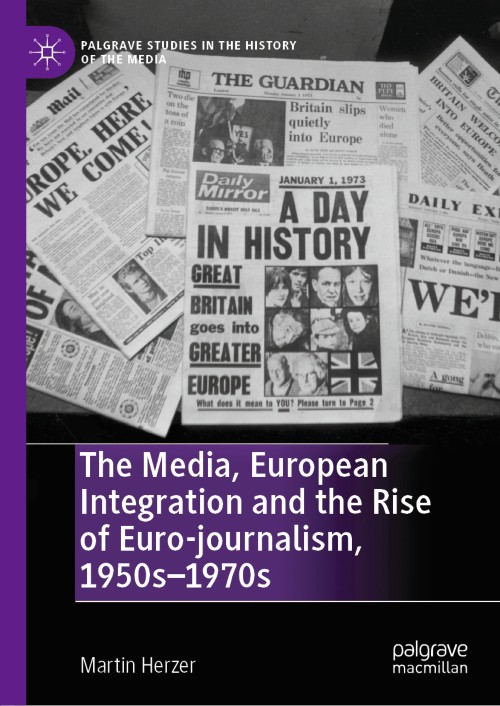
245 14|aThe Media, European Integration and the Rise of Euro-journalism, 1950s–1970s|h[electronic resource] /|cby Martin Herzer.
250 |a1st ed. 2019.
264 1|aCham :|bSpringer International Publishing :|bImprint: Palgrave Macmillan,|c2019.
300 |aXIV, 357 p. 1 illus.|bonline resource.
336 |atext|btxt|2rdacontent
337 |acomputer|bc|2rdamedia
338 |aonline resource|bcr|2rdacarrier
347 |atext file|bPDF|2rda
490 1 |aPalgrave Studies in the History of the Media,|x2634-6583
505 0 |aIntroduction -- The Media and the Many Europes -- The Emergence of the Euro-journalists -- The Rise of the Euro-narrative -- The Dominance of Euro-journalism -- Euro-journalism and the Emergence of a European Polity -- Conclusion: The Media, Politics and European Identity Building.
520 |aThis book explains how the media helped to invent the European Union as the supranational polity that we know today. Against conventional EU scholarship, it tells the story of the rise of the Euro-journalists – pro-European advocacy journalists – within the post-war Western European media, and argues that the Euro-journalists pioneered a shift in the media representation of European integration. During the 1950s, multiple visions of Western European cooperation competed in the media, which initially considered the European Community to be a merely technocratic international organization. By the late 1970s, however, the media were symbolically magnifying the Community as a sui generis European polity and the sole embodiment of Europe. Normative research on the media and European integration has focused on how the media might help to construct a democratic and legitimate European Union. In contrast, this book aims to deconstruct a pro-European advocacy journalism, which became dominant within the Western European media between the 1950s and the 1970s. Moreover, the book shows how journalists – as part of Western European elites – played a key role in elite European identity building campaigns.
650 0|aEurope|xHistory|x1492-.
650 0|aCivilization|xHistory.
650 0|aWorld politics.
650 0|aCommunication.
650 14|aHistory of Modern Europe.
650 24|aCultural History.
650 24|aPolitical History.
650 24|aMedia and Communication.
773 0 |tSpringer Nature eBook
776 08|iPrinted edition:|z9783030287771
776 08|iPrinted edition:|z9783030287795
776 08|iPrinted edition:|z9783030287801
830 0|aPalgrave Studies in the History of the Media,|x2634-6583
856 40|uhttps://doi.org/10.1007/978-3-030-28778-8
912 |aZDB-2-HTY
912 |aZDB-2-SXH
950 |aHistory (SpringerNature-41172)
950 |aHistory (R0) (SpringerNature-43722)