

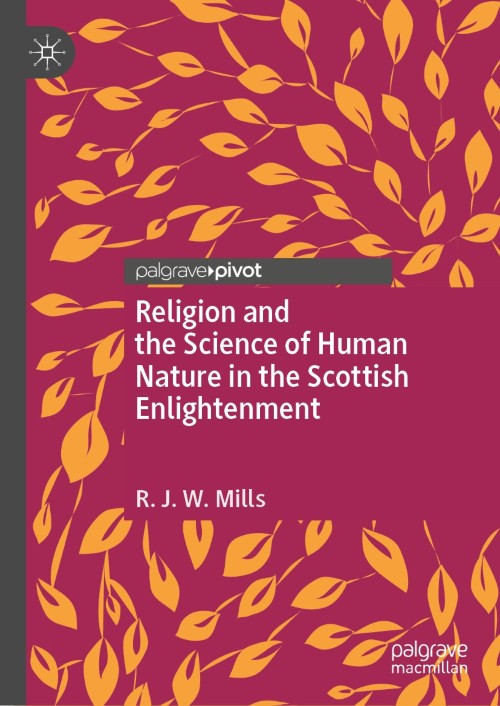
Religion and the Science of Human Nature in the Scottish Enlightenment [electronic resource] / by R.J.W. Mills.
Erişim Adresi
ISBN
9783031490316
Dil Kodu
İngilizce
Yer Numarası
DK/2939
Yazar
Basım Bildirimi
1st ed. 2023.
Yayın Bilgisi
Cham : Springer International Publishing : Imprint: Palgrave Macmillan, 2023.
Fiziksel Niteleme
XIV, 334 p. 1 illus. online resource.
İçindekiler Notu
Chapter 1 Introduction -- Chapter 2 Religion and the Start of the Science of Human Nature: Campbell, Turnbull and Hume -- Chapter 3 David Hume and the Emptiness of Natural Religion -- Chapter 4 Adam Smith on Religious Psychology in Society -- Chapter 5 Henry Home, Lord Kames on Mechanistic Human Nature -- Chapter 6 David Hume’s ‘Natural History of Religion’ (1757) -- Chapter 7 William Robertson on Revelation and the Limits of Progress -- chapter 8 Adam Ferguson, Stoicism and the Individual Alone -- Chapter 9 George Campbell on Miracles and the Weakness of Hume’s ‘Science of Man’ -- Chapter 10 John Gregory on Human Nature, Happiness and Religious Devotion -- Chapter 11 James Dunbar on Climate and Civil Religion. -- Chapter 12 James Burnett, Lord Monboddo on Egyptian Daemons -- 13. The Radicalism of James Hutton -- 14. Dugald Stewart, Religion and the End of the ‘Science of Human Nature’ -- 15 Conclusion.
Özet, vb.
“Robin Mills’ new book is a comprehensive and insightful account of the academic study of religion by philosophers in the Scottish Enlightenment. It is especially valuable for its attention to figures who are not well known today, but who were influential in the eighteenth century." Dr James Foster, University of Sioux Falls Religion and Science are often seen as hostile concepts, but as the example of the Scottish Enlightenment shows, this is not necessarily the case. In Robin Mills’ new book he takes us beyond the headline of David Hume’s alleged atheism and explores the enlightened Scottish conversation about religion. In doing so he shows how the Scottish Enlightenment sought to apply an empirically based social theory to explain religion and its evolution, and the impact this had on the religious views of this significant group of thinkers. It sheds new light on an important moment in intellectual history. Dr Craig Smith, University of Glasgow Absorbing and thoughtful, Robin Mills’s book on the natural history of religion in the Scottish Enlightenment fills a conspicuous gap in the history of ideas. With remarkable erudition and no little finesse, he brings home the originality and distinctiveness of the Scottish endeavour to produce a naturalistic account of religion in the second half of the eighteenth century. What is particularly refreshing about Mills’s study, however, is his unfashionable insistence that this venture represented a rupture with previous approaches to the study of religion, inaugurating a recognisably modern outlook. Dr Niall O’Flaherty, King’s College London “There has been a lot of scholarly interest in the Scottish Enlightenment’s thinking on religion, but surprisingly little has been written on the links between this writing and the Scots’ famous ‘Science of Man’. In this excellent volume Robin Mills sets out to remedy this by offering a survey of the social scientific examination of religion by a range of key Scottish thinkers of the time. Clear, concise, and elegantly written, it is a welcome addition to the literature.” — Craig Smith, Professor of the History of Political Thought, The University of Glasgow, UK This book examines how enlightened Scottish social theorists c.1740 to c.1800 understood the origin and development of religion. Challenging scholarly disregard for the topic, it shows how most prominent thinkers of the Scottish Enlightenment thought deeply about the relationship between religion, human nature and historical change. The Scots viewed this relationship as an important strand within the study of the 'science of human nature' and the 'history of man.' The fruits of this investigation were a sophisticated and innovative account of religious change that is characterized by a striking modernity and naturalism, even by the more devout theorists. The views of the literati surveyed here need to be incorporated into our larger histories of the 'science of religion' as much as they do into our understanding of the social theory of the Scottish Enlightenment. R. J. W. Mills is an Honorary Research Fellow at the Institute of Intellectual History, University of St Andrews, UK. .
Konu
Intellectual life __ History.
Great Britain __ History.
Europe __ History __ 1492-.
Philosophy __ History.
Religion __ History.
Intellectual History.
History of Britain and Ireland.
History of Early Modern Europe.
History of Philosophy.
History of Religion.
Great Britain __ History.
Europe __ History __ 1492-.
Philosophy __ History.
Religion __ History.
Intellectual History.
History of Britain and Ireland.
History of Early Modern Europe.
History of Philosophy.
History of Religion.
Eseri Alıntıla
Referansları kullanmadan önce gözden geçirmeniz ve varsa gerekli düzeltmeleri yapmanız önerilir.
Dijital Kaynak
MARC Görünümü
LEADER 06001nam a22005415i 4500
001 610267
003 TR_AnAIT
005 20250627063148
007 cr nn 008mamaa
008 240205s2023 sz | s |||| 0|eng d
020 |a9783031490316|9978-3-031-49031-6
024 7 |a10.1007/978-3-031-49031-6|2doi
041 |aeng
049 |aTürk Tarih Kurumu Kütüphanesi
050 4|aD1-2027
072 7|aJFCX|2bicssc
072 7|aHIS000000|2bisacsh
072 7|aJBCC9|2thema
082 04|a001.09|223
090 |aDK/2939
100 1 |aMills, R.J.W.|eauthor.|4aut|4http://id.loc.gov/vocabulary/relators/aut
245 10|aReligion and the Science of Human Nature in the Scottish Enlightenment|h[electronic resource] /|cby R.J.W. Mills.
250 |a1st ed. 2023.
264 1|aCham :|bSpringer International Publishing :|bImprint: Palgrave Macmillan,|c2023.
300 |aXIV, 334 p. 1 illus.|bonline resource.
336 |atext|btxt|2rdacontent
337 |acomputer|bc|2rdamedia
338 |aonline resource|bcr|2rdacarrier
347 |atext file|bPDF|2rda
505 0 |aChapter 1 Introduction -- Chapter 2 Religion and the Start of the Science of Human Nature: Campbell, Turnbull and Hume -- Chapter 3 David Hume and the Emptiness of Natural Religion -- Chapter 4 Adam Smith on Religious Psychology in Society -- Chapter 5 Henry Home, Lord Kames on Mechanistic Human Nature -- Chapter 6 David Hume’s ‘Natural History of Religion’ (1757) -- Chapter 7 William Robertson on Revelation and the Limits of Progress -- chapter 8 Adam Ferguson, Stoicism and the Individual Alone -- Chapter 9 George Campbell on Miracles and the Weakness of Hume’s ‘Science of Man’ -- Chapter 10 John Gregory on Human Nature, Happiness and Religious Devotion -- Chapter 11 James Dunbar on Climate and Civil Religion. -- Chapter 12 James Burnett, Lord Monboddo on Egyptian Daemons -- 13. The Radicalism of James Hutton -- 14. Dugald Stewart, Religion and the End of the ‘Science of Human Nature’ -- 15 Conclusion.
520 |a “Robin Mills’ new book is a comprehensive and insightful account of the academic study of religion by philosophers in the Scottish Enlightenment. It is especially valuable for its attention to figures who are not well known today, but who were influential in the eighteenth century." Dr James Foster, University of Sioux Falls Religion and Science are often seen as hostile concepts, but as the example of the Scottish Enlightenment shows, this is not necessarily the case. In Robin Mills’ new book he takes us beyond the headline of David Hume’s alleged atheism and explores the enlightened Scottish conversation about religion. In doing so he shows how the Scottish Enlightenment sought to apply an empirically based social theory to explain religion and its evolution, and the impact this had on the religious views of this significant group of thinkers. It sheds new light on an important moment in intellectual history. Dr Craig Smith, University of Glasgow Absorbing and thoughtful, Robin Mills’s book on the natural history of religion in the Scottish Enlightenment fills a conspicuous gap in the history of ideas. With remarkable erudition and no little finesse, he brings home the originality and distinctiveness of the Scottish endeavour to produce a naturalistic account of religion in the second half of the eighteenth century. What is particularly refreshing about Mills’s study, however, is his unfashionable insistence that this venture represented a rupture with previous approaches to the study of religion, inaugurating a recognisably modern outlook. Dr Niall O’Flaherty, King’s College London “There has been a lot of scholarly interest in the Scottish Enlightenment’s thinking on religion, but surprisingly little has been written on the links between this writing and the Scots’ famous ‘Science of Man’. In this excellent volume Robin Mills sets out to remedy this by offering a survey of the social scientific examination of religion by a range of key Scottish thinkers of the time. Clear, concise, and elegantly written, it is a welcome addition to the literature.” — Craig Smith, Professor of the History of Political Thought, The University of Glasgow, UK This book examines how enlightened Scottish social theorists c.1740 to c.1800 understood the origin and development of religion. Challenging scholarly disregard for the topic, it shows how most prominent thinkers of the Scottish Enlightenment thought deeply about the relationship between religion, human nature and historical change. The Scots viewed this relationship as an important strand within the study of the 'science of human nature' and the 'history of man.' The fruits of this investigation were a sophisticated and innovative account of religious change that is characterized by a striking modernity and naturalism, even by the more devout theorists. The views of the literati surveyed here need to be incorporated into our larger histories of the 'science of religion' as much as they do into our understanding of the social theory of the Scottish Enlightenment. R. J. W. Mills is an Honorary Research Fellow at the Institute of Intellectual History, University of St Andrews, UK. .
650 0|aIntellectual life|xHistory.
650 0|aGreat Britain|xHistory.
650 0|aEurope|xHistory|x1492-.
650 0|aPhilosophy|xHistory.
650 0|aReligion|xHistory.
650 14|aIntellectual History.
650 24|aHistory of Britain and Ireland.
650 24|aHistory of Early Modern Europe.
650 24|aHistory of Philosophy.
650 24|aHistory of Religion.
773 0 |tSpringer Nature eBook
776 08|iPrinted edition:|z9783031490309
776 08|iPrinted edition:|z9783031490323
776 08|iPrinted edition:|z9783031490330
856 40|uhttps://doi.org/10.1007/978-3-031-49031-6
912 |aZDB-2-HTY
912 |aZDB-2-SXH
950 |aHistory (SpringerNature-41172)
950 |aHistory (R0) (SpringerNature-43722)
001 610267
003 TR_AnAIT
005 20250627063148
007 cr nn 008mamaa
008 240205s2023 sz | s |||| 0|eng d
020 |a9783031490316|9978-3-031-49031-6
024 7 |a10.1007/978-3-031-49031-6|2doi
041 |aeng
049 |aTürk Tarih Kurumu Kütüphanesi
050 4|aD1-2027
072 7|aJFCX|2bicssc
072 7|aHIS000000|2bisacsh
072 7|aJBCC9|2thema
082 04|a001.09|223
090 |aDK/2939
100 1 |aMills, R.J.W.|eauthor.|4aut|4http://id.loc.gov/vocabulary/relators/aut
245 10|aReligion and the Science of Human Nature in the Scottish Enlightenment|h[electronic resource] /|cby R.J.W. Mills.
250 |a1st ed. 2023.
264 1|aCham :|bSpringer International Publishing :|bImprint: Palgrave Macmillan,|c2023.
300 |aXIV, 334 p. 1 illus.|bonline resource.
336 |atext|btxt|2rdacontent
337 |acomputer|bc|2rdamedia
338 |aonline resource|bcr|2rdacarrier
347 |atext file|bPDF|2rda
505 0 |aChapter 1 Introduction -- Chapter 2 Religion and the Start of the Science of Human Nature: Campbell, Turnbull and Hume -- Chapter 3 David Hume and the Emptiness of Natural Religion -- Chapter 4 Adam Smith on Religious Psychology in Society -- Chapter 5 Henry Home, Lord Kames on Mechanistic Human Nature -- Chapter 6 David Hume’s ‘Natural History of Religion’ (1757) -- Chapter 7 William Robertson on Revelation and the Limits of Progress -- chapter 8 Adam Ferguson, Stoicism and the Individual Alone -- Chapter 9 George Campbell on Miracles and the Weakness of Hume’s ‘Science of Man’ -- Chapter 10 John Gregory on Human Nature, Happiness and Religious Devotion -- Chapter 11 James Dunbar on Climate and Civil Religion. -- Chapter 12 James Burnett, Lord Monboddo on Egyptian Daemons -- 13. The Radicalism of James Hutton -- 14. Dugald Stewart, Religion and the End of the ‘Science of Human Nature’ -- 15 Conclusion.
520 |a “Robin Mills’ new book is a comprehensive and insightful account of the academic study of religion by philosophers in the Scottish Enlightenment. It is especially valuable for its attention to figures who are not well known today, but who were influential in the eighteenth century." Dr James Foster, University of Sioux Falls Religion and Science are often seen as hostile concepts, but as the example of the Scottish Enlightenment shows, this is not necessarily the case. In Robin Mills’ new book he takes us beyond the headline of David Hume’s alleged atheism and explores the enlightened Scottish conversation about religion. In doing so he shows how the Scottish Enlightenment sought to apply an empirically based social theory to explain religion and its evolution, and the impact this had on the religious views of this significant group of thinkers. It sheds new light on an important moment in intellectual history. Dr Craig Smith, University of Glasgow Absorbing and thoughtful, Robin Mills’s book on the natural history of religion in the Scottish Enlightenment fills a conspicuous gap in the history of ideas. With remarkable erudition and no little finesse, he brings home the originality and distinctiveness of the Scottish endeavour to produce a naturalistic account of religion in the second half of the eighteenth century. What is particularly refreshing about Mills’s study, however, is his unfashionable insistence that this venture represented a rupture with previous approaches to the study of religion, inaugurating a recognisably modern outlook. Dr Niall O’Flaherty, King’s College London “There has been a lot of scholarly interest in the Scottish Enlightenment’s thinking on religion, but surprisingly little has been written on the links between this writing and the Scots’ famous ‘Science of Man’. In this excellent volume Robin Mills sets out to remedy this by offering a survey of the social scientific examination of religion by a range of key Scottish thinkers of the time. Clear, concise, and elegantly written, it is a welcome addition to the literature.” — Craig Smith, Professor of the History of Political Thought, The University of Glasgow, UK This book examines how enlightened Scottish social theorists c.1740 to c.1800 understood the origin and development of religion. Challenging scholarly disregard for the topic, it shows how most prominent thinkers of the Scottish Enlightenment thought deeply about the relationship between religion, human nature and historical change. The Scots viewed this relationship as an important strand within the study of the 'science of human nature' and the 'history of man.' The fruits of this investigation were a sophisticated and innovative account of religious change that is characterized by a striking modernity and naturalism, even by the more devout theorists. The views of the literati surveyed here need to be incorporated into our larger histories of the 'science of religion' as much as they do into our understanding of the social theory of the Scottish Enlightenment. R. J. W. Mills is an Honorary Research Fellow at the Institute of Intellectual History, University of St Andrews, UK. .
650 0|aIntellectual life|xHistory.
650 0|aGreat Britain|xHistory.
650 0|aEurope|xHistory|x1492-.
650 0|aPhilosophy|xHistory.
650 0|aReligion|xHistory.
650 14|aIntellectual History.
650 24|aHistory of Britain and Ireland.
650 24|aHistory of Early Modern Europe.
650 24|aHistory of Philosophy.
650 24|aHistory of Religion.
773 0 |tSpringer Nature eBook
776 08|iPrinted edition:|z9783031490309
776 08|iPrinted edition:|z9783031490323
776 08|iPrinted edition:|z9783031490330
856 40|uhttps://doi.org/10.1007/978-3-031-49031-6
912 |aZDB-2-HTY
912 |aZDB-2-SXH
950 |aHistory (SpringerNature-41172)
950 |aHistory (R0) (SpringerNature-43722)
Materyaller
Depodan talep edilen materyal sadece kütüphane içerisinde kullanılmaktadır.
Materyal dışarıya ödünç verilmemektedir.
Materyal dışarıya ödünç verilmemektedir.
