LEADER 04126nam a22005655i 4500
001 610272
003 TR_AnAIT
005 20250627063138
007 cr nn 008mamaa
008 240207s2023 sz | s |||| 0|eng d
020 |a9783031494383|9978-3-031-49438-3
024 7 |a10.1007/978-3-031-49438-3|2doi
041 |aeng
049 |aTürk Tarih Kurumu Kütüphanesi
050 4|aDA1-995
072 7|aHBJD1|2bicssc
072 7|aHIS015000|2bisacsh
072 7|aNHD|x1DD|2thema
082 04|a941|223
090 |aDK/2944
100 1 |aFeather, Daniel J.|eauthor.|4aut|4http://id.loc.gov/vocabulary/relators/aut
245 10|aBritish Cultural Diplomacy in South Africa, 1960–1994|h[electronic resource] /|cby Daniel J. Feather.
250 |a1st ed. 2023.
264 1|aCham :|bSpringer International Publishing :|bImprint: Palgrave Macmillan,|c2023.
300 |aXI, 332 p. 2 illus.|bonline resource.
336 |atext|btxt|2rdacontent
337 |acomputer|bc|2rdamedia
338 |aonline resource|bcr|2rdacarrier
347 |atext file|bPDF|2rda
490 1 |aBritain and the World,|x2947-7190
505 0 |aChapter 1: Introduction -- Part I. Educational Policy -- Chapter 2: Racialised Educational Diplomacy: Scholarships and Race, 1960-1964 -- Chapter 3: UK-South African Educational Cooperation in the Years of ‘High’ Apartheid, 1964 to 1979.-Chapter 4: Forging Ties with the ‘Successor Generation’, 1979 to 1994.-Part 2: Cultural and Sporting Contact.-Chapter 5: The British Broadcasting Company: Asset or Hindrance to the Perception of the UK in Apartheid South Africa?.-Chapter 6: British ‘Cultural Manifestations’ in South Africa, 1960 to 1994.-Chapter 7: UK Policy Towards Sporting Contact with South Africa, 1960 to 1977.-Chapter 8: UK Policy Towards Sporting Contact with South Africa, 1977 to 1994.-Chapter 9: Conclusion.
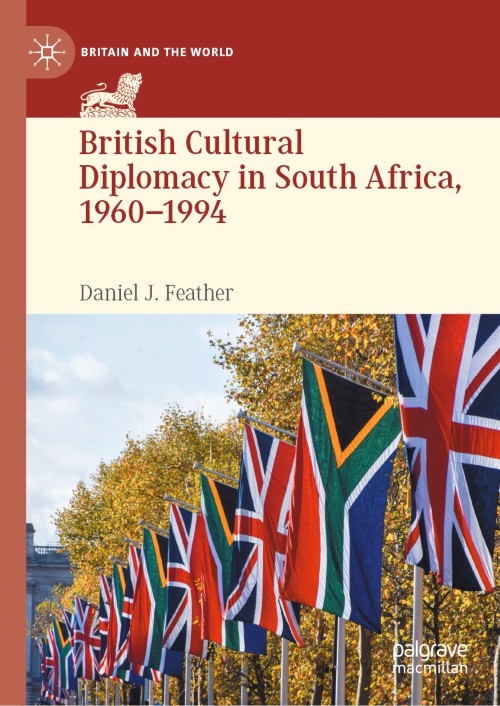
520 |aDaniel J. Feather is a Senior Lecturer in History at Liverpool John Moores University, in the UK. He has published articles in leading international and diplomatic history journals and obtained multiple research grants from bodies such as the Royal Historical Society and British Academy. Daniel is a British Council Research Partner and is also on the editorial board of AM Digital’s Apartheid South Africa, 1981-1994 digitisation project. This book analyses the British government’s use of cultural diplomacy in South Africa from 1960 to 1994. Previously, scholarship on UK-South African relations has focussed mainly on political, economic, or military links; this book makes an important and original intervention by emphasising how the British government sought to use cultural ties as part of its diplomacy in South Africa. The book also highlights the controversy these links generated owing to broader international efforts to ostracise South Africa owing to the racist apartheid system in the country at the time. By examining British policy towards educational exchanges, performing arts tours, radio and television broadcasts, and sporting contact, this book provides a dynamic case study from which to analyse Britain’s use of cultural diplomacy during a period of relative decline, while also adding a new layer to the well-established literature on the UK-South African special relationship. .
650 0|aGreat Britain|xHistory.
650 0|aAfrica, Sub-Saharan|xHistory.
650 0|aInternational relations|xHistory.
650 0|aImperialism.
650 0|aWorld politics.
650 14|aHistory of Britain and Ireland.
650 24|aHistory of Sub-Saharan Africa.
650 24|aDiplomatic and International History.
650 24|aImperialism and Colonialism.
650 24|aPolitical History.
773 0 |tSpringer Nature eBook
776 08|iPrinted edition:|z9783031494376
776 08|iPrinted edition:|z9783031494390
776 08|iPrinted edition:|z9783031494406
830 0|aBritain and the World,|x2947-7190
856 40|uhttps://doi.org/10.1007/978-3-031-49438-3
912 |aZDB-2-HTY
912 |aZDB-2-SXH
950 |aHistory (SpringerNature-41172)
950 |aHistory (R0) (SpringerNature-43722)