

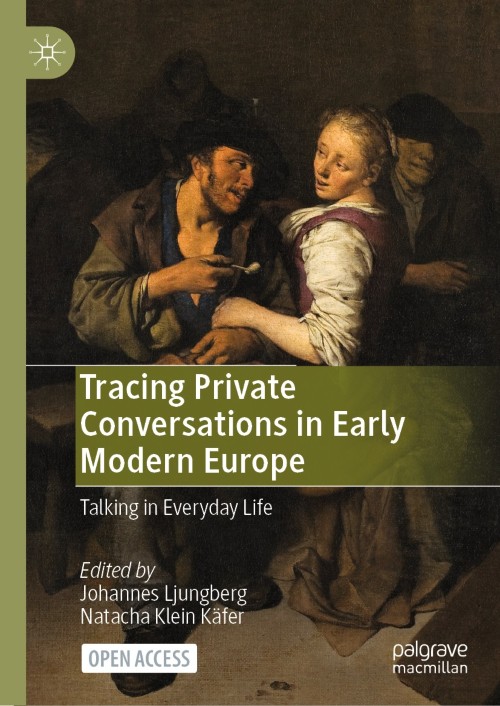
Tracing Private Conversations in Early Modern Europe [electronic resource] : Talking in Everyday Life / edited by Johannes Ljungberg, Natacha Klein Käfer.
Erişim Adresi
ISBN
9783031466304
Dil Kodu
İngilizce
Yer Numarası
DK/2957
Basım Bildirimi
1st ed. 2024.
Yayın Bilgisi
Cham : Springer International Publishing : Imprint: Palgrave Macmillan, 2024.
Fiziksel Niteleme
XX, 350 p. 12 illus., 8 illus. in color. online resource.
İçindekiler Notu
1. Language, Settings, and Networks of Early Modern Private Conversations; Johannes Ljungberg and Natacha Klein Käfer -- Part I: Between Silence and Talking -- 2. Talking About Religion During Religious War: Gilles de Gouberville, Normandy, 1562; Virginia Reinburg -- 3. When Private Speech Goes Public: Libertinage, Crypto-Judaic Conversations, and the Private Literary World of Jean Fontanier, 1621; Adam Horsley -- 4. Talking Privately in Utopia: Ideals of Silence and Dissimulation in Smeek’s Krinke Kesmes (1708); Liam Benison -- Part II: Navigating Hierarchical Settings -- 5. “Alone amongst ourselves”: How to Talk in Private According to the Cologne Diarist Hermann von Weinsberg (1518–97); Krisztina Péter -- 6. “We take care of our own”: Talking About ‘Disability’ in Early Modern Netherlandish Households; Barbara A. Kaminska -- 7. “So that I never fail to warn and exhort”: Pastoral Care and Private Conversation in a Seventeenth-Century Reformed Village; Markus Bardenheuer -- 8. “The secret sins that one commits by thought alone”: Confession as Private and Public in Seventeenth-Century France; Lars Cyril Nørgaard -- Part III: Intimate Conversations -- 9. Marital Conversations: Using Privacy to Negotiate Marital Conflicts in Adam Eyre’s Diary, 1647–1649; Katharina Simon -- 10. “Unnecessary Conversations”: Talking About Sex in the Early Modern Polish Village; Tomasz Wiślicz -- 11. Multimedia Conversations: Love and Lovesickness in Sixteenth-Century Italian Single-Sheet Prints; Alexandra Kocsis -- 12. Towards further studies of private conversations; Mette Birkedal Bruun, Johannes Ljungberg and Natacha Klein Käfer.
Özet, vb.
This open access book provides a multifold exploration of how people in early modern Europe understood, conducted, and actively used private conversations. From sharing personal matters to discussing delicate secrets, all layers of early modern society had their motives for wanting to keep certain exchanges out of public eyes and ears, and ways of trying to achieve this. Detecting such instances in historical sources typically becomes a complex pursuit, full of subtle references that require creative approaches, especially when it comes to more informal practices. Yet, in a reading against the grain, different sources can offer us hints of how conversations took place in private. The book consists of a historiographical and methodological introduction to the study of private conversations, followed by ten case studies from a variety of cities, villages, and countryside across early modern Europe. The concluding epilogue suggests some pathways to further explore the terrain of how people have talked in private in past societies. Johannes Ljungberg is an Assistant Professor at the Danish National Research Foundation’s Centre for Privacy Studies, at the University of Copenhagen. His research focuses on religiously dissenting networks in the Nordic countries and privacy in urban spaces during the early modern period. Natacha Klein Käfer is an Assistant Professor at the Danish National Research Foundation’s Centre for Privacy Studies, at the University of Copenhagen. Her research focuses on the history of healing and issues of confidentiality between healers and patients as well as networks of knowledge in the early modern period.
Konu
Europe __ History __ 1492-.
Social history.
Civilization __ History.
History of Early Modern Europe.
Social History.
Cultural History.
Social history.
Civilization __ History.
History of Early Modern Europe.
Social History.
Cultural History.
Diğer Yazarlar
Eseri Alıntıla
Referansları kullanmadan önce gözden geçirmeniz ve varsa gerekli düzeltmeleri yapmanız önerilir.
Dijital Kaynak
MARC Görünümü
LEADER 05271nam a22005415i 4500
001 610285
003 TR_AnAIT
005 20250627063113
007 cr nn 008mamaa
008 240301s2024 sz | s |||| 0|eng d
020 |a9783031466304|9978-3-031-46630-4
024 7 |a10.1007/978-3-031-46630-4|2doi
041 |aeng
049 |aTürk Tarih Kurumu Kütüphanesi
050 4|aD203.2-475
072 7|aHBJD|2bicssc
072 7|aHBLH|2bicssc
072 7|aHIS010000|2bisacsh
072 7|aNHD|x3M|2thema
082 04|a940.903|223
090 |aDK/2957
245 10|aTracing Private Conversations in Early Modern Europe|h[electronic resource] :|bTalking in Everyday Life /|cedited by Johannes Ljungberg, Natacha Klein Käfer.
250 |a1st ed. 2024.
264 1|aCham :|bSpringer International Publishing :|bImprint: Palgrave Macmillan,|c2024.
300 |aXX, 350 p. 12 illus., 8 illus. in color.|bonline resource.
336 |atext|btxt|2rdacontent
337 |acomputer|bc|2rdamedia
338 |aonline resource|bcr|2rdacarrier
347 |atext file|bPDF|2rda
505 0 |a1. Language, Settings, and Networks of Early Modern Private Conversations; Johannes Ljungberg and Natacha Klein Käfer -- Part I: Between Silence and Talking -- 2. Talking About Religion During Religious War: Gilles de Gouberville, Normandy, 1562; Virginia Reinburg -- 3. When Private Speech Goes Public: Libertinage, Crypto-Judaic Conversations, and the Private Literary World of Jean Fontanier, 1621; Adam Horsley -- 4. Talking Privately in Utopia: Ideals of Silence and Dissimulation in Smeek’s Krinke Kesmes (1708); Liam Benison -- Part II: Navigating Hierarchical Settings -- 5. “Alone amongst ourselves”: How to Talk in Private According to the Cologne Diarist Hermann von Weinsberg (1518–97); Krisztina Péter -- 6. “We take care of our own”: Talking About ‘Disability’ in Early Modern Netherlandish Households; Barbara A. Kaminska -- 7. “So that I never fail to warn and exhort”: Pastoral Care and Private Conversation in a Seventeenth-Century Reformed Village; Markus Bardenheuer -- 8. “The secret sins that one commits by thought alone”: Confession as Private and Public in Seventeenth-Century France; Lars Cyril Nørgaard -- Part III: Intimate Conversations -- 9. Marital Conversations: Using Privacy to Negotiate Marital Conflicts in Adam Eyre’s Diary, 1647–1649; Katharina Simon -- 10. “Unnecessary Conversations”: Talking About Sex in the Early Modern Polish Village; Tomasz Wiślicz -- 11. Multimedia Conversations: Love and Lovesickness in Sixteenth-Century Italian Single-Sheet Prints; Alexandra Kocsis -- 12. Towards further studies of private conversations; Mette Birkedal Bruun, Johannes Ljungberg and Natacha Klein Käfer.
506 0 |aOpen Access
520 |aThis open access book provides a multifold exploration of how people in early modern Europe understood, conducted, and actively used private conversations. From sharing personal matters to discussing delicate secrets, all layers of early modern society had their motives for wanting to keep certain exchanges out of public eyes and ears, and ways of trying to achieve this. Detecting such instances in historical sources typically becomes a complex pursuit, full of subtle references that require creative approaches, especially when it comes to more informal practices. Yet, in a reading against the grain, different sources can offer us hints of how conversations took place in private. The book consists of a historiographical and methodological introduction to the study of private conversations, followed by ten case studies from a variety of cities, villages, and countryside across early modern Europe. The concluding epilogue suggests some pathways to further explore the terrain of how people have talked in private in past societies. Johannes Ljungberg is an Assistant Professor at the Danish National Research Foundation’s Centre for Privacy Studies, at the University of Copenhagen. His research focuses on religiously dissenting networks in the Nordic countries and privacy in urban spaces during the early modern period. Natacha Klein Käfer is an Assistant Professor at the Danish National Research Foundation’s Centre for Privacy Studies, at the University of Copenhagen. Her research focuses on the history of healing and issues of confidentiality between healers and patients as well as networks of knowledge in the early modern period.
650 0|aEurope|xHistory|x1492-.
650 0|aSocial history.
650 0|aCivilization|xHistory.
650 14|aHistory of Early Modern Europe.
650 24|aSocial History.
650 24|aCultural History.
700 1 |aLjungberg, Johannes.|eeditor.|4edt|4http://id.loc.gov/vocabulary/relators/edt
700 1 |aKlein Käfer, Natacha.|eeditor.|4edt|4http://id.loc.gov/vocabulary/relators/edt
773 0 |tSpringer Nature eBook
776 08|iPrinted edition:|z9783031466298
776 08|iPrinted edition:|z9783031466311
776 08|iPrinted edition:|z9783031466328
856 40|uhttps://doi.org/10.1007/978-3-031-46630-4
912 |aZDB-2-HTY
912 |aZDB-2-SXH
912 |aZDB-2-SOB
950 |aHistory (SpringerNature-41172)
950 |aHistory (R0) (SpringerNature-43722)
001 610285
003 TR_AnAIT
005 20250627063113
007 cr nn 008mamaa
008 240301s2024 sz | s |||| 0|eng d
020 |a9783031466304|9978-3-031-46630-4
024 7 |a10.1007/978-3-031-46630-4|2doi
041 |aeng
049 |aTürk Tarih Kurumu Kütüphanesi
050 4|aD203.2-475
072 7|aHBJD|2bicssc
072 7|aHBLH|2bicssc
072 7|aHIS010000|2bisacsh
072 7|aNHD|x3M|2thema
082 04|a940.903|223
090 |aDK/2957
245 10|aTracing Private Conversations in Early Modern Europe|h[electronic resource] :|bTalking in Everyday Life /|cedited by Johannes Ljungberg, Natacha Klein Käfer.
250 |a1st ed. 2024.
264 1|aCham :|bSpringer International Publishing :|bImprint: Palgrave Macmillan,|c2024.
300 |aXX, 350 p. 12 illus., 8 illus. in color.|bonline resource.
336 |atext|btxt|2rdacontent
337 |acomputer|bc|2rdamedia
338 |aonline resource|bcr|2rdacarrier
347 |atext file|bPDF|2rda
505 0 |a1. Language, Settings, and Networks of Early Modern Private Conversations; Johannes Ljungberg and Natacha Klein Käfer -- Part I: Between Silence and Talking -- 2. Talking About Religion During Religious War: Gilles de Gouberville, Normandy, 1562; Virginia Reinburg -- 3. When Private Speech Goes Public: Libertinage, Crypto-Judaic Conversations, and the Private Literary World of Jean Fontanier, 1621; Adam Horsley -- 4. Talking Privately in Utopia: Ideals of Silence and Dissimulation in Smeek’s Krinke Kesmes (1708); Liam Benison -- Part II: Navigating Hierarchical Settings -- 5. “Alone amongst ourselves”: How to Talk in Private According to the Cologne Diarist Hermann von Weinsberg (1518–97); Krisztina Péter -- 6. “We take care of our own”: Talking About ‘Disability’ in Early Modern Netherlandish Households; Barbara A. Kaminska -- 7. “So that I never fail to warn and exhort”: Pastoral Care and Private Conversation in a Seventeenth-Century Reformed Village; Markus Bardenheuer -- 8. “The secret sins that one commits by thought alone”: Confession as Private and Public in Seventeenth-Century France; Lars Cyril Nørgaard -- Part III: Intimate Conversations -- 9. Marital Conversations: Using Privacy to Negotiate Marital Conflicts in Adam Eyre’s Diary, 1647–1649; Katharina Simon -- 10. “Unnecessary Conversations”: Talking About Sex in the Early Modern Polish Village; Tomasz Wiślicz -- 11. Multimedia Conversations: Love and Lovesickness in Sixteenth-Century Italian Single-Sheet Prints; Alexandra Kocsis -- 12. Towards further studies of private conversations; Mette Birkedal Bruun, Johannes Ljungberg and Natacha Klein Käfer.
506 0 |aOpen Access
520 |aThis open access book provides a multifold exploration of how people in early modern Europe understood, conducted, and actively used private conversations. From sharing personal matters to discussing delicate secrets, all layers of early modern society had their motives for wanting to keep certain exchanges out of public eyes and ears, and ways of trying to achieve this. Detecting such instances in historical sources typically becomes a complex pursuit, full of subtle references that require creative approaches, especially when it comes to more informal practices. Yet, in a reading against the grain, different sources can offer us hints of how conversations took place in private. The book consists of a historiographical and methodological introduction to the study of private conversations, followed by ten case studies from a variety of cities, villages, and countryside across early modern Europe. The concluding epilogue suggests some pathways to further explore the terrain of how people have talked in private in past societies. Johannes Ljungberg is an Assistant Professor at the Danish National Research Foundation’s Centre for Privacy Studies, at the University of Copenhagen. His research focuses on religiously dissenting networks in the Nordic countries and privacy in urban spaces during the early modern period. Natacha Klein Käfer is an Assistant Professor at the Danish National Research Foundation’s Centre for Privacy Studies, at the University of Copenhagen. Her research focuses on the history of healing and issues of confidentiality between healers and patients as well as networks of knowledge in the early modern period.
650 0|aEurope|xHistory|x1492-.
650 0|aSocial history.
650 0|aCivilization|xHistory.
650 14|aHistory of Early Modern Europe.
650 24|aSocial History.
650 24|aCultural History.
700 1 |aLjungberg, Johannes.|eeditor.|4edt|4http://id.loc.gov/vocabulary/relators/edt
700 1 |aKlein Käfer, Natacha.|eeditor.|4edt|4http://id.loc.gov/vocabulary/relators/edt
773 0 |tSpringer Nature eBook
776 08|iPrinted edition:|z9783031466298
776 08|iPrinted edition:|z9783031466311
776 08|iPrinted edition:|z9783031466328
856 40|uhttps://doi.org/10.1007/978-3-031-46630-4
912 |aZDB-2-HTY
912 |aZDB-2-SXH
912 |aZDB-2-SOB
950 |aHistory (SpringerNature-41172)
950 |aHistory (R0) (SpringerNature-43722)
Materyaller
Depodan talep edilen materyal sadece kütüphane içerisinde kullanılmaktadır.
Materyal dışarıya ödünç verilmemektedir.
Materyal dışarıya ödünç verilmemektedir.
