

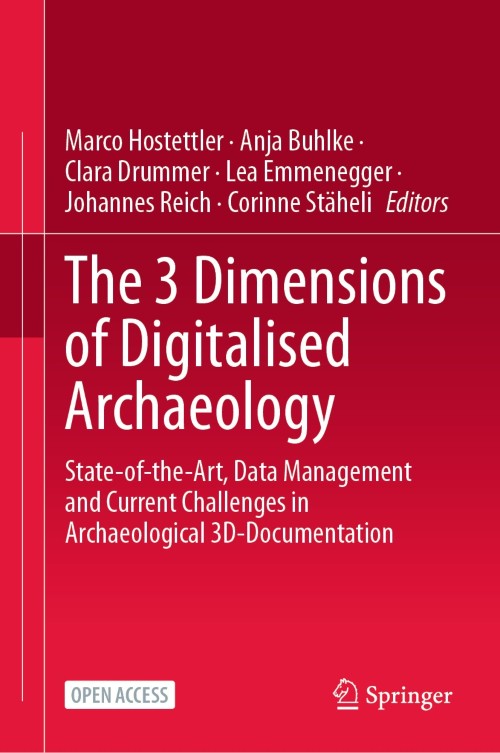
The 3 Dimensions of Digitalised Archaeology [electronic resource] : State-of-the-Art, Data Management and Current Challenges in Archaeological 3D-Documentation / edited by Marco Hostettler, Anja Buhlke, Clara Drummer, Lea Emmenegger, Johannes Reich, Corinne Stäheli.
Erişim Adresi
ISBN
9783031530326
Dil Kodu
İngilizce
Yer Numarası
DK/2960
Basım Bildirimi
1st ed. 2024.
Yayın Bilgisi
Cham : Springer International Publishing : Imprint: Springer, 2024.
Fiziksel Niteleme
XXI, 225 p. 99 illus., 58 illus. in color. online resource.
İçindekiler Notu
Part 1. Introduction -- Chapter 1. Editors: 3D-Archaeology and Cultural Heritage: Where are we today? -- Chapter 2. Technological developments -- Chapter 3. 1 Tobias Schreck, Stephan Karl, Elisabeth Trinkl (Graz): Exploring the virtual. Crossmodal search and visual exploration of 3D Cultural Heritage -- Chapter 4. Thomas Reuter (Dresden): Standardization, Data-Management and Scientific Usage of 3D-Data. 15 Years of 3D-Archaeology in the Archaeological Heritage Office of Saxony -- Part 2. Case Studies in Cultural Heritage and Archaeology -- Chapter 5. François Fouriaux (École Française de Rome): Defrag memories: 3D spatial analysis of remains of commemorative gestures in the necropolis of Porta Nocera at Pompeii -- Chapter 6. Vasiliy Kovalev (Novosibirsk): A 3D-approach to Siberian Rock Art Documentation.-Part 3. Current Challenges -- Chapter 7. Marco Hostettler, Anja Buhlke, Clara Drummer, Lea Emmenegger, Johannes Reich, Corinne Stäheli(Bern, Kiel, Berlin): The current application of image-based 3D technologies in archaeology. Results of an online survey -- Chapter 8. Kate Fernie (CARARE/Europeana): 3D content in EUROPEANA: The challenges of providing access -- Chapter 9. Jill Hilditch (Amsterdam): Balancing storage and user functionality: The 3D and archaeological data strategy of the tracing the potter’s wheel project -- Part 4. Data Management -- Chapter 10. Jugoslav Pendic (Novi Sad): Data management and handling of 3D-objects in the post-collection phase -- Chapter 11. Christoph Rummel and Clemens Brünenberg: Bathing in the Pompeian Light - Integrating SFM technology in excavation and standing remains assessment -- Part 5. Conclusion -- Chapter 12. Editors: Conclusion: Where is 3D-Archaeology going?.
Özet, vb.
This Open access book aims to provide an overview of state-of-the-art approaches to 3D documentation from a practical perspective and formulate the most important areas for future developments. Bringing together a wide range of case studies, examples of best practice approaches, workflows, and first attempts to establish sustainable solutions to pressing problems, this book offers readers current practical advice on how to approach 3D archaeology and cultural heritage. Divided into five parts, this book begins with an overview of 3D archaeology in its present state. It goes on to give insights into the development of the technology and recent cutting-edge applications. The next section identifies current challenges in 3D archaeology and then presents approaches and solutions for data management of a large number of 3D objects and ways to ensure sustainable solutions for the archiving of the produced data. This book will be of interest to researchers working in the fields of archaeology, heritage management, and digital humanities in general.
Konu
History.
Archaeology.
Digital humanities.
Social sciences __ Data processing.
History.
Archaeology.
Digital Humanities.
Computer Application in Social and Behavioral Sciences.
Archaeology.
Digital humanities.
Social sciences __ Data processing.
History.
Archaeology.
Digital Humanities.
Computer Application in Social and Behavioral Sciences.
Eseri Alıntıla
Referansları kullanmadan önce gözden geçirmeniz ve varsa gerekli düzeltmeleri yapmanız önerilir.
Dijital Kaynak
MARC Görünümü
LEADER 05281nam a22006255i 4500
001 610288
003 TR_AnAIT
005 20250627063105
007 cr nn 008mamaa
008 240311s2024 sz | s |||| 0|eng d
020 |a9783031530326|9978-3-031-53032-6
024 7 |a10.1007/978-3-031-53032-6|2doi
041 |aeng
049 |aTürk Tarih Kurumu Kütüphanesi
050 4|aD1-2027
072 7|aHB|2bicssc
072 7|aHBAH|2bicssc
072 7|aHIS000000|2bisacsh
072 7|aNH|2thema
072 7|aNHAH|2thema
082 04|a900|223
090 |aDK/2960
245 14|aThe 3 Dimensions of Digitalised Archaeology|h[electronic resource] :|bState-of-the-Art, Data Management and Current Challenges in Archaeological 3D-Documentation /|cedited by Marco Hostettler, Anja Buhlke, Clara Drummer, Lea Emmenegger, Johannes Reich, Corinne Stäheli.
250 |a1st ed. 2024.
264 1|aCham :|bSpringer International Publishing :|bImprint: Springer,|c2024.
300 |aXXI, 225 p. 99 illus., 58 illus. in color.|bonline resource.
336 |atext|btxt|2rdacontent
337 |acomputer|bc|2rdamedia
338 |aonline resource|bcr|2rdacarrier
347 |atext file|bPDF|2rda
505 0 |aPart 1. Introduction -- Chapter 1. Editors: 3D-Archaeology and Cultural Heritage: Where are we today? -- Chapter 2. Technological developments -- Chapter 3. 1 Tobias Schreck, Stephan Karl, Elisabeth Trinkl (Graz): Exploring the virtual. Crossmodal search and visual exploration of 3D Cultural Heritage -- Chapter 4. Thomas Reuter (Dresden): Standardization, Data-Management and Scientific Usage of 3D-Data. 15 Years of 3D-Archaeology in the Archaeological Heritage Office of Saxony -- Part 2. Case Studies in Cultural Heritage and Archaeology -- Chapter 5. François Fouriaux (École Française de Rome): Defrag memories: 3D spatial analysis of remains of commemorative gestures in the necropolis of Porta Nocera at Pompeii -- Chapter 6. Vasiliy Kovalev (Novosibirsk): A 3D-approach to Siberian Rock Art Documentation.-Part 3. Current Challenges -- Chapter 7. Marco Hostettler, Anja Buhlke, Clara Drummer, Lea Emmenegger, Johannes Reich, Corinne Stäheli(Bern, Kiel, Berlin): The current application of image-based 3D technologies in archaeology. Results of an online survey -- Chapter 8. Kate Fernie (CARARE/Europeana): 3D content in EUROPEANA: The challenges of providing access -- Chapter 9. Jill Hilditch (Amsterdam): Balancing storage and user functionality: The 3D and archaeological data strategy of the tracing the potter’s wheel project -- Part 4. Data Management -- Chapter 10. Jugoslav Pendic (Novi Sad): Data management and handling of 3D-objects in the post-collection phase -- Chapter 11. Christoph Rummel and Clemens Brünenberg: Bathing in the Pompeian Light - Integrating SFM technology in excavation and standing remains assessment -- Part 5. Conclusion -- Chapter 12. Editors: Conclusion: Where is 3D-Archaeology going?.
506 0 |aOpen Access
520 |aThis Open access book aims to provide an overview of state-of-the-art approaches to 3D documentation from a practical perspective and formulate the most important areas for future developments. Bringing together a wide range of case studies, examples of best practice approaches, workflows, and first attempts to establish sustainable solutions to pressing problems, this book offers readers current practical advice on how to approach 3D archaeology and cultural heritage. Divided into five parts, this book begins with an overview of 3D archaeology in its present state. It goes on to give insights into the development of the technology and recent cutting-edge applications. The next section identifies current challenges in 3D archaeology and then presents approaches and solutions for data management of a large number of 3D objects and ways to ensure sustainable solutions for the archiving of the produced data. This book will be of interest to researchers working in the fields of archaeology, heritage management, and digital humanities in general.
650 0|aHistory.
650 0|aArchaeology.
650 0|aDigital humanities.
650 0|aSocial sciences|xData processing.
650 14|aHistory.
650 24|aArchaeology.
650 24|aDigital Humanities.
650 24|aComputer Application in Social and Behavioral Sciences.
700 1 |aHostettler, Marco.|eeditor.|4edt|4http://id.loc.gov/vocabulary/relators/edt
700 1 |aBuhlke, Anja.|eeditor.|4edt|4http://id.loc.gov/vocabulary/relators/edt
700 1 |aDrummer, Clara.|eeditor.|4edt|4http://id.loc.gov/vocabulary/relators/edt
700 1 |aEmmenegger, Lea.|eeditor.|4edt|4http://id.loc.gov/vocabulary/relators/edt
700 1 |aReich, Johannes.|eeditor.|4edt|4http://id.loc.gov/vocabulary/relators/edt
700 1 |aStäheli, Corinne.|eeditor.|4edt|4http://id.loc.gov/vocabulary/relators/edt
773 0 |tSpringer Nature eBook
776 08|iPrinted edition:|z9783031530319
776 08|iPrinted edition:|z9783031530333
776 08|iPrinted edition:|z9783031530340
856 40|uhttps://doi.org/10.1007/978-3-031-53032-6
912 |aZDB-2-HTY
912 |aZDB-2-SXH
912 |aZDB-2-SOB
950 |aHistory (SpringerNature-41172)
950 |aHistory (R0) (SpringerNature-43722)
001 610288
003 TR_AnAIT
005 20250627063105
007 cr nn 008mamaa
008 240311s2024 sz | s |||| 0|eng d
020 |a9783031530326|9978-3-031-53032-6
024 7 |a10.1007/978-3-031-53032-6|2doi
041 |aeng
049 |aTürk Tarih Kurumu Kütüphanesi
050 4|aD1-2027
072 7|aHB|2bicssc
072 7|aHBAH|2bicssc
072 7|aHIS000000|2bisacsh
072 7|aNH|2thema
072 7|aNHAH|2thema
082 04|a900|223
090 |aDK/2960
245 14|aThe 3 Dimensions of Digitalised Archaeology|h[electronic resource] :|bState-of-the-Art, Data Management and Current Challenges in Archaeological 3D-Documentation /|cedited by Marco Hostettler, Anja Buhlke, Clara Drummer, Lea Emmenegger, Johannes Reich, Corinne Stäheli.
250 |a1st ed. 2024.
264 1|aCham :|bSpringer International Publishing :|bImprint: Springer,|c2024.
300 |aXXI, 225 p. 99 illus., 58 illus. in color.|bonline resource.
336 |atext|btxt|2rdacontent
337 |acomputer|bc|2rdamedia
338 |aonline resource|bcr|2rdacarrier
347 |atext file|bPDF|2rda
505 0 |aPart 1. Introduction -- Chapter 1. Editors: 3D-Archaeology and Cultural Heritage: Where are we today? -- Chapter 2. Technological developments -- Chapter 3. 1 Tobias Schreck, Stephan Karl, Elisabeth Trinkl (Graz): Exploring the virtual. Crossmodal search and visual exploration of 3D Cultural Heritage -- Chapter 4. Thomas Reuter (Dresden): Standardization, Data-Management and Scientific Usage of 3D-Data. 15 Years of 3D-Archaeology in the Archaeological Heritage Office of Saxony -- Part 2. Case Studies in Cultural Heritage and Archaeology -- Chapter 5. François Fouriaux (École Française de Rome): Defrag memories: 3D spatial analysis of remains of commemorative gestures in the necropolis of Porta Nocera at Pompeii -- Chapter 6. Vasiliy Kovalev (Novosibirsk): A 3D-approach to Siberian Rock Art Documentation.-Part 3. Current Challenges -- Chapter 7. Marco Hostettler, Anja Buhlke, Clara Drummer, Lea Emmenegger, Johannes Reich, Corinne Stäheli(Bern, Kiel, Berlin): The current application of image-based 3D technologies in archaeology. Results of an online survey -- Chapter 8. Kate Fernie (CARARE/Europeana): 3D content in EUROPEANA: The challenges of providing access -- Chapter 9. Jill Hilditch (Amsterdam): Balancing storage and user functionality: The 3D and archaeological data strategy of the tracing the potter’s wheel project -- Part 4. Data Management -- Chapter 10. Jugoslav Pendic (Novi Sad): Data management and handling of 3D-objects in the post-collection phase -- Chapter 11. Christoph Rummel and Clemens Brünenberg: Bathing in the Pompeian Light - Integrating SFM technology in excavation and standing remains assessment -- Part 5. Conclusion -- Chapter 12. Editors: Conclusion: Where is 3D-Archaeology going?.
506 0 |aOpen Access
520 |aThis Open access book aims to provide an overview of state-of-the-art approaches to 3D documentation from a practical perspective and formulate the most important areas for future developments. Bringing together a wide range of case studies, examples of best practice approaches, workflows, and first attempts to establish sustainable solutions to pressing problems, this book offers readers current practical advice on how to approach 3D archaeology and cultural heritage. Divided into five parts, this book begins with an overview of 3D archaeology in its present state. It goes on to give insights into the development of the technology and recent cutting-edge applications. The next section identifies current challenges in 3D archaeology and then presents approaches and solutions for data management of a large number of 3D objects and ways to ensure sustainable solutions for the archiving of the produced data. This book will be of interest to researchers working in the fields of archaeology, heritage management, and digital humanities in general.
650 0|aHistory.
650 0|aArchaeology.
650 0|aDigital humanities.
650 0|aSocial sciences|xData processing.
650 14|aHistory.
650 24|aArchaeology.
650 24|aDigital Humanities.
650 24|aComputer Application in Social and Behavioral Sciences.
700 1 |aHostettler, Marco.|eeditor.|4edt|4http://id.loc.gov/vocabulary/relators/edt
700 1 |aBuhlke, Anja.|eeditor.|4edt|4http://id.loc.gov/vocabulary/relators/edt
700 1 |aDrummer, Clara.|eeditor.|4edt|4http://id.loc.gov/vocabulary/relators/edt
700 1 |aEmmenegger, Lea.|eeditor.|4edt|4http://id.loc.gov/vocabulary/relators/edt
700 1 |aReich, Johannes.|eeditor.|4edt|4http://id.loc.gov/vocabulary/relators/edt
700 1 |aStäheli, Corinne.|eeditor.|4edt|4http://id.loc.gov/vocabulary/relators/edt
773 0 |tSpringer Nature eBook
776 08|iPrinted edition:|z9783031530319
776 08|iPrinted edition:|z9783031530333
776 08|iPrinted edition:|z9783031530340
856 40|uhttps://doi.org/10.1007/978-3-031-53032-6
912 |aZDB-2-HTY
912 |aZDB-2-SXH
912 |aZDB-2-SOB
950 |aHistory (SpringerNature-41172)
950 |aHistory (R0) (SpringerNature-43722)
Materyaller
Depodan talep edilen materyal sadece kütüphane içerisinde kullanılmaktadır.
Materyal dışarıya ödünç verilmemektedir.
Materyal dışarıya ödünç verilmemektedir.
