

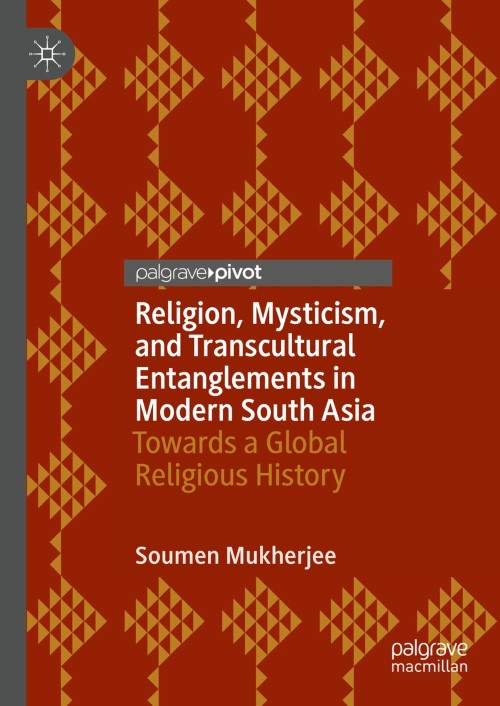
Religion, Mysticism, and Transcultural Entanglements in Modern South Asia [electronic resource] : Towards a Global Religious History / by Soumen Mukherjee.
Erişim Adresi
ISBN
9783031496370
Dil Kodu
İngilizce
Yer Numarası
DK/2985
Yazar
Basım Bildirimi
1st ed. 2024.
Yayın Bilgisi
Cham : Springer Nature Switzerland : Imprint: Springer, 2024.
Fiziksel Niteleme
XVII, 201 p. 2 illus. online resource.
İçindekiler Notu
1 Mystics, scholars, and spiritual cosmopolitans in modern South Asia: An introduction -- 2 The quest for ‘medieval mysticism’ and Vaiṣṇava Vedānta: The Tagore-Sen-Underhill circle and the Chicago moment of Mahanambrata Brahmachari -- 3 Islam, yoga, and sāmyavāda: Allama Iqbal and Kazi Nazrul Islam on nationalism, metaphysics, and existence -- 4 Theosophists, yogīs, and pacifism in troubled times: Bhagavan Das, Nicholas Roerich, and Gopinath Kaviraj on humanity and realms of transcendence -- 5 Pilgrims and their cosmopolitan itineraries: The many worlds of Subhas Chandra Bose, Dilip Kumar Roy, andYogi Krishnaprem -- 6 From interwar idealism through ‘perennial philosophy’: Concluding reflections.
Özet, vb.
“An insightful study of the spiritual quest undertaken by an impressive array of South Asian intellectuals who reappraised the very meaning of religion. Far from being a mode of inward-looking cultural defense, Soumen Mukherjee convincingly interprets mysticism and spirituality as a cosmopolitan pursuit by creative thinkers delving into devotional traditions of India’s past while responding to global challenges of the early twentieth century.” — Sugata Bose, Gardiner Professor of Oceanic History and Affairs, Harvard University “A detailed and erudite study of the way in which mysticism and spirituality came to dominate Indian forms of selfhood and self-making from the first half of the twentieth century. Part of a global debate spanning Asia, Europe, and America, interest in the esoteric and metaphysical distinguished Indian thinkers from their peers in other countries while nevertheless joining them in conversation to make for a truly global debate on the meaning and freedom of the self.” — Faisal Devji, Professor of Indian History, University of Oxford and Fellow, St Antony’s College “In India, as in many other Asian contexts, claims of modernity have sat uneasily with histories and traditions of mysticism and spirituality… This outstanding book helps us break out of such unproductive dichotomies by focusing on religious and cultural discussions in India in the early twentieth century… Yet, this riveting book is neither conventionally parochial nor fashionably global— it hypostasizes ‘spiritual cosmopolitans’ situating thinkers within contexts of transregional religious movements and networks.” —Samita Sen, Vere Harmsworth Professor of Imperial and Naval History, University of Cambridge and Fellow, Trinity College This book explores the location of spirituality and mysticism in modern Indian religious and intellectual life. It examines select personalities and their ideas since the early twentieth century, their role in the interwoven spheres of socio-religious and political thought, and in burgeoning spiritual imaginaries, often at the intersection of academic and public discourse. As part of a global ecumene connected by affective bonds, these spiritual cosmopolitans often defied binary frameworks (East/ West; imperial core/ periphery; colonizer/ colonized), and in the upshot reappraised and recast the very concept of religion in response to overarching ‘this-worldly’ exigencies. Soumen Mukherjee teaches History at Presidency University in Kolkata. He is the author of Ismailism and Islam in Modern South Asia: Community and Identity in the Age of Religious Internationals (2017). .
Konu
Asia __ History.
India __ Religion.
Imperialism.
Asian History.
Indian Religions.
Imperialism and Colonialism.
India __ Religion.
Imperialism.
Asian History.
Indian Religions.
Imperialism and Colonialism.
Eseri Alıntıla
Referansları kullanmadan önce gözden geçirmeniz ve varsa gerekli düzeltmeleri yapmanız önerilir.
Dijital Kaynak
MARC Görünümü
LEADER 05027nam a22004815i 4500
001 610313
003 TR_AnAIT
005 20250627063012
007 cr nn 008mamaa
008 240412s2024 sz | s |||| 0|eng d
020 |a9783031496370|9978-3-031-49637-0
024 7 |a10.1007/978-3-031-49637-0|2doi
041 |aeng
049 |aTürk Tarih Kurumu Kütüphanesi
050 4|aDS1-937
072 7|aHBJF|2bicssc
072 7|aHIS003000|2bisacsh
072 7|aNHF|2thema
082 04|a950|223
090 |aDK/2985
100 1 |aMukherjee, Soumen.|eauthor.|4aut|4http://id.loc.gov/vocabulary/relators/aut
245 10|aReligion, Mysticism, and Transcultural Entanglements in Modern South Asia|h[electronic resource] :|bTowards a Global Religious History /|cby Soumen Mukherjee.
250 |a1st ed. 2024.
264 1|aCham :|bSpringer Nature Switzerland :|bImprint: Springer,|c2024.
300 |aXVII, 201 p. 2 illus.|bonline resource.
336 |atext|btxt|2rdacontent
337 |acomputer|bc|2rdamedia
338 |aonline resource|bcr|2rdacarrier
347 |atext file|bPDF|2rda
505 0 |a1 Mystics, scholars, and spiritual cosmopolitans in modern South Asia: An introduction -- 2 The quest for ‘medieval mysticism’ and Vaiṣṇava Vedānta: The Tagore-Sen-Underhill circle and the Chicago moment of Mahanambrata Brahmachari -- 3 Islam, yoga, and sāmyavāda: Allama Iqbal and Kazi Nazrul Islam on nationalism, metaphysics, and existence -- 4 Theosophists, yogīs, and pacifism in troubled times: Bhagavan Das, Nicholas Roerich, and Gopinath Kaviraj on humanity and realms of transcendence -- 5 Pilgrims and their cosmopolitan itineraries: The many worlds of Subhas Chandra Bose, Dilip Kumar Roy, andYogi Krishnaprem -- 6 From interwar idealism through ‘perennial philosophy’: Concluding reflections.
520 |a“An insightful study of the spiritual quest undertaken by an impressive array of South Asian intellectuals who reappraised the very meaning of religion. Far from being a mode of inward-looking cultural defense, Soumen Mukherjee convincingly interprets mysticism and spirituality as a cosmopolitan pursuit by creative thinkers delving into devotional traditions of India’s past while responding to global challenges of the early twentieth century.” — Sugata Bose, Gardiner Professor of Oceanic History and Affairs, Harvard University “A detailed and erudite study of the way in which mysticism and spirituality came to dominate Indian forms of selfhood and self-making from the first half of the twentieth century. Part of a global debate spanning Asia, Europe, and America, interest in the esoteric and metaphysical distinguished Indian thinkers from their peers in other countries while nevertheless joining them in conversation to make for a truly global debate on the meaning and freedom of the self.” — Faisal Devji, Professor of Indian History, University of Oxford and Fellow, St Antony’s College “In India, as in many other Asian contexts, claims of modernity have sat uneasily with histories and traditions of mysticism and spirituality… This outstanding book helps us break out of such unproductive dichotomies by focusing on religious and cultural discussions in India in the early twentieth century… Yet, this riveting book is neither conventionally parochial nor fashionably global— it hypostasizes ‘spiritual cosmopolitans’ situating thinkers within contexts of transregional religious movements and networks.” —Samita Sen, Vere Harmsworth Professor of Imperial and Naval History, University of Cambridge and Fellow, Trinity College This book explores the location of spirituality and mysticism in modern Indian religious and intellectual life. It examines select personalities and their ideas since the early twentieth century, their role in the interwoven spheres of socio-religious and political thought, and in burgeoning spiritual imaginaries, often at the intersection of academic and public discourse. As part of a global ecumene connected by affective bonds, these spiritual cosmopolitans often defied binary frameworks (East/ West; imperial core/ periphery; colonizer/ colonized), and in the upshot reappraised and recast the very concept of religion in response to overarching ‘this-worldly’ exigencies. Soumen Mukherjee teaches History at Presidency University in Kolkata. He is the author of Ismailism and Islam in Modern South Asia: Community and Identity in the Age of Religious Internationals (2017). .
650 0|aAsia|xHistory.
650 0|aIndia|xReligion.
650 0|aImperialism.
650 14|aAsian History.
650 24|aIndian Religions.
650 24|aImperialism and Colonialism.
773 0 |tSpringer Nature eBook
776 08|iPrinted edition:|z9783031496363
776 08|iPrinted edition:|z9783031496387
856 40|uhttps://doi.org/10.1007/978-3-031-49637-0
912 |aZDB-2-HTY
912 |aZDB-2-SXH
950 |aHistory (SpringerNature-41172)
950 |aHistory (R0) (SpringerNature-43722)
001 610313
003 TR_AnAIT
005 20250627063012
007 cr nn 008mamaa
008 240412s2024 sz | s |||| 0|eng d
020 |a9783031496370|9978-3-031-49637-0
024 7 |a10.1007/978-3-031-49637-0|2doi
041 |aeng
049 |aTürk Tarih Kurumu Kütüphanesi
050 4|aDS1-937
072 7|aHBJF|2bicssc
072 7|aHIS003000|2bisacsh
072 7|aNHF|2thema
082 04|a950|223
090 |aDK/2985
100 1 |aMukherjee, Soumen.|eauthor.|4aut|4http://id.loc.gov/vocabulary/relators/aut
245 10|aReligion, Mysticism, and Transcultural Entanglements in Modern South Asia|h[electronic resource] :|bTowards a Global Religious History /|cby Soumen Mukherjee.
250 |a1st ed. 2024.
264 1|aCham :|bSpringer Nature Switzerland :|bImprint: Springer,|c2024.
300 |aXVII, 201 p. 2 illus.|bonline resource.
336 |atext|btxt|2rdacontent
337 |acomputer|bc|2rdamedia
338 |aonline resource|bcr|2rdacarrier
347 |atext file|bPDF|2rda
505 0 |a1 Mystics, scholars, and spiritual cosmopolitans in modern South Asia: An introduction -- 2 The quest for ‘medieval mysticism’ and Vaiṣṇava Vedānta: The Tagore-Sen-Underhill circle and the Chicago moment of Mahanambrata Brahmachari -- 3 Islam, yoga, and sāmyavāda: Allama Iqbal and Kazi Nazrul Islam on nationalism, metaphysics, and existence -- 4 Theosophists, yogīs, and pacifism in troubled times: Bhagavan Das, Nicholas Roerich, and Gopinath Kaviraj on humanity and realms of transcendence -- 5 Pilgrims and their cosmopolitan itineraries: The many worlds of Subhas Chandra Bose, Dilip Kumar Roy, andYogi Krishnaprem -- 6 From interwar idealism through ‘perennial philosophy’: Concluding reflections.
520 |a“An insightful study of the spiritual quest undertaken by an impressive array of South Asian intellectuals who reappraised the very meaning of religion. Far from being a mode of inward-looking cultural defense, Soumen Mukherjee convincingly interprets mysticism and spirituality as a cosmopolitan pursuit by creative thinkers delving into devotional traditions of India’s past while responding to global challenges of the early twentieth century.” — Sugata Bose, Gardiner Professor of Oceanic History and Affairs, Harvard University “A detailed and erudite study of the way in which mysticism and spirituality came to dominate Indian forms of selfhood and self-making from the first half of the twentieth century. Part of a global debate spanning Asia, Europe, and America, interest in the esoteric and metaphysical distinguished Indian thinkers from their peers in other countries while nevertheless joining them in conversation to make for a truly global debate on the meaning and freedom of the self.” — Faisal Devji, Professor of Indian History, University of Oxford and Fellow, St Antony’s College “In India, as in many other Asian contexts, claims of modernity have sat uneasily with histories and traditions of mysticism and spirituality… This outstanding book helps us break out of such unproductive dichotomies by focusing on religious and cultural discussions in India in the early twentieth century… Yet, this riveting book is neither conventionally parochial nor fashionably global— it hypostasizes ‘spiritual cosmopolitans’ situating thinkers within contexts of transregional religious movements and networks.” —Samita Sen, Vere Harmsworth Professor of Imperial and Naval History, University of Cambridge and Fellow, Trinity College This book explores the location of spirituality and mysticism in modern Indian religious and intellectual life. It examines select personalities and their ideas since the early twentieth century, their role in the interwoven spheres of socio-religious and political thought, and in burgeoning spiritual imaginaries, often at the intersection of academic and public discourse. As part of a global ecumene connected by affective bonds, these spiritual cosmopolitans often defied binary frameworks (East/ West; imperial core/ periphery; colonizer/ colonized), and in the upshot reappraised and recast the very concept of religion in response to overarching ‘this-worldly’ exigencies. Soumen Mukherjee teaches History at Presidency University in Kolkata. He is the author of Ismailism and Islam in Modern South Asia: Community and Identity in the Age of Religious Internationals (2017). .
650 0|aAsia|xHistory.
650 0|aIndia|xReligion.
650 0|aImperialism.
650 14|aAsian History.
650 24|aIndian Religions.
650 24|aImperialism and Colonialism.
773 0 |tSpringer Nature eBook
776 08|iPrinted edition:|z9783031496363
776 08|iPrinted edition:|z9783031496387
856 40|uhttps://doi.org/10.1007/978-3-031-49637-0
912 |aZDB-2-HTY
912 |aZDB-2-SXH
950 |aHistory (SpringerNature-41172)
950 |aHistory (R0) (SpringerNature-43722)
Materyaller
Depodan talep edilen materyal sadece kütüphane içerisinde kullanılmaktadır.
Materyal dışarıya ödünç verilmemektedir.
Materyal dışarıya ödünç verilmemektedir.
