

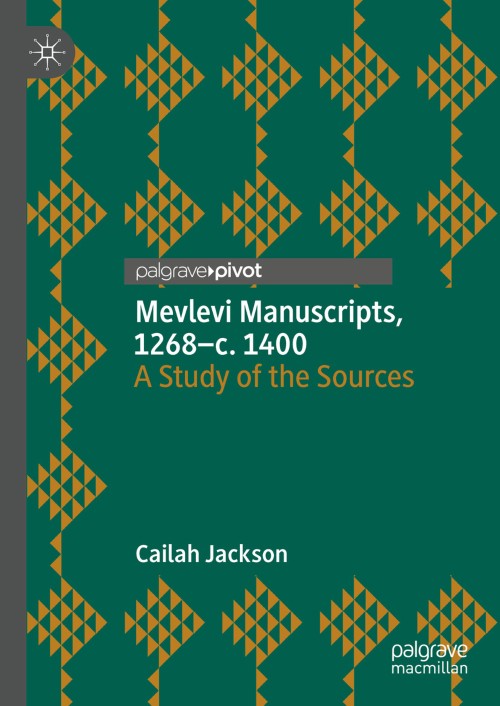
Mevlevi Manuscripts, 1268–c. 1400 [electronic resource] : A Study of the Sources / by Cailah Jackson.
Erişim Adresi
ISBN
9783031483677
Dil Kodu
İngilizce
Yer Numarası
DK/2995
Yazar
Basım Bildirimi
1st ed. 2024.
Yayın Bilgisi
Cham : Springer Nature Switzerland : Imprint: Springer, 2024.
Fiziksel Niteleme
XVII, 160 p. 10 illus. online resource.
İçindekiler Notu
1 Introduction -- 2 The Manuscript Sources -- 3 Texts and Intellectual Interests -- 4 Scribes, Patrons and Readers -- 5 Locations of Manuscript Production -- 6 Conclusion -- 7 Appendices.
Özet, vb.
“This important study of Mevlevi manuscripts is an outstanding piece of scholarship, based on a close examination of numerous often neglected manuscript sources. It sheds new light not just on the manuscripts themselves, but also the early Mevlevi community – its artists, artisans, and patrons, and their intellectual interests. It makes a significant contribution both to art historical scholarship and to the growing field of Islamic manuscript studies, and will be required reading for anyone interested in medieval Anatolia or Sufism.” —Professor A. C. S. Peacock, University of St Andrews, UK This book provides a detailed and carefully researched catalogue of over 140 manuscripts related to the Mevlevi Sufis in their formative period during the thirteenth and fourteenth centuries. It also offers an in-depth and rigorous analysis of the manuscript material, which reveals much about the role of manuscripts in early Mevlevi life, the identity of disciples who were scribes and manuscript owners, and the geographical spread of the Sufi group. The Mevlevi Sufis were one of the most important and prominent socio-religious groups to emerge in late medieval Anatolia, following the Mongol conquests of the 1240s. Sometimes known colloquially as the ‘whirling dervishes,’ the Mevlevis became particularly powerful under Ottoman rule in the early modern period, even counting some sultans as their disciples. However, there is still much to learn about their earliest days, following the death of their ‘patron saint’ Jalal al-Din Rumi in 1273. Rumi is of course also notable as the author of the Masnavi, an extensive work of Sufi poetry written in rhyming couplets that is the core of Mevlevi ritual and learning. Beyond Mevlevi circles, Rumi remains very popular today as a ‘mystic’ poet. This study sheds new light on the intellectual culture of his time. Cailah Jackson is a Research Associate of the Khalili Research Centre, University of Oxford and former Junior Research Fellow at Wolfson College, University of Oxford and the Oxford Centre for Islamic Studies.
Konu
Middle East __ History.
Islam __ History.
Cultural property.
Archaeology.
History of the Middle East.
Islamic History.
Cultural Heritage.
Archaeology and Heritage.
Islam __ History.
Cultural property.
Archaeology.
History of the Middle East.
Islamic History.
Cultural Heritage.
Archaeology and Heritage.
