LEADER 03610nam a22005295i 4500
001 610325
003 TR_AnAIT
005 20250627062949
007 cr nn 008mamaa
008 240509s2024 sz | s |||| 0|eng d
020 |a9783031508752|9978-3-031-50875-2
024 7 |a10.1007/978-3-031-50875-2|2doi
041 |aeng
049 |aTürk Tarih Kurumu Kütüphanesi
050 4|aD203.2-475
072 7|aHBJD|2bicssc
072 7|aHBLL|2bicssc
072 7|aHIS010000|2bisacsh
072 7|aNHD|2thema
082 04|a940.903|223
090 |aDK/2997
100 1 |aOnur, Petek.|eauthor.|4aut|4http://id.loc.gov/vocabulary/relators/aut
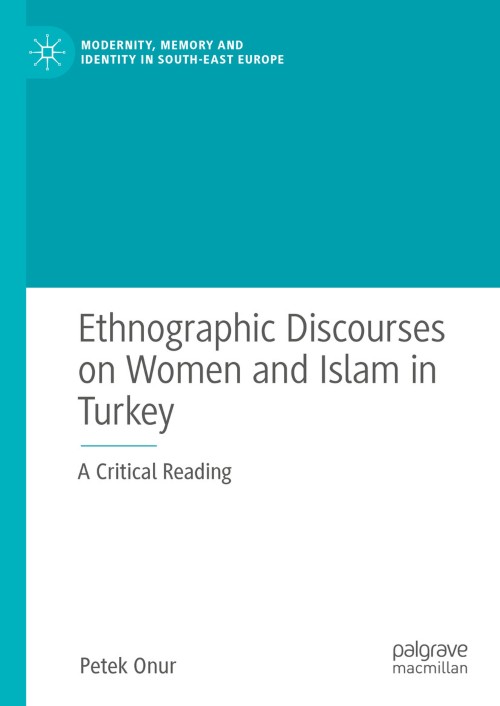
245 10|aEthnographic Discourses on Women and Islam in Turkey|h[electronic resource] :|bA Critical Reading /|cby Petek Onur.
250 |a1st ed. 2024.
264 1|aCham :|bSpringer Nature Switzerland :|bImprint: Palgrave Macmillan,|c2024.
300 |aX, 305 p. 590 illus.|bonline resource.
336 |atext|btxt|2rdacontent
337 |acomputer|bc|2rdamedia
338 |aonline resource|bcr|2rdacarrier
347 |atext file|bPDF|2rda
490 1 |aModernity, Memory and Identity in South-East Europe,|x2523-7993
505 0 |aChapter 1. Introduction: Studying Muslim Women in Ethnographic Discourse—A Background -- Chapter 2. Paradigms, Approaches, Issues, Challenges -- Chapter 3. Islam and the Traditional Gender Hierarchy: 1983–1992 -- Chapter 4. Approaching the New Islamist Women: 1994–2006 -- Chapter 5. Women in the AKP Years, 2007–2021: Conservative Politics and Neoliberalism -- Chapter 6. Conclusion.
520 |aThis book provides a meta-reading of how ethnographic discourses on women and Islam in Turkey have changed since their emergence in 1983. It analyses the published ethnographic works in three discursive periods and shows that paradigm shifts in social sciences, processes of neo-liberal globalization and globalization of Islamism as well as political, social, cultural and economic transformations at the local level shape these periods. As an exceptional example of modernization in the Middle East and the post-imperial states in South-East Europe, Turkey has been experiencing tensions between Islamic beliefs and practices and Westernization and secularization processes. Countless aspects of Muslim women’s lives appear as symbols and indicators in this society like in many other Muslim majority societies and to scholars of gender and women’s studies in discussing the faith-based patriarchy. Thus, this book exhibits the necessity of developing a critical perspective on ethnographic representations of Muslim women in Turkey. Petek Onur is an assistant professor at University of Copenhagen, Department of Cross-Cultural and Regional Studies. She was a Marie-Curie fellow at the same department in 2020-2022 and postdoctoral researcher at Europa-Universität Flensburg, Interdisciplinary Centre for European Studies in 2023-2024. .
650 0|aEurope|xHistory|x1492-.
650 0|aSocial history.
650 0|aWomen|xHistory.
650 14|aHistory of Modern Europe.
650 24|aSocial History.
650 24|aWomen's History / History of Gender.
773 0 |tSpringer Nature eBook
776 08|iPrinted edition:|z9783031508745
776 08|iPrinted edition:|z9783031508769
776 08|iPrinted edition:|z9783031508776
830 0|aModernity, Memory and Identity in South-East Europe,|x2523-7993
856 40|uhttps://doi.org/10.1007/978-3-031-50875-2
912 |aZDB-2-HTY
912 |aZDB-2-SXH
950 |aHistory (SpringerNature-41172)
950 |aHistory (R0) (SpringerNature-43722)