LEADER 03821nam a22005535i 4500
001 610394
003 TR_AnAIT
005 20250627062734
007 cr nn 008mamaa
008 240820s2024 sz | s |||| 0|eng d
020 |a9783031679612|9978-3-031-67961-2
024 7 |a10.1007/978-3-031-67961-2|2doi
041 |aeng
049 |aTürk Tarih Kurumu Kütüphanesi
050 4|aF1409.6-1414.2
072 7|aHBJK|2bicssc
072 7|aHIS024000|2bisacsh
072 7|aNHK|2thema
082 04|a980|223
090 |aDK/3066
100 1 |aGowricharn, Ruben.|eauthor.|4aut|4http://id.loc.gov/vocabulary/relators/aut
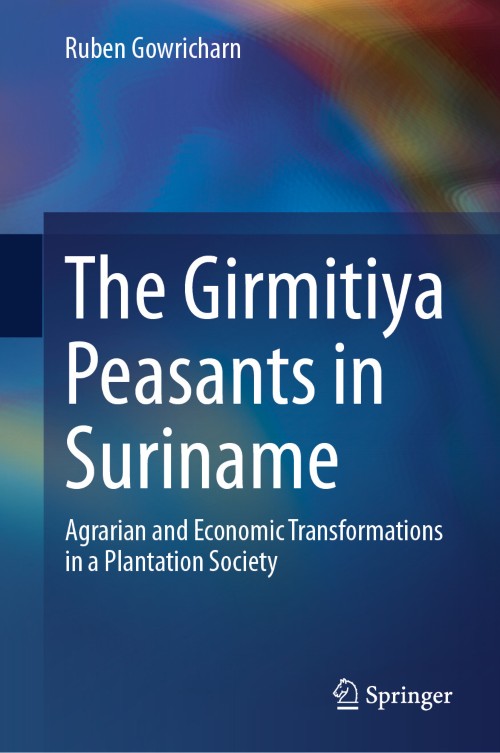
245 14|aThe Girmitiya Peasants in Suriname|h[electronic resource] :|bAgrarian and Economic Transformations in a Plantation Society /|cby Ruben Gowricharn.
250 |a1st ed. 2024.
264 1|aCham :|bSpringer Nature Switzerland :|bImprint: Springer,|c2024.
300 |aXXIII, 287 p. 30 illus., 5 illus. in color.|bonline resource.
336 |atext|btxt|2rdacontent
337 |acomputer|bc|2rdamedia
338 |aonline resource|bcr|2rdacarrier
347 |atext file|bPDF|2rda
505 0 |aChapter 1. Peasants in Girmitiya scholarship -- Part I: From rural dweller to plantation labourer -- Chapter 2. Migration and agrarian human capital -- Chapter 3. Labourers on the plantations -- Chapter 4. An embryonic ethnic community -- Part II: From labourer to peasant -- Chapter 5. The rise of rice peasants -- Chapter 6. Homemaking in Suriname -- Chapter 7. Ruralisation policy -- Part III: From peasant to urban dweller -- Chapter 8. The mechanisation of rice farming -- Chapter 9. Ethnic and economic politics -- Chapter 10. The transition of rice farmers -- Conclusion: Transformations of the Girmitiya peasantry.
520 |aThis book examines the Indo-Surinamese Girmitiya peasants and their contributions to developing the ethnic community within their newly adopted home. It demonstrates the transformation of the Girmitiyas from agriculturalists in British India to plantation labourers to peasants and finally to urban dwellers. The author argues that it was the Girmitiya peasants who had made greater contributions to developing the ethnic community over the labourers of whom about one-third returned to British India. The work covers the history of how the peasants institutionalised their practice, changed the physical landscape and integrated economically and politically as an ethnic group in their newly adopted homeland. Furthermore, the author presents arguments to demonstrate that Girmitiya peasants survived the plantation labour and peasant life due to their knowledge and skills of agrarian cultivation, known as agrarian human capital. The scholarly literature about the labour migration from British India has focused heavily on the fate of the labourers. Consequently, the history of the Girmitiya peasants as well as the cultural heritage they have produced has been grossly neglected. This book purports to fill this void by telling the history of Girmitiya peasants in Suriname, a Caribbean society adjacent to former British Guyana.
650 0|aLatin America|xHistory.
650 0|aCultural property.
650 0|aAgriculture.
650 0|aLabor.
650 0|aHistory.
650 0|aImperialism.
650 14|aLatin American History.
650 24|aCultural Heritage.
650 24|aAgriculture.
650 24|aLabor History.
650 24|aImperialism and Colonialism.
773 0 |tSpringer Nature eBook
776 08|iPrinted edition:|z9783031679605
776 08|iPrinted edition:|z9783031679629
776 08|iPrinted edition:|z9783031679636
856 40|uhttps://doi.org/10.1007/978-3-031-67961-2
912 |aZDB-2-HTY
912 |aZDB-2-SXH
950 |aHistory (SpringerNature-41172)
950 |aHistory (R0) (SpringerNature-43722)