

Hylomorphism into Pieces [electronic resource] : Elements, Atoms, and Corpuscles in Natural Philosophy and Medicine, 1400–1600 / edited by Nicola Polloni, Sylvain Roudaut.
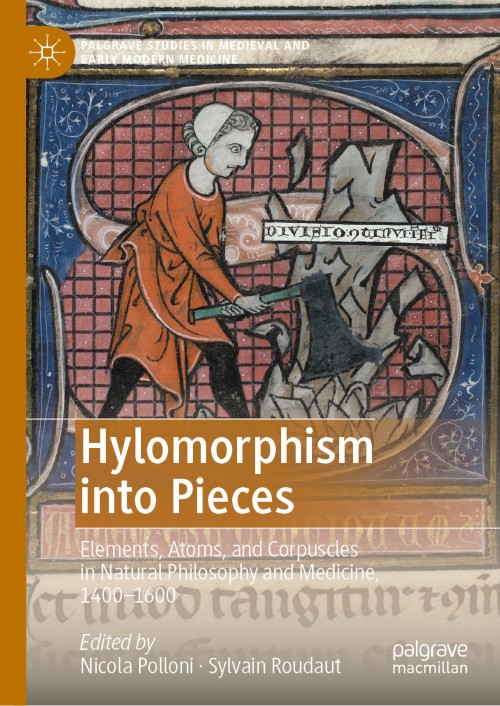
Erişim Adresi
ISBN
9783031609275
Dil Kodu
İngilizce
Yer Numarası
DK/3093
Basım Bildirimi
1st ed. 2024.
Yayın Bilgisi
Cham : Springer International Publishing : Imprint: Palgrave Macmillan, 2024.
Fiziksel Niteleme
IX, 368 p. 8 illus. online resource.
Dizi
Palgrave Studies in Medieval and Early Modern Medicine, 2524-7395
İçindekiler Notu
Chapter 1:Nicola Polloni and Sylvain Roudaut- Hylomorphism into Pieces? Introductory Remarks -- Chapter 2: Aurélien Robert- Atoms, Minima and Points: Democritean Corpuscularism in the 13th Century -- Chapter 3: Roberto Zambiasi - The ‘No-Frills’ Doctrine of Minima naturalia in the Latin Middle Ages and in the Renaissance: A First Exploration -- Chapter 4: Henrik Lagerlund - The Changing View of Successive Entities in the 14th Century: Peter of Mantua on Matter and Form -- Chapter 5: Claire Murphy - Unity out of Multiplicity: Nicholas of Cusa’s Theory of the Elements -- Chapter 6: Luca Burzelli - Pietro Pomponazzi and the Debate on the Four Elements -- Chapter 7: Sylvain Roudaut - Points of Form and Other Minima: Hylomorphism and Indivisibles in the Circle of John Mair -- Chapter 8: Russell Friedman - Late Scholastic Thomism into Pieces: Hylomorphism and Indeterminate Dimensions in Domingo Báñez’s Commentary on De generatione et corruptione -- Chapter 9: Nicola Polloni - Francisco de Toledo on Elemental Mixtures -- Chapter 10: Fabrizio Bigotti - Prime Matter is Three-Dimensionality: The Debate on the Extension of Prime Matter from Zabarella to Galileo -- Chapter 11:Hiro Hirai- Jacob Schegk, Simplicius and “Anaxagoras the Atomist”: Aristotelian Commentaries and Renaissance Corpuscularism -- Chapter 12:Erik Åkerlund - Rodrigo de Arriaga’s Substance Trialism.
Özet, vb.
Focussing on late medieval and early modern philosophy and medicine, this edited collection explores the replacement of hylomorphism—the dominant theory of bodies in the Middle Ages—with new theories of matter such as corpuscularianism and atomism at the dawn of the Modern period. Together, the contributions offer a comprehensive overview of a crucial historical moment for the history of philosophy and science: the rise of a new conception of matter against declining scholastic theories. They highlight the key aspects of this historical transition by investigating precise concepts that were central to this shift, namely the notions of elements, atoms, and corpuscles. Shedding light on the gradual process by which hylomorphism was eventually replaced by a more positive conception of matter and natural processes, the book demonstrates how many thinkers of the late medieval period were willing to integrate new theories into the conceptual framework of Aristotelian natural philosophy, and tried to harmonise them with the traditional concepts and axioms of scholastic doctrines. Showing how these conceptual innovations resulted from a complex interaction between different fields of late medieval and early modern knowledge, the authors bring together research from the disciplines of metaphysics, medieval philosophy, and medical science. Providing an overview of an important theoretical shift in the transition from the Middle Ages to the Modern Era, this book is essential reading for scholars of philosophy, and historians of medieval and early modern science and medicine. Nicola Polloni is an Associate Professor of Medieval Philosophy at the University of Messina, in Italy. His research delves into medieval hylomorphism, focusing on the tensions arising from the intertwining of metaphysics and natural philosophy. Sylvain Roudaut is a Research Fellow at KU Leuven in Belgium. His research focuses on the interaction between metaphysics, natural philosophy, and mathematics in the Middle Ages.
Konu
Science __ History.
Medicine __ History.
Philosophy __ History.
Europe __ History __ 476-1492.
Europe __ History __ 1492-.
History of Science.
History of Medicine.
History of Philosophy.
History of Medieval Europe.
History of Early Modern Europe.
Medicine __ History.
Philosophy __ History.
Europe __ History __ 476-1492.
Europe __ History __ 1492-.
History of Science.
History of Medicine.
History of Philosophy.
History of Medieval Europe.
History of Early Modern Europe.
Diğer Yazarlar
Eseri Alıntıla
Referansları kullanmadan önce gözden geçirmeniz ve varsa gerekli düzeltmeleri yapmanız önerilir.
Dijital Kaynak
MARC Görünümü
LEADER 05584nam a22005775i 4500
001 610421
003 TR_AnAIT
005 20250627062642
007 cr nn 008mamaa
008 240924s2024 sz | s |||| 0|eng d
020 |a9783031609275|9978-3-031-60927-5
024 7 |a10.1007/978-3-031-60927-5|2doi
041 |aeng
049 |aTürk Tarih Kurumu Kütüphanesi
050 4|aQ124.6-127.2
072 7|aPDX|2bicssc
072 7|aSCI034000|2bisacsh
072 7|aPDX|2thema
082 04|a509|223
090 |aDK/3093
245 10|aHylomorphism into Pieces|h[electronic resource] :|bElements, Atoms, and Corpuscles in Natural Philosophy and Medicine, 1400–1600 /|cedited by Nicola Polloni, Sylvain Roudaut.
250 |a1st ed. 2024.
264 1|aCham :|bSpringer International Publishing :|bImprint: Palgrave Macmillan,|c2024.
300 |aIX, 368 p. 8 illus.|bonline resource.
336 |atext|btxt|2rdacontent
337 |acomputer|bc|2rdamedia
338 |aonline resource|bcr|2rdacarrier
347 |atext file|bPDF|2rda
490 1 |aPalgrave Studies in Medieval and Early Modern Medicine,|x2524-7395
505 0 |aChapter 1:Nicola Polloni and Sylvain Roudaut- Hylomorphism into Pieces? Introductory Remarks -- Chapter 2: Aurélien Robert- Atoms, Minima and Points: Democritean Corpuscularism in the 13th Century -- Chapter 3: Roberto Zambiasi - The ‘No-Frills’ Doctrine of Minima naturalia in the Latin Middle Ages and in the Renaissance: A First Exploration -- Chapter 4: Henrik Lagerlund - The Changing View of Successive Entities in the 14th Century: Peter of Mantua on Matter and Form -- Chapter 5: Claire Murphy - Unity out of Multiplicity: Nicholas of Cusa’s Theory of the Elements -- Chapter 6: Luca Burzelli - Pietro Pomponazzi and the Debate on the Four Elements -- Chapter 7: Sylvain Roudaut - Points of Form and Other Minima: Hylomorphism and Indivisibles in the Circle of John Mair -- Chapter 8: Russell Friedman - Late Scholastic Thomism into Pieces: Hylomorphism and Indeterminate Dimensions in Domingo Báñez’s Commentary on De generatione et corruptione -- Chapter 9: Nicola Polloni - Francisco de Toledo on Elemental Mixtures -- Chapter 10: Fabrizio Bigotti - Prime Matter is Three-Dimensionality: The Debate on the Extension of Prime Matter from Zabarella to Galileo -- Chapter 11:Hiro Hirai- Jacob Schegk, Simplicius and “Anaxagoras the Atomist”: Aristotelian Commentaries and Renaissance Corpuscularism -- Chapter 12:Erik Åkerlund - Rodrigo de Arriaga’s Substance Trialism.
520 |aFocussing on late medieval and early modern philosophy and medicine, this edited collection explores the replacement of hylomorphism—the dominant theory of bodies in the Middle Ages—with new theories of matter such as corpuscularianism and atomism at the dawn of the Modern period. Together, the contributions offer a comprehensive overview of a crucial historical moment for the history of philosophy and science: the rise of a new conception of matter against declining scholastic theories. They highlight the key aspects of this historical transition by investigating precise concepts that were central to this shift, namely the notions of elements, atoms, and corpuscles. Shedding light on the gradual process by which hylomorphism was eventually replaced by a more positive conception of matter and natural processes, the book demonstrates how many thinkers of the late medieval period were willing to integrate new theories into the conceptual framework of Aristotelian natural philosophy, and tried to harmonise them with the traditional concepts and axioms of scholastic doctrines. Showing how these conceptual innovations resulted from a complex interaction between different fields of late medieval and early modern knowledge, the authors bring together research from the disciplines of metaphysics, medieval philosophy, and medical science. Providing an overview of an important theoretical shift in the transition from the Middle Ages to the Modern Era, this book is essential reading for scholars of philosophy, and historians of medieval and early modern science and medicine. Nicola Polloni is an Associate Professor of Medieval Philosophy at the University of Messina, in Italy. His research delves into medieval hylomorphism, focusing on the tensions arising from the intertwining of metaphysics and natural philosophy. Sylvain Roudaut is a Research Fellow at KU Leuven in Belgium. His research focuses on the interaction between metaphysics, natural philosophy, and mathematics in the Middle Ages.
650 0|aScience|xHistory.
650 0|aMedicine|xHistory.
650 0|aPhilosophy|xHistory.
650 0|aEurope|xHistory|x476-1492.
650 0|aEurope|xHistory|x1492-.
650 14|aHistory of Science.
650 24|aHistory of Medicine.
650 24|aHistory of Philosophy.
650 24|aHistory of Medieval Europe.
650 24|aHistory of Early Modern Europe.
700 1 |aPolloni, Nicola.|eeditor.|4edt|4http://id.loc.gov/vocabulary/relators/edt
700 1 |aRoudaut, Sylvain.|eeditor.|4edt|4http://id.loc.gov/vocabulary/relators/edt
773 0 |tSpringer Nature eBook
776 08|iPrinted edition:|z9783031609268
776 08|iPrinted edition:|z9783031609282
776 08|iPrinted edition:|z9783031609299
830 0|aPalgrave Studies in Medieval and Early Modern Medicine,|x2524-7395
856 40|uhttps://doi.org/10.1007/978-3-031-60927-5
912 |aZDB-2-HTY
912 |aZDB-2-SXH
950 |aHistory (SpringerNature-41172)
950 |aHistory (R0) (SpringerNature-43722)
001 610421
003 TR_AnAIT
005 20250627062642
007 cr nn 008mamaa
008 240924s2024 sz | s |||| 0|eng d
020 |a9783031609275|9978-3-031-60927-5
024 7 |a10.1007/978-3-031-60927-5|2doi
041 |aeng
049 |aTürk Tarih Kurumu Kütüphanesi
050 4|aQ124.6-127.2
072 7|aPDX|2bicssc
072 7|aSCI034000|2bisacsh
072 7|aPDX|2thema
082 04|a509|223
090 |aDK/3093
245 10|aHylomorphism into Pieces|h[electronic resource] :|bElements, Atoms, and Corpuscles in Natural Philosophy and Medicine, 1400–1600 /|cedited by Nicola Polloni, Sylvain Roudaut.
250 |a1st ed. 2024.
264 1|aCham :|bSpringer International Publishing :|bImprint: Palgrave Macmillan,|c2024.
300 |aIX, 368 p. 8 illus.|bonline resource.
336 |atext|btxt|2rdacontent
337 |acomputer|bc|2rdamedia
338 |aonline resource|bcr|2rdacarrier
347 |atext file|bPDF|2rda
490 1 |aPalgrave Studies in Medieval and Early Modern Medicine,|x2524-7395
505 0 |aChapter 1:Nicola Polloni and Sylvain Roudaut- Hylomorphism into Pieces? Introductory Remarks -- Chapter 2: Aurélien Robert- Atoms, Minima and Points: Democritean Corpuscularism in the 13th Century -- Chapter 3: Roberto Zambiasi - The ‘No-Frills’ Doctrine of Minima naturalia in the Latin Middle Ages and in the Renaissance: A First Exploration -- Chapter 4: Henrik Lagerlund - The Changing View of Successive Entities in the 14th Century: Peter of Mantua on Matter and Form -- Chapter 5: Claire Murphy - Unity out of Multiplicity: Nicholas of Cusa’s Theory of the Elements -- Chapter 6: Luca Burzelli - Pietro Pomponazzi and the Debate on the Four Elements -- Chapter 7: Sylvain Roudaut - Points of Form and Other Minima: Hylomorphism and Indivisibles in the Circle of John Mair -- Chapter 8: Russell Friedman - Late Scholastic Thomism into Pieces: Hylomorphism and Indeterminate Dimensions in Domingo Báñez’s Commentary on De generatione et corruptione -- Chapter 9: Nicola Polloni - Francisco de Toledo on Elemental Mixtures -- Chapter 10: Fabrizio Bigotti - Prime Matter is Three-Dimensionality: The Debate on the Extension of Prime Matter from Zabarella to Galileo -- Chapter 11:Hiro Hirai- Jacob Schegk, Simplicius and “Anaxagoras the Atomist”: Aristotelian Commentaries and Renaissance Corpuscularism -- Chapter 12:Erik Åkerlund - Rodrigo de Arriaga’s Substance Trialism.
520 |aFocussing on late medieval and early modern philosophy and medicine, this edited collection explores the replacement of hylomorphism—the dominant theory of bodies in the Middle Ages—with new theories of matter such as corpuscularianism and atomism at the dawn of the Modern period. Together, the contributions offer a comprehensive overview of a crucial historical moment for the history of philosophy and science: the rise of a new conception of matter against declining scholastic theories. They highlight the key aspects of this historical transition by investigating precise concepts that were central to this shift, namely the notions of elements, atoms, and corpuscles. Shedding light on the gradual process by which hylomorphism was eventually replaced by a more positive conception of matter and natural processes, the book demonstrates how many thinkers of the late medieval period were willing to integrate new theories into the conceptual framework of Aristotelian natural philosophy, and tried to harmonise them with the traditional concepts and axioms of scholastic doctrines. Showing how these conceptual innovations resulted from a complex interaction between different fields of late medieval and early modern knowledge, the authors bring together research from the disciplines of metaphysics, medieval philosophy, and medical science. Providing an overview of an important theoretical shift in the transition from the Middle Ages to the Modern Era, this book is essential reading for scholars of philosophy, and historians of medieval and early modern science and medicine. Nicola Polloni is an Associate Professor of Medieval Philosophy at the University of Messina, in Italy. His research delves into medieval hylomorphism, focusing on the tensions arising from the intertwining of metaphysics and natural philosophy. Sylvain Roudaut is a Research Fellow at KU Leuven in Belgium. His research focuses on the interaction between metaphysics, natural philosophy, and mathematics in the Middle Ages.
650 0|aScience|xHistory.
650 0|aMedicine|xHistory.
650 0|aPhilosophy|xHistory.
650 0|aEurope|xHistory|x476-1492.
650 0|aEurope|xHistory|x1492-.
650 14|aHistory of Science.
650 24|aHistory of Medicine.
650 24|aHistory of Philosophy.
650 24|aHistory of Medieval Europe.
650 24|aHistory of Early Modern Europe.
700 1 |aPolloni, Nicola.|eeditor.|4edt|4http://id.loc.gov/vocabulary/relators/edt
700 1 |aRoudaut, Sylvain.|eeditor.|4edt|4http://id.loc.gov/vocabulary/relators/edt
773 0 |tSpringer Nature eBook
776 08|iPrinted edition:|z9783031609268
776 08|iPrinted edition:|z9783031609282
776 08|iPrinted edition:|z9783031609299
830 0|aPalgrave Studies in Medieval and Early Modern Medicine,|x2524-7395
856 40|uhttps://doi.org/10.1007/978-3-031-60927-5
912 |aZDB-2-HTY
912 |aZDB-2-SXH
950 |aHistory (SpringerNature-41172)
950 |aHistory (R0) (SpringerNature-43722)
Materyaller
Depodan talep edilen materyal sadece kütüphane içerisinde kullanılmaktadır.
Materyal dışarıya ödünç verilmemektedir.
Materyal dışarıya ödünç verilmemektedir.
