

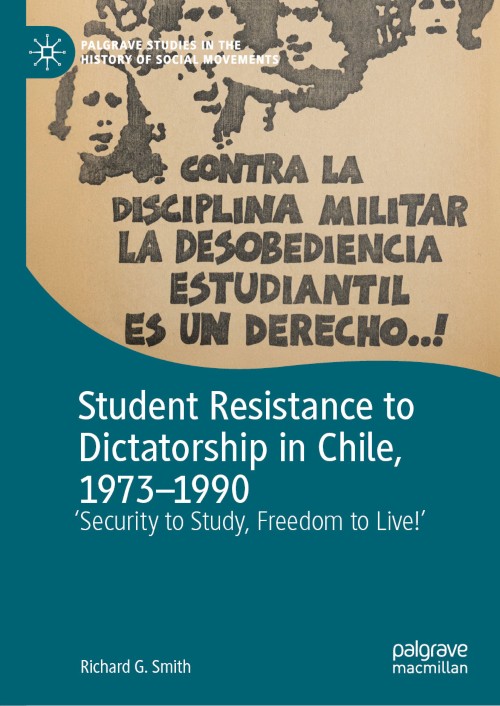
Student Resistance to Dictatorship in Chile, 1973-1990 [electronic resource] : 'Security to Study, Freedom to Live!' / by Richard G. Smith.
Erişim Adresi
ISBN
9783031643842
Dil Kodu
İngilizce
Yer Numarası
DK/3098
Basım Bildirimi
1st ed. 2024.
Yayın Bilgisi
Cham : Springer Nature Switzerland : Imprint: Palgrave Macmillan, 2024.
Fiziksel Niteleme
XXVI, 346 p. 17 illus., 6 illus. in color. online resource.
Dizi
Palgrave Studies in the History of Social Movements, 2634-6567
İçindekiler Notu
Chapter 1: Introduction - Chilean Students' Opposition to the Pinochet Regime (1973-1990) -- Chapter 2: Contexts -- Chapter 3: A Culture of Opposition -- Chapter 4: Democracy at the University of Chile -- Chapter 5: Secondary School Students Campaign for Democracy -- Chapter 6: The Right to be Young.
Özet, vb.
This book documents and analyses Chilean university and school students’ opposition to the Pinochet regime during the latter years of the 1970s and the 1980s. The book focuses on key episodes such as the establishment of cultural groups within the militarily controlled universities that enabled students to congregate and exchange ideas for the first time since the 1973 coup; how university and secondary school students created their own democratic institutions to challenge the regime-appointed bodies; and how these eventually led to the restoration of the national federations that had been banned by the military government. The author explores the key relationship between the vertically organised, underground political parties, and the horizontally organised, broad, non-partisan organisations created by the students, arguing that this structure brought advantages to the movement. The students’ contribution to the national protests in the 1980s ensured that opposition to the regime was highly visible in the city centre, resulting in a socially broadened opposition with a focus on youth, rather than disenfranchisement and poverty. Offering a detailed account of different forms of student activism, this book evaluates the role of school and university students within the broader anti-dictatorship opposition in Chile. Richard G. Smith originally trained as a chemist before a career in consumer product innovation took him all over the world, including three years living in Buenos Aires and many more working and travelling across the length and breadth of Latin America. He was Visiting Fellow at the University of London’s Centre for Latin American and Caribbean Studies (2022-23), and is an Honorary Research Fellow in the University of Liverpool’s Department of History, where he previously studied. During his time at Liverpool, Richard taught Contemporary Latin American Politics as a Graduate Teaching Assistant, and was Visiting International Fellow at the University of Georgia, USA, which included research, lecturing and teaching.
Konu
Social history.
World politics.
Latin America __ History.
Education __ History.
Military history.
Social History.
Political History.
Latin American History.
History of Education.
Military History.
World politics.
Latin America __ History.
Education __ History.
Military history.
Social History.
Political History.
Latin American History.
History of Education.
Military History.
Eseri Alıntıla
Referansları kullanmadan önce gözden geçirmeniz ve varsa gerekli düzeltmeleri yapmanız önerilir.
Dijital Kaynak
MARC Görünümü
LEADER 04448nam a22005655i 4500
001 610426
003 TR_AnAIT
005 20250627062633
007 cr nn 008mamaa
008 240930s2024 sz | s |||| 0|eng d
020 |a9783031643842|9978-3-031-64384-2
024 7 |a10.1007/978-3-031-64384-2|2doi
041 |aeng
049 |aTürk Tarih Kurumu Kütüphanesi
050 4|aHN
072 7|aHBTB|2bicssc
072 7|aHIS054000|2bisacsh
072 7|aNHTB|2thema
082 04|a306.09|223
090 |aDK/3098
100 1 |aSmith, Richard G.|eauthor.|0(orcid)0000-0001-5894-4600|1https://orcid.org/0000-0001-5894-4600|4aut|4http://id.loc.gov/vocabulary/relators/aut
245 10|aStudent Resistance to Dictatorship in Chile, 1973-1990|h[electronic resource] :|b'Security to Study, Freedom to Live!' /|cby Richard G. Smith.
250 |a1st ed. 2024.
264 1|aCham :|bSpringer Nature Switzerland :|bImprint: Palgrave Macmillan,|c2024.
300 |aXXVI, 346 p. 17 illus., 6 illus. in color.|bonline resource.
336 |atext|btxt|2rdacontent
337 |acomputer|bc|2rdamedia
338 |aonline resource|bcr|2rdacarrier
347 |atext file|bPDF|2rda
490 1 |aPalgrave Studies in the History of Social Movements,|x2634-6567
505 0 |aChapter 1: Introduction - Chilean Students' Opposition to the Pinochet Regime (1973-1990) -- Chapter 2: Contexts -- Chapter 3: A Culture of Opposition -- Chapter 4: Democracy at the University of Chile -- Chapter 5: Secondary School Students Campaign for Democracy -- Chapter 6: The Right to be Young.
520 |aThis book documents and analyses Chilean university and school students’ opposition to the Pinochet regime during the latter years of the 1970s and the 1980s. The book focuses on key episodes such as the establishment of cultural groups within the militarily controlled universities that enabled students to congregate and exchange ideas for the first time since the 1973 coup; how university and secondary school students created their own democratic institutions to challenge the regime-appointed bodies; and how these eventually led to the restoration of the national federations that had been banned by the military government. The author explores the key relationship between the vertically organised, underground political parties, and the horizontally organised, broad, non-partisan organisations created by the students, arguing that this structure brought advantages to the movement. The students’ contribution to the national protests in the 1980s ensured that opposition to the regime was highly visible in the city centre, resulting in a socially broadened opposition with a focus on youth, rather than disenfranchisement and poverty. Offering a detailed account of different forms of student activism, this book evaluates the role of school and university students within the broader anti-dictatorship opposition in Chile. Richard G. Smith originally trained as a chemist before a career in consumer product innovation took him all over the world, including three years living in Buenos Aires and many more working and travelling across the length and breadth of Latin America. He was Visiting Fellow at the University of London’s Centre for Latin American and Caribbean Studies (2022-23), and is an Honorary Research Fellow in the University of Liverpool’s Department of History, where he previously studied. During his time at Liverpool, Richard taught Contemporary Latin American Politics as a Graduate Teaching Assistant, and was Visiting International Fellow at the University of Georgia, USA, which included research, lecturing and teaching.
650 0|aSocial history.
650 0|aWorld politics.
650 0|aLatin America|xHistory.
650 0|aEducation|xHistory.
650 0|aMilitary history.
650 14|aSocial History.
650 24|aPolitical History.
650 24|aLatin American History.
650 24|aHistory of Education.
650 24|aMilitary History.
773 0 |tSpringer Nature eBook
776 08|iPrinted edition:|z9783031643835
776 08|iPrinted edition:|z9783031643859
776 08|iPrinted edition:|z9783031643866
830 0|aPalgrave Studies in the History of Social Movements,|x2634-6567
856 40|uhttps://doi.org/10.1007/978-3-031-64384-2
912 |aZDB-2-HTY
912 |aZDB-2-SXH
950 |aHistory (SpringerNature-41172)
950 |aHistory (R0) (SpringerNature-43722)
001 610426
003 TR_AnAIT
005 20250627062633
007 cr nn 008mamaa
008 240930s2024 sz | s |||| 0|eng d
020 |a9783031643842|9978-3-031-64384-2
024 7 |a10.1007/978-3-031-64384-2|2doi
041 |aeng
049 |aTürk Tarih Kurumu Kütüphanesi
050 4|aHN
072 7|aHBTB|2bicssc
072 7|aHIS054000|2bisacsh
072 7|aNHTB|2thema
082 04|a306.09|223
090 |aDK/3098
100 1 |aSmith, Richard G.|eauthor.|0(orcid)0000-0001-5894-4600|1https://orcid.org/0000-0001-5894-4600|4aut|4http://id.loc.gov/vocabulary/relators/aut
245 10|aStudent Resistance to Dictatorship in Chile, 1973-1990|h[electronic resource] :|b'Security to Study, Freedom to Live!' /|cby Richard G. Smith.
250 |a1st ed. 2024.
264 1|aCham :|bSpringer Nature Switzerland :|bImprint: Palgrave Macmillan,|c2024.
300 |aXXVI, 346 p. 17 illus., 6 illus. in color.|bonline resource.
336 |atext|btxt|2rdacontent
337 |acomputer|bc|2rdamedia
338 |aonline resource|bcr|2rdacarrier
347 |atext file|bPDF|2rda
490 1 |aPalgrave Studies in the History of Social Movements,|x2634-6567
505 0 |aChapter 1: Introduction - Chilean Students' Opposition to the Pinochet Regime (1973-1990) -- Chapter 2: Contexts -- Chapter 3: A Culture of Opposition -- Chapter 4: Democracy at the University of Chile -- Chapter 5: Secondary School Students Campaign for Democracy -- Chapter 6: The Right to be Young.
520 |aThis book documents and analyses Chilean university and school students’ opposition to the Pinochet regime during the latter years of the 1970s and the 1980s. The book focuses on key episodes such as the establishment of cultural groups within the militarily controlled universities that enabled students to congregate and exchange ideas for the first time since the 1973 coup; how university and secondary school students created their own democratic institutions to challenge the regime-appointed bodies; and how these eventually led to the restoration of the national federations that had been banned by the military government. The author explores the key relationship between the vertically organised, underground political parties, and the horizontally organised, broad, non-partisan organisations created by the students, arguing that this structure brought advantages to the movement. The students’ contribution to the national protests in the 1980s ensured that opposition to the regime was highly visible in the city centre, resulting in a socially broadened opposition with a focus on youth, rather than disenfranchisement and poverty. Offering a detailed account of different forms of student activism, this book evaluates the role of school and university students within the broader anti-dictatorship opposition in Chile. Richard G. Smith originally trained as a chemist before a career in consumer product innovation took him all over the world, including three years living in Buenos Aires and many more working and travelling across the length and breadth of Latin America. He was Visiting Fellow at the University of London’s Centre for Latin American and Caribbean Studies (2022-23), and is an Honorary Research Fellow in the University of Liverpool’s Department of History, where he previously studied. During his time at Liverpool, Richard taught Contemporary Latin American Politics as a Graduate Teaching Assistant, and was Visiting International Fellow at the University of Georgia, USA, which included research, lecturing and teaching.
650 0|aSocial history.
650 0|aWorld politics.
650 0|aLatin America|xHistory.
650 0|aEducation|xHistory.
650 0|aMilitary history.
650 14|aSocial History.
650 24|aPolitical History.
650 24|aLatin American History.
650 24|aHistory of Education.
650 24|aMilitary History.
773 0 |tSpringer Nature eBook
776 08|iPrinted edition:|z9783031643835
776 08|iPrinted edition:|z9783031643859
776 08|iPrinted edition:|z9783031643866
830 0|aPalgrave Studies in the History of Social Movements,|x2634-6567
856 40|uhttps://doi.org/10.1007/978-3-031-64384-2
912 |aZDB-2-HTY
912 |aZDB-2-SXH
950 |aHistory (SpringerNature-41172)
950 |aHistory (R0) (SpringerNature-43722)
Materyaller
Depodan talep edilen materyal sadece kütüphane içerisinde kullanılmaktadır.
Materyal dışarıya ödünç verilmemektedir.
Materyal dışarıya ödünç verilmemektedir.
