

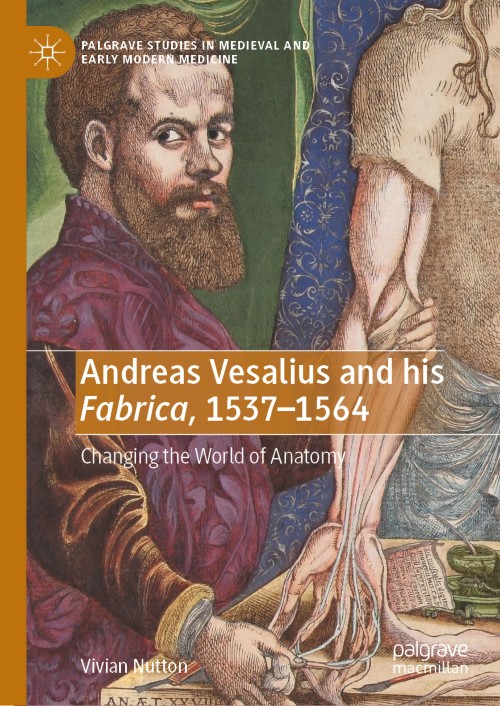
Andreas Vesalius and his Fabrica, 1537-1564 [electronic resource] : Changing the World of Anatomy / by Vivian Nutton.
Erişim Adresi
ISBN
9783031695650
Dil Kodu
İngilizce
Yer Numarası
DK/3103
Yazar
Basım Bildirimi
1st ed. 2024.
Yayın Bilgisi
Cham : Springer Nature Switzerland : Imprint: Palgrave Macmillan, 2024.
Fiziksel Niteleme
XVII, 281 p. 42 illus., 31 illus. in color. online resource.
Dizi
Palgrave Studies in Medieval and Early Modern Medicine, 2524-7395
İçindekiler Notu
Introduction -- 2. Before the Fabrica -- 3. The 1543 Fabrica -- 4. After the Fabrica -- 5. Conclusion.
Özet, vb.
This monograph presents a study of the most significant book in the history of anatomy, Fleming Andreas Vesalius’ (1514-1564) De humani corporis fabrica. Vesalius’ Fabrica was immediately recognised as changing the view of the human body when it was published in 1543, and it remains iconic today. Despite this, little has been written about Vesalius’ later revisions and corrections to the work, as well as his annotations leading up to the book. The author addresses this lacuna by examining the Fabrica from its inception in Paris in the 1530s, through its publication in 1543, to subsequent revisions and its present status as an expensive treasure. The book also contains new discoveries about the period of Vesalius’ earliest publications from 1537-8, the printing and production of the 1543 Fabrica, and the extensive remaking of the 1555 edition. Chapters also explore Vesalius’ background in new humanist medicine and anatomical teaching in Paris and Italy, the verbal message that the Fabrica was intended to convey, and the immediate responses to the book. Vivian Nutton is Emeritus Professor at University College London, in the UK, where he spent thirty years teaching the history of medicine. He has lectured extensively on classical and renaissance medicine around the world, and has written many books and articles on the topic. Vivian is the President of the Centre for the Study of Medicine and the Body in the Renaissance (CSMBR), in Italy. Additionally, he is Fellow of the British Academy, Member of the German Academy of Sciences, Foreign Associate of the Académie des Inscriptions et Belles Lettres, Fellow of the Academia Europaea, and honorary Fellow of the Royal College of Physicians, among other honours.
Konu
Europe __ History __ 1492-.
Science __ History.
Medicine __ History.
Books __ History.
European literature __ Renaissance, 1450-1600.
History of Early Modern Europe.
History of Science.
History of Medicine.
History of the Book.
Early Modern and Renaissance Literature.
Science __ History.
Medicine __ History.
Books __ History.
European literature __ Renaissance, 1450-1600.
History of Early Modern Europe.
History of Science.
History of Medicine.
History of the Book.
Early Modern and Renaissance Literature.
