

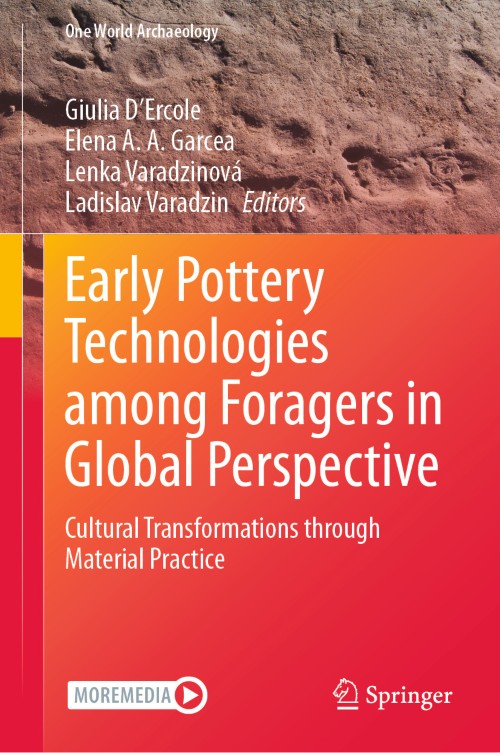
Early Pottery Technologies among Foragers in Global Perspective [electronic resource] : Cultural Transformations through Material Practice / edited by Giulia D’Ercole, Elena A. A. Garcea, Lenka Varadzinová, Ladislav Varadzin.
Erişim Adresi
ISBN
9783031717772
Dil Kodu
İngilizce
Yer Numarası
DK/3131
Basım Bildirimi
1st ed. 2024.
Yayın Bilgisi
Cham : Springer Nature Switzerland : Imprint: Springer, 2024.
Fiziksel Niteleme
XXIV, 295 p. 79 illus., 51 illus. in color. online resource.
Dizi
One World Archaeology, 2625-865X
İçindekiler Notu
Chapter 1. Introduction; D’Ercole G., Garcea E. A. A., Varadzinová L. and Varadzin L -- Chapter 2. Pre-Younger Dryas pottery manufacturing techniques and behaviours: Comparative cases from Tanegashima Island, southern Japan; Iizuka, F., Vandiver, P. -- Chapter 3. Maritime Expansion, Pottery Technology, and Crafting Identities: the emergence and use of pottery by coastal hunter-gatherer-fishers of Korea and Russian Far East; Jangsuk, K., Seong, C. -- Chapter 4. Taken at the Flood: Catastrophic landscape change and the emergence of ceramics in Eastern Siberia; Hommel, P. -- Chapter 5. Review Paper (TBA) Jordan, P. D. -- Chapter 6. Could the invention of pottery have western roots?; Yanshina, O. -- Chapter 7. On the emergence of pottery vessel technology: does residue analysis have the answers?; Heron, C., Craig, O. -- Chapter 8. Container cultures in hunter-gatherer societies of North Eurasia: Deciphering functions, roles and meanings; Piezonka, H. -- Chapter 9. Why pottery? – an Eastern Fennoscandian view on the beginning of ceramics production; Pesonen, P., Papakosta, V.. - Chapter 10. Ceramisation of hunter-gatherers in north-central Europe; Nowak, M. -- Chapter 11. The beginning of Pottery Production in Northeast India; Sharma, S. -- Chapter 12. Intensification and ritualization of the manipulation of staples along the steps to food production in Eastern Anatolia; Balossi Restelli, F. -- Chapter 13. Pots among foragers: Early Holocene Ceramic Production in the Tadrart Acacus; Di Lernia, S., Rotunno, R -- Chapter 14. Four thousand years of ceramics by foragers in the Jebel Sabaloka, Middle Nile Valley (Sudan); Garcea, E.A.A., D’Ercole, G., McCool, J-P, Varadzin, L., Varadzinová, L. -- Chapter 15. Boiling energy: socioecological and spiritual dimensions of pottery emergence among southern African foragers; Stewart, B. -- Chapter 16. Post-harvest intensification and Pottery Pre-Neolithics: parallel innovations of endo-cuisine in Asian and African hunter-gatherers; Fuller, D. Q. -- Chapter 17. Doing things from the beginning: new data on the independent invention of pottery in Amazonian shellmounds; Pugliese, F. -- Chapter 18. Cultural transformations through material practice: early pottery technologies among foragers in global perspective: is there a common denominator?; D’Ercole G., Garcea E. A. A., Varadzinová L. and Varadzin L.
Özet, vb.
This book presents up-to-date perspectives on pre-farming innovations through material practices, resource intensification, and emerging technologies, particularly pottery manufacture. It includes original studies on the earliest pottery productions among foragers from different parts of the world based on first-hand excavations and laboratory analyses. Its broad geographic scope includes Northern and Central Europe, Eastern Asia (different regions in China), Northern, Western, and Southern Africa, and southeastern North America, comprising parts of the world previously ignored (different regions in Africa) and extending beyond the Old World, i.e., North America. It also takes into account the differing chronologies of the emergence of pottery before food production, which are not limited to the late Pleistocene and early Holocene, but extend as late as the middle Holocene (e.g., in Southern Africa). This volume offers a fresh and still unexplored, global intercultural and interactive discussion on the emergence of pottery. By mapping the latest findings and variety of methodological approaches, it intends to capture both variability and common denominators of the cultural processes between the end of the Pleistocene and the early/mid-Holocene in which the production and use of pottery played a significant role among hunter-gatherers. This book is a fundamental contribution to the understanding of the role of material practices in cultural transformations in late prehistory worldwide and to the debate on how local narratives mirror different social identities, meanings, and/or functions depending on the specific economic context, settlement system, and cultural landscape. It emphasizes how transformative technologies can potentially create radical changes in the way human populations live and interact with each other. Ultimately, this volume contains valuable reflections and expectations for the future of worldwide pottery research among foragers.
Konu
Archaeology.
Anthropology.
Archaeology.
Anthropology.
Anthropology.
Archaeology.
Anthropology.
Eseri Alıntıla
Referansları kullanmadan önce gözden geçirmeniz ve varsa gerekli düzeltmeleri yapmanız önerilir.
Dijital Kaynak
MARC Görünümü
LEADER 06443nam a22005295i 4500
001 610459
003 TR_AnAIT
005 20250627062533
007 cr nn 008mamaa
008 241107s2024 sz | s |||| 0|eng d
020 |a9783031717772|9978-3-031-71777-2
024 7 |a10.1007/978-3-031-71777-2|2doi
041 |aeng
049 |aTürk Tarih Kurumu Kütüphanesi
050 4|aCC1-960
072 7|aHD|2bicssc
072 7|aSOC003000|2bisacsh
072 7|aNK|2thema
082 04|a930.1|223
090 |aDK/3131
245 10|aEarly Pottery Technologies among Foragers in Global Perspective|h[electronic resource] :|bCultural Transformations through Material Practice /|cedited by Giulia D’Ercole, Elena A. A. Garcea, Lenka Varadzinová, Ladislav Varadzin.
250 |a1st ed. 2024.
264 1|aCham :|bSpringer Nature Switzerland :|bImprint: Springer,|c2024.
300 |aXXIV, 295 p. 79 illus., 51 illus. in color.|bonline resource.
336 |atext|btxt|2rdacontent
337 |acomputer|bc|2rdamedia
338 |aonline resource|bcr|2rdacarrier
347 |atext file|bPDF|2rda
490 1 |aOne World Archaeology,|x2625-865X
505 0 |aChapter 1. Introduction; D’Ercole G., Garcea E. A. A., Varadzinová L. and Varadzin L -- Chapter 2. Pre-Younger Dryas pottery manufacturing techniques and behaviours: Comparative cases from Tanegashima Island, southern Japan; Iizuka, F., Vandiver, P. -- Chapter 3. Maritime Expansion, Pottery Technology, and Crafting Identities: the emergence and use of pottery by coastal hunter-gatherer-fishers of Korea and Russian Far East; Jangsuk, K., Seong, C. -- Chapter 4. Taken at the Flood: Catastrophic landscape change and the emergence of ceramics in Eastern Siberia; Hommel, P. -- Chapter 5. Review Paper (TBA) Jordan, P. D. -- Chapter 6. Could the invention of pottery have western roots?; Yanshina, O. -- Chapter 7. On the emergence of pottery vessel technology: does residue analysis have the answers?; Heron, C., Craig, O. -- Chapter 8. Container cultures in hunter-gatherer societies of North Eurasia: Deciphering functions, roles and meanings; Piezonka, H. -- Chapter 9. Why pottery? – an Eastern Fennoscandian view on the beginning of ceramics production; Pesonen, P., Papakosta, V.. - Chapter 10. Ceramisation of hunter-gatherers in north-central Europe; Nowak, M. -- Chapter 11. The beginning of Pottery Production in Northeast India; Sharma, S. -- Chapter 12. Intensification and ritualization of the manipulation of staples along the steps to food production in Eastern Anatolia; Balossi Restelli, F. -- Chapter 13. Pots among foragers: Early Holocene Ceramic Production in the Tadrart Acacus; Di Lernia, S., Rotunno, R -- Chapter 14. Four thousand years of ceramics by foragers in the Jebel Sabaloka, Middle Nile Valley (Sudan); Garcea, E.A.A., D’Ercole, G., McCool, J-P, Varadzin, L., Varadzinová, L. -- Chapter 15. Boiling energy: socioecological and spiritual dimensions of pottery emergence among southern African foragers; Stewart, B. -- Chapter 16. Post-harvest intensification and Pottery Pre-Neolithics: parallel innovations of endo-cuisine in Asian and African hunter-gatherers; Fuller, D. Q. -- Chapter 17. Doing things from the beginning: new data on the independent invention of pottery in Amazonian shellmounds; Pugliese, F. -- Chapter 18. Cultural transformations through material practice: early pottery technologies among foragers in global perspective: is there a common denominator?; D’Ercole G., Garcea E. A. A., Varadzinová L. and Varadzin L.
520 |aThis book presents up-to-date perspectives on pre-farming innovations through material practices, resource intensification, and emerging technologies, particularly pottery manufacture. It includes original studies on the earliest pottery productions among foragers from different parts of the world based on first-hand excavations and laboratory analyses. Its broad geographic scope includes Northern and Central Europe, Eastern Asia (different regions in China), Northern, Western, and Southern Africa, and southeastern North America, comprising parts of the world previously ignored (different regions in Africa) and extending beyond the Old World, i.e., North America. It also takes into account the differing chronologies of the emergence of pottery before food production, which are not limited to the late Pleistocene and early Holocene, but extend as late as the middle Holocene (e.g., in Southern Africa). This volume offers a fresh and still unexplored, global intercultural and interactive discussion on the emergence of pottery. By mapping the latest findings and variety of methodological approaches, it intends to capture both variability and common denominators of the cultural processes between the end of the Pleistocene and the early/mid-Holocene in which the production and use of pottery played a significant role among hunter-gatherers. This book is a fundamental contribution to the understanding of the role of material practices in cultural transformations in late prehistory worldwide and to the debate on how local narratives mirror different social identities, meanings, and/or functions depending on the specific economic context, settlement system, and cultural landscape. It emphasizes how transformative technologies can potentially create radical changes in the way human populations live and interact with each other. Ultimately, this volume contains valuable reflections and expectations for the future of worldwide pottery research among foragers.
650 0|aArchaeology.
650 0|aAnthropology.
650 14|aArchaeology.
650 24|aAnthropology.
700 1 |aD’Ercole, Giulia.|eeditor.|4edt|4http://id.loc.gov/vocabulary/relators/edt
700 1 |aGarcea, Elena A. A.|eeditor.|4edt|4http://id.loc.gov/vocabulary/relators/edt
700 1 |aVaradzinová, Lenka.|eeditor.|4edt|4http://id.loc.gov/vocabulary/relators/edt
700 1 |aVaradzin, Ladislav.|eeditor.|4edt|4http://id.loc.gov/vocabulary/relators/edt
773 0 |tSpringer Nature eBook
776 08|iPrinted edition:|z9783031717765
776 08|iPrinted edition:|z9783031717789
776 08|iPrinted edition:|z9783031717796
830 0|aOne World Archaeology,|x2625-865X
856 40|uhttps://doi.org/10.1007/978-3-031-71777-2
912 |aZDB-2-HTY
912 |aZDB-2-SXH
950 |aHistory (SpringerNature-41172)
950 |aHistory (R0) (SpringerNature-43722)
001 610459
003 TR_AnAIT
005 20250627062533
007 cr nn 008mamaa
008 241107s2024 sz | s |||| 0|eng d
020 |a9783031717772|9978-3-031-71777-2
024 7 |a10.1007/978-3-031-71777-2|2doi
041 |aeng
049 |aTürk Tarih Kurumu Kütüphanesi
050 4|aCC1-960
072 7|aHD|2bicssc
072 7|aSOC003000|2bisacsh
072 7|aNK|2thema
082 04|a930.1|223
090 |aDK/3131
245 10|aEarly Pottery Technologies among Foragers in Global Perspective|h[electronic resource] :|bCultural Transformations through Material Practice /|cedited by Giulia D’Ercole, Elena A. A. Garcea, Lenka Varadzinová, Ladislav Varadzin.
250 |a1st ed. 2024.
264 1|aCham :|bSpringer Nature Switzerland :|bImprint: Springer,|c2024.
300 |aXXIV, 295 p. 79 illus., 51 illus. in color.|bonline resource.
336 |atext|btxt|2rdacontent
337 |acomputer|bc|2rdamedia
338 |aonline resource|bcr|2rdacarrier
347 |atext file|bPDF|2rda
490 1 |aOne World Archaeology,|x2625-865X
505 0 |aChapter 1. Introduction; D’Ercole G., Garcea E. A. A., Varadzinová L. and Varadzin L -- Chapter 2. Pre-Younger Dryas pottery manufacturing techniques and behaviours: Comparative cases from Tanegashima Island, southern Japan; Iizuka, F., Vandiver, P. -- Chapter 3. Maritime Expansion, Pottery Technology, and Crafting Identities: the emergence and use of pottery by coastal hunter-gatherer-fishers of Korea and Russian Far East; Jangsuk, K., Seong, C. -- Chapter 4. Taken at the Flood: Catastrophic landscape change and the emergence of ceramics in Eastern Siberia; Hommel, P. -- Chapter 5. Review Paper (TBA) Jordan, P. D. -- Chapter 6. Could the invention of pottery have western roots?; Yanshina, O. -- Chapter 7. On the emergence of pottery vessel technology: does residue analysis have the answers?; Heron, C., Craig, O. -- Chapter 8. Container cultures in hunter-gatherer societies of North Eurasia: Deciphering functions, roles and meanings; Piezonka, H. -- Chapter 9. Why pottery? – an Eastern Fennoscandian view on the beginning of ceramics production; Pesonen, P., Papakosta, V.. - Chapter 10. Ceramisation of hunter-gatherers in north-central Europe; Nowak, M. -- Chapter 11. The beginning of Pottery Production in Northeast India; Sharma, S. -- Chapter 12. Intensification and ritualization of the manipulation of staples along the steps to food production in Eastern Anatolia; Balossi Restelli, F. -- Chapter 13. Pots among foragers: Early Holocene Ceramic Production in the Tadrart Acacus; Di Lernia, S., Rotunno, R -- Chapter 14. Four thousand years of ceramics by foragers in the Jebel Sabaloka, Middle Nile Valley (Sudan); Garcea, E.A.A., D’Ercole, G., McCool, J-P, Varadzin, L., Varadzinová, L. -- Chapter 15. Boiling energy: socioecological and spiritual dimensions of pottery emergence among southern African foragers; Stewart, B. -- Chapter 16. Post-harvest intensification and Pottery Pre-Neolithics: parallel innovations of endo-cuisine in Asian and African hunter-gatherers; Fuller, D. Q. -- Chapter 17. Doing things from the beginning: new data on the independent invention of pottery in Amazonian shellmounds; Pugliese, F. -- Chapter 18. Cultural transformations through material practice: early pottery technologies among foragers in global perspective: is there a common denominator?; D’Ercole G., Garcea E. A. A., Varadzinová L. and Varadzin L.
520 |aThis book presents up-to-date perspectives on pre-farming innovations through material practices, resource intensification, and emerging technologies, particularly pottery manufacture. It includes original studies on the earliest pottery productions among foragers from different parts of the world based on first-hand excavations and laboratory analyses. Its broad geographic scope includes Northern and Central Europe, Eastern Asia (different regions in China), Northern, Western, and Southern Africa, and southeastern North America, comprising parts of the world previously ignored (different regions in Africa) and extending beyond the Old World, i.e., North America. It also takes into account the differing chronologies of the emergence of pottery before food production, which are not limited to the late Pleistocene and early Holocene, but extend as late as the middle Holocene (e.g., in Southern Africa). This volume offers a fresh and still unexplored, global intercultural and interactive discussion on the emergence of pottery. By mapping the latest findings and variety of methodological approaches, it intends to capture both variability and common denominators of the cultural processes between the end of the Pleistocene and the early/mid-Holocene in which the production and use of pottery played a significant role among hunter-gatherers. This book is a fundamental contribution to the understanding of the role of material practices in cultural transformations in late prehistory worldwide and to the debate on how local narratives mirror different social identities, meanings, and/or functions depending on the specific economic context, settlement system, and cultural landscape. It emphasizes how transformative technologies can potentially create radical changes in the way human populations live and interact with each other. Ultimately, this volume contains valuable reflections and expectations for the future of worldwide pottery research among foragers.
650 0|aArchaeology.
650 0|aAnthropology.
650 14|aArchaeology.
650 24|aAnthropology.
700 1 |aD’Ercole, Giulia.|eeditor.|4edt|4http://id.loc.gov/vocabulary/relators/edt
700 1 |aGarcea, Elena A. A.|eeditor.|4edt|4http://id.loc.gov/vocabulary/relators/edt
700 1 |aVaradzinová, Lenka.|eeditor.|4edt|4http://id.loc.gov/vocabulary/relators/edt
700 1 |aVaradzin, Ladislav.|eeditor.|4edt|4http://id.loc.gov/vocabulary/relators/edt
773 0 |tSpringer Nature eBook
776 08|iPrinted edition:|z9783031717765
776 08|iPrinted edition:|z9783031717789
776 08|iPrinted edition:|z9783031717796
830 0|aOne World Archaeology,|x2625-865X
856 40|uhttps://doi.org/10.1007/978-3-031-71777-2
912 |aZDB-2-HTY
912 |aZDB-2-SXH
950 |aHistory (SpringerNature-41172)
950 |aHistory (R0) (SpringerNature-43722)
Materyaller
Depodan talep edilen materyal sadece kütüphane içerisinde kullanılmaktadır.
Materyal dışarıya ödünç verilmemektedir.
Materyal dışarıya ödünç verilmemektedir.
