LEADER 03606nam a22005295i 4500
001 611335
003 TR_AnAIT
005 20250627055818
007 cr nn 008mamaa
008 151228s2012 xxu| s |||| 0|eng d
020 |a9781137002624|9978-1-137-00262-4
024 7 |a10.1057/9781137002624|2doi
041 |aeng
049 |aTürk Tarih Kurumu Kütüphanesi
050 4|aDT1-3415
072 7|aHBJH|2bicssc
072 7|aHIS001000|2bisacsh
072 7|aNHH|2thema
082 04|a960|223
090 |aDK/4006
100 1 |aLynch, Hollis R.|eauthor.|4aut|4http://id.loc.gov/vocabulary/relators/aut
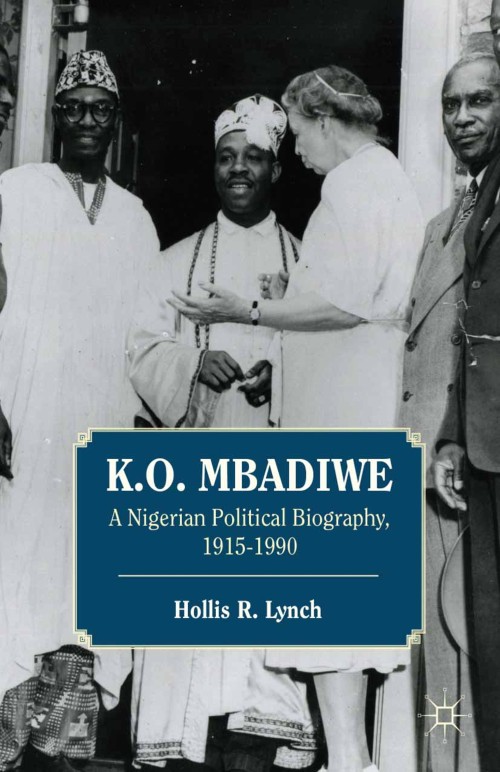
245 10|aK. O. Mbadiwe|h[electronic resource] :|bA Nigerian Political Biography, 1915–1990 /|cby Hollis R. Lynch.
250 |a1st ed. 2012.
264 1|aNew York :|bPalgrave Macmillan US :|bImprint: Palgrave Macmillan,|c2012.
300 |aVII, 294 p. 3 illus.|bonline resource.
336 |atext|btxt|2rdacontent
337 |acomputer|bc|2rdamedia
338 |aonline resource|bcr|2rdacarrier
347 |atext file|bPDF|2rda
520 |aThis book offers a comprehensive political biography of Kingsley Ozuomba Mbadiwe, (1915-1990), a central figure in Nigerian political history for more than forty years. Starting in 1936 as a protégé of Nnamdi Azikiwe, then Nigeria's most renowned nationalist, Mbadiwe himself by the 1950s became a frontline nationalist. And next to Tafawa Balewa from the North who became Prime Minster in 1957, he was the most important figure in the Nigerian Federal Government between 1952 and Nigeria's first military coup in 1966. During this time he held a succession of important Cabinet positions and was Parliamentary Leader of the National Council of Nigeria and the Cameroons (NCNC), which was in a ruling alliance with the Northern People's Congress (NPC). In contrast, his older prominent political contemporaries, Azikiwe of the Eastern Region, Igbo Leader of the NCNC; Obafemi Awolowo of the Western Region, Yoruba Leader of the Action Group (AG); and Ahmadu Bello of the Northern Region, Fulani Leader of the NPC, all carved out their political careers totally or largely at the regional level. Throughout his political career Mbadiwe's focus was always at the national level. Truly, it has been stated that Mbadiwe was one of the founding fathers of the Nigerian State. Nonetheless, Mbadiwe's ambition for himself to lead Nigeria and for his nation to set it on the path to greatness faced insuperable difficulties. In a country of widespread poverty, high illiteracy, and a grossly underdevelopedprivate sector, there were fierce ethnic and regional conflicts for the control of governments and resources, leading to massive corruption and serious instability. This in turn led to prolonged military rule twenty years in Mbadiwe's lifetime which was often more corrupt and repressive than civilian rule, and was bitterly deprecated by Mbadiwe.
650 0|aAfrica|xHistory.
650 0|aHistory, Modern.
650 0|aWorld politics.
650 0|aLiterature.
650 0|aPolitical science.
650 14|aAfrican History.
650 24|aModern History.
650 24|aPolitical History.
650 24|aLiterature.
650 24|aPolitical Science.
773 0 |tSpringer Nature eBook
776 08|iPrinted edition:|z9781137002617
776 08|iPrinted edition:|z9781349433865
776 08|iPrinted edition:|z9781349433872
856 40|uhttps://doi.org/10.1057/9781137002624
912 |aZDB-2-PHC
912 |aZDB-2-SXH
950 |aPalgrave History Collection (SpringerNature-41138)
950 |aHistory (R0) (SpringerNature-43722)