

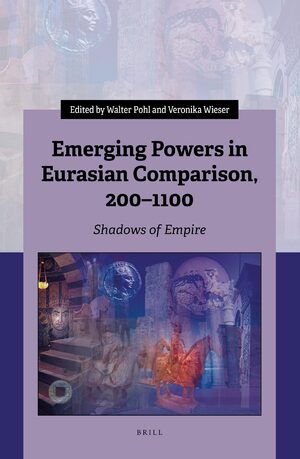
Emerging Powers in Eurasian Comparison, 200–1100 : Shadows of Empire / edited by Walter Pohl and Veronika Wieser.
Erişim Adresi
ISBN
9789004519916 (electronic book)
9789004518568 (print)
9789004518568 (print)
Yer Numarası
DK/5861
Eser Adının Farklı Biçimi
Shadows of Empire
Yayın Bilgisi
Leiden ; Boston : Brill, 2022.
Fiziksel Niteleme
1 online resource
Bibliyografi, vb. Notu
Includes bibliographical references and index.
Özet, vb.
This book looks at the fall and persistence of empires from the perspective of the powers that replaced them, and compares several cases between China and the West in the first millennium CE with surprisingly similar beginnings and different outcomes.
This book compares the ways in which new powers arose in the shadows of the Roman Empire and its Byzantine and Carolingian successors, of Iran, the Caliphate and China in the first millennium CE. These new powers were often established by external military elites who had served the empire. They remained in an uneasy balance with the remaining empire, could eventually replace it, or be drawn into the imperial sphere again. Some relied on dynastic legitimacy, others on ethnic identification, while most of them sought imperial legitimation. Across Eurasia, their dynamic was similar in many respects; why were the outcomes so different? Contributors are Alexander Beihammer, Maaike van Berkel, Francesco Borri, Andrew Chittick, Michael R. Drompp, Stefan Esders, Ildar Garipzanov, Jürgen Paul, Walter Pohl, Johannes Preiser-Kapeller, Helmut Reimitz, Jonathan Shepard, Q. Edward Wang, Veronika Wieser, and Ian N. Wood.
This book compares the ways in which new powers arose in the shadows of the Roman Empire and its Byzantine and Carolingian successors, of Iran, the Caliphate and China in the first millennium CE. These new powers were often established by external military elites who had served the empire. They remained in an uneasy balance with the remaining empire, could eventually replace it, or be drawn into the imperial sphere again. Some relied on dynastic legitimacy, others on ethnic identification, while most of them sought imperial legitimation. Across Eurasia, their dynamic was similar in many respects; why were the outcomes so different? Contributors are Alexander Beihammer, Maaike van Berkel, Francesco Borri, Andrew Chittick, Michael R. Drompp, Stefan Esders, Ildar Garipzanov, Jürgen Paul, Walter Pohl, Johannes Preiser-Kapeller, Helmut Reimitz, Jonathan Shepard, Q. Edward Wang, Veronika Wieser, and Ian N. Wood.
Konu
Ancient History.
Asian Studies.
Classical Studies.
History & Culture.
History.
Medieval History.
Middle East and Islamic Studies.
Slavic and Eurasian Studies.
Asian Studies.
Classical Studies.
History & Culture.
History.
Medieval History.
Middle East and Islamic Studies.
Slavic and Eurasian Studies.
Diğer Yazarlar
