LEADER 02977naaaa2200409aa54500
001 787645
003 TR_AnAIT
005 20251016085728
006 aocade |||| 001 0d
007 ta
008 251003s2025 tu ocade |||| 001 0deng c
020 |a9786256230491
040 |aTTK
041 |aeng
049 |aTürk Tarih Kurumu Kütüphanesi
090 |aA.X/1344
100 1 |aBalta, Evangelia,|d1955-
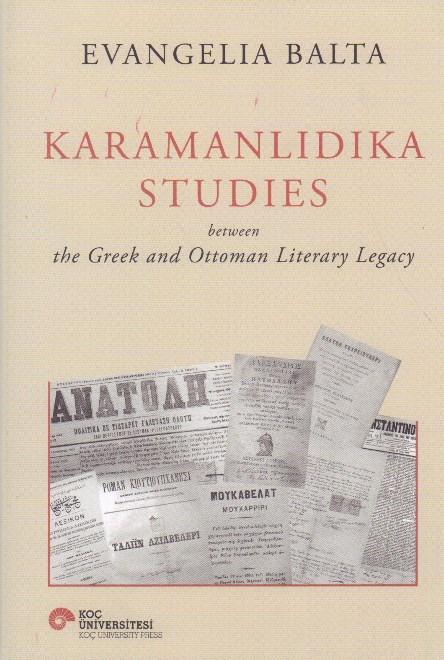
245 10|aKaramanlidika studies :|bbetween the Greek and Ottoman literary legacy /|cEvangelia Balta ; coordinating editor Ezgi Dikici ; editor Tuğba Yıldırım.
246 1 |aBetween the Greek and Ottoman literary legacy
250 |a1ˢᵗ edition.
260 |aİstanbul :|bKoç University Press,|c2025.
300 |a544 sayfa :|bresim, portre, çizim, tıpkıbasım, tablo ;|c24 cm.
490 1 |aKoç University Press ;|v343.|aTurkish and Ottoman studies: history, society, and culture ;|v4
500 |aİndeks s. 511-544.
504 |aBibliyografya s. 453-510.
520 |a“This collection gathers the recent studies of Evangelia Balta, who has contributed since 1978 to the growing interest in Karamanlidika Studies through her research and publications. This interdisciplinary field, a branch of Ottoman Studies, covers history, literature, anthropology, and linguistics, exploring topics related to the history and culture of the Karamanlis or Karamanlidhes, the Turkish-speaking Orthodox Anatolians, who settled in Greece after the Treaty of Lausanne (1923). As one of the many non-Muslim groups that made up multi-cultural Ottoman society, Karamanlidhes, from the beginning of the eighteenth century, defined themselves and left their ethnoreligious cultural traces on the Ottoman legacy through their publications in Turkish using the Greek alphabet. Their book production was a vehicle for circulating cultural goods produced in the Empire, Europe, and the Greek Kingdom. It also served as a bridge between the Ottoman world and Greek education after the emergence of nationalism. The volume Karamanlidika Studies between the Greek and Ottoman Literary Legacy explores the perception of various cultures by the Orthodox Rums and opens up new areas of discussion on refugee poetry, as well as the life and work of the authors, editors, and translators of Karamanlidika books. Furthermore, it spurs the search for unknown manuscripts containing memoirs, autobiographies, and Ottoman archival material.” --|cArka kapak.
650 4|aTürk edebiyatı|y19. yy.|xTarih ve kritik.
650 4|aDil ve kültür|zYunanistan|xTarih.
650 4|aDil ve kültür|zTürkiye|xTarih.
650 4|aKaramanlı baskıları|xTarih.
650 4|aTürk baskıları|xTarih.
700 1 |aDikici, Ezgi,|eeditör.
700 1 |aYıldırım, Tuğba,|eeditör.
830 0|aKoç University Press ;|v343.
830 0|aKoç University Press.|pTurkish and Ottoman studies: history, society, and culture ;|v4.