

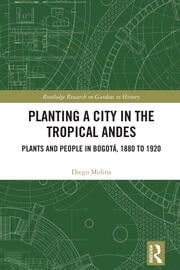
Planting a city in the tropical Andes : plants and people in Bogotá, 1880 to 1920 / Diego Molina.
ISBN
9781003208167 electronic book
1003208169 electronic book
9781040148648 electronic publication
1040148646 electronic publication
9781040148587 electronic book
1040148581 electronic book
9781032076560 hardcover
9781032076584 paperback
1003208169 electronic book
9781040148648 electronic publication
1040148646 electronic publication
9781040148587 electronic book
1040148581 electronic book
9781032076560 hardcover
9781032076584 paperback
Dil Kodu
İngilizce
Yayın Bilgisi
New York : Routledge, Taylor & Francis Group, 2025.
©2025
©2025
Fiziksel Niteleme
1 online resource (xiii, 206 pages) : illustrations, maps.
Dizi
Routledge research on gardens in history
İçindekiler Notu
Introduction. The city of plants -- The genesis of Bogotá's mixed flora -- Urban spaces, cultivated plants and people -- The 'invisible' flora -- From colonial squares to hygienic gardens -- The gardeners -- The plants -- New and disciplined relationships with plants -- A treeless and desolate land -- The Alamedas and the Liberty Tree -- Eucalyptus : the all-purpose tree -- Conclusion. A disciplined floristical island in the tropical Andes.
Özet, vb.
"This book reveals how the 19th Century modernisation of Bogotá led to a transformation in the social role of plants - showing how this city located in the high altitudes of the tropical Andes turned into a 'floristic island' formed by native, introduce, wild and cultivated plants. Urbanisation is one of the main forces behind biodiversity loss. Paradoxically, the expansion of cities has made urban environment spaces with a greater numbers of plant species compared to their surrounding areas. Planting a City in the Tropical Andes takes a multidisciplinary approach to shed light on the cultural and ecological mechanisms that have transformed modern cities into what can be described as 'floristic islands'. By drawing upon a wide array of historical sources, this book explains how the 19th-century modernization of Bogotá (Colombia), led to the replacement of traditional botanical practices with technical knowledge, which in turn endowed the city with a unique floristic inventory. Through a unique botanical perspective on Latin American urban history, this book uncovers how capitalist dynamics in Bogotá transformed plants into providers of clean air and water and their use in the urban landscape contributed to the cultivation of disciplined citizenry. Placing plants at the forefront of its narrative, the book offers an original contribution to the underexplored history of horticulture in tropical Latin America. It serves as a compelling example of how the creative and conflicting forces of the Anthropocene have forged new environments and previously unseen relationships between people and plants. This volume will be of great use to scholars and students interested in social history, urban environmental histories and cultural history"-- Provided by publisher.
Konu
Plants __ Colombia __ Bogotá __ History __ 19th century.
Human-plant relationships __ Colombia __ Bogotá __ History __ 19th century.
Urban ecology (Biology) __ Colombia __ Bogotá __ History __ 19th century.
HISTORY / Latin America / South America __ bisacsh
HISTORY / Social History __ bisacsh
HISTORY / Modern / General __ bisacsh
Human-plant relationships __ Colombia __ Bogotá __ History __ 19th century.
Urban ecology (Biology) __ Colombia __ Bogotá __ History __ 19th century.
HISTORY / Latin America / South America __ bisacsh
HISTORY / Social History __ bisacsh
HISTORY / Modern / General __ bisacsh
Veritabanı
Eseri Alıntıla
Referansları kullanmadan önce gözden geçirmeniz ve varsa gerekli düzeltmeleri yapmanız önerilir.
Dijital Kaynak
MARC Görünümü
LEADER 04474cam a2200553 i 4500
001 792112
003 TR_AnAIT
005 20260122235558
006 m o d
007 cr cnu---unuuu
008 240818t20252025nyuab ob 001 0 eng
020 |a9781003208167|qelectronic book
020 |a1003208169|qelectronic book
020 |a9781040148648|qelectronic publication
020 |a1040148646|qelectronic publication
020 |a9781040148587|qelectronic book
020 |a1040148581|qelectronic book
020 |z9781032076560|qhardcover
020 |z9781032076584|qpaperback
024 7 |a10.4324/9781003208167|2doi
035 |a(OCoLC)1453288531
035 |a(OCoLC-P)1453288531
040 |aOCoLC-P|beng|erda|cOCoLC-P
041 |aeng
049 |aTürk Tarih Kurumu Kütüphanesi
050 04|aQK265|b.M65 2025
072 7|aHIS|x033000|2bisacsh
072 7|aHIS|x054000|2bisacsh
072 7|aHIS|x037030|2bisacsh
072 7|aHB|2bicssc
082 00|a581.9861/48|223/eng/20240826
100 1 |aMolina Franco, Diego Alejandro,|eauthor.|1https://id.oclc.org/worldcat/entity/E39PCjFvwhMrcxdbBRrppGTmBP
245 10|aPlanting a city in the tropical Andes :|bplants and people in Bogotá, 1880 to 1920 /|cDiego Molina.
264 1|aNew York :|bRoutledge, Taylor & Francis Group,|c2025.
264 4|c©2025
300 |a1 online resource (xiii, 206 pages) :|billustrations, maps.
336 |atext|btxt|2rdacontent
337 |acomputer|bc|2rdamedia
338 |aonline resource|bcr|2rdacarrier
490 0 |aRoutledge research on gardens in history
505 0 |aIntroduction. The city of plants -- The genesis of Bogotá's mixed flora -- Urban spaces, cultivated plants and people -- The 'invisible' flora -- From colonial squares to hygienic gardens -- The gardeners -- The plants -- New and disciplined relationships with plants -- A treeless and desolate land -- The Alamedas and the Liberty Tree -- Eucalyptus : the all-purpose tree -- Conclusion. A disciplined floristical island in the tropical Andes.
520 |a"This book reveals how the 19th Century modernisation of Bogotá led to a transformation in the social role of plants - showing how this city located in the high altitudes of the tropical Andes turned into a 'floristic island' formed by native, introduce, wild and cultivated plants. Urbanisation is one of the main forces behind biodiversity loss. Paradoxically, the expansion of cities has made urban environment spaces with a greater numbers of plant species compared to their surrounding areas. Planting a City in the Tropical Andes takes a multidisciplinary approach to shed light on the cultural and ecological mechanisms that have transformed modern cities into what can be described as 'floristic islands'. By drawing upon a wide array of historical sources, this book explains how the 19th-century modernization of Bogotá (Colombia), led to the replacement of traditional botanical practices with technical knowledge, which in turn endowed the city with a unique floristic inventory. Through a unique botanical perspective on Latin American urban history, this book uncovers how capitalist dynamics in Bogotá transformed plants into providers of clean air and water and their use in the urban landscape contributed to the cultivation of disciplined citizenry. Placing plants at the forefront of its narrative, the book offers an original contribution to the underexplored history of horticulture in tropical Latin America. It serves as a compelling example of how the creative and conflicting forces of the Anthropocene have forged new environments and previously unseen relationships between people and plants. This volume will be of great use to scholars and students interested in social history, urban environmental histories and cultural history"--|cProvided by publisher.
588 |aOCLC-licensed vendor bibliographic record.
650 0|aPlants|zColombia|zBogotá|xHistory|y19th century.
650 0|aHuman-plant relationships|zColombia|zBogotá|xHistory|y19th century.
650 0|aUrban ecology (Biology)|zColombia|zBogotá|xHistory|y19th century.
650 7|aHISTORY / Latin America / South America|2bisacsh
650 7|aHISTORY / Social History|2bisacsh
650 7|aHISTORY / Modern / General|2bisacsh
856 40|3Taylor & Francis|uhttps://www.taylorfrancis.com/books/9781003208167
856 42|3OCLC metadata license agreement|uhttp://www.oclc.org/content/dam/oclc/forms/terms/vbrl-201703.pdf
901 |aTaylor & Francis
001 792112
003 TR_AnAIT
005 20260122235558
006 m o d
007 cr cnu---unuuu
008 240818t20252025nyuab ob 001 0 eng
020 |a9781003208167|qelectronic book
020 |a1003208169|qelectronic book
020 |a9781040148648|qelectronic publication
020 |a1040148646|qelectronic publication
020 |a9781040148587|qelectronic book
020 |a1040148581|qelectronic book
020 |z9781032076560|qhardcover
020 |z9781032076584|qpaperback
024 7 |a10.4324/9781003208167|2doi
035 |a(OCoLC)1453288531
035 |a(OCoLC-P)1453288531
040 |aOCoLC-P|beng|erda|cOCoLC-P
041 |aeng
049 |aTürk Tarih Kurumu Kütüphanesi
050 04|aQK265|b.M65 2025
072 7|aHIS|x033000|2bisacsh
072 7|aHIS|x054000|2bisacsh
072 7|aHIS|x037030|2bisacsh
072 7|aHB|2bicssc
082 00|a581.9861/48|223/eng/20240826
100 1 |aMolina Franco, Diego Alejandro,|eauthor.|1https://id.oclc.org/worldcat/entity/E39PCjFvwhMrcxdbBRrppGTmBP
245 10|aPlanting a city in the tropical Andes :|bplants and people in Bogotá, 1880 to 1920 /|cDiego Molina.
264 1|aNew York :|bRoutledge, Taylor & Francis Group,|c2025.
264 4|c©2025
300 |a1 online resource (xiii, 206 pages) :|billustrations, maps.
336 |atext|btxt|2rdacontent
337 |acomputer|bc|2rdamedia
338 |aonline resource|bcr|2rdacarrier
490 0 |aRoutledge research on gardens in history
505 0 |aIntroduction. The city of plants -- The genesis of Bogotá's mixed flora -- Urban spaces, cultivated plants and people -- The 'invisible' flora -- From colonial squares to hygienic gardens -- The gardeners -- The plants -- New and disciplined relationships with plants -- A treeless and desolate land -- The Alamedas and the Liberty Tree -- Eucalyptus : the all-purpose tree -- Conclusion. A disciplined floristical island in the tropical Andes.
520 |a"This book reveals how the 19th Century modernisation of Bogotá led to a transformation in the social role of plants - showing how this city located in the high altitudes of the tropical Andes turned into a 'floristic island' formed by native, introduce, wild and cultivated plants. Urbanisation is one of the main forces behind biodiversity loss. Paradoxically, the expansion of cities has made urban environment spaces with a greater numbers of plant species compared to their surrounding areas. Planting a City in the Tropical Andes takes a multidisciplinary approach to shed light on the cultural and ecological mechanisms that have transformed modern cities into what can be described as 'floristic islands'. By drawing upon a wide array of historical sources, this book explains how the 19th-century modernization of Bogotá (Colombia), led to the replacement of traditional botanical practices with technical knowledge, which in turn endowed the city with a unique floristic inventory. Through a unique botanical perspective on Latin American urban history, this book uncovers how capitalist dynamics in Bogotá transformed plants into providers of clean air and water and their use in the urban landscape contributed to the cultivation of disciplined citizenry. Placing plants at the forefront of its narrative, the book offers an original contribution to the underexplored history of horticulture in tropical Latin America. It serves as a compelling example of how the creative and conflicting forces of the Anthropocene have forged new environments and previously unseen relationships between people and plants. This volume will be of great use to scholars and students interested in social history, urban environmental histories and cultural history"--|cProvided by publisher.
588 |aOCLC-licensed vendor bibliographic record.
650 0|aPlants|zColombia|zBogotá|xHistory|y19th century.
650 0|aHuman-plant relationships|zColombia|zBogotá|xHistory|y19th century.
650 0|aUrban ecology (Biology)|zColombia|zBogotá|xHistory|y19th century.
650 7|aHISTORY / Latin America / South America|2bisacsh
650 7|aHISTORY / Social History|2bisacsh
650 7|aHISTORY / Modern / General|2bisacsh
856 40|3Taylor & Francis|uhttps://www.taylorfrancis.com/books/9781003208167
856 42|3OCLC metadata license agreement|uhttp://www.oclc.org/content/dam/oclc/forms/terms/vbrl-201703.pdf
901 |aTaylor & Francis
Materyaller
Depodan talep edilen materyal sadece kütüphane içerisinde kullanılmaktadır.
Materyal dışarıya ödünç verilmemektedir.
Materyal dışarıya ödünç verilmemektedir.
