LEADER 03279cam a2200481M 4500
001 792162
003 TR_AnAIT
005 20260122235645
006 m o d
007 cr |n|||||||||
008 220531s2022 xx o 0|| 0 eng d
020 |a9781000608175|q(electronic bk.)
020 |a1000608174|q(electronic bk.)
020 |a9781003272939|q(electronic bk.)
020 |a1003272932|q(electronic bk.)
020 |a9781000608182|q(electronic bk. : EPUB)
020 |a1000608182|q(electronic bk. : EPUB)
020 |z1032181982
020 |z9781032181981
024 7 |a10.4324/9781003272939|2doi
035 |a(OCoLC)1322050707
035 |a(OCoLC-P)1322050707
040 |aOCoLC-P|beng|cOCoLC-P
041 |aeng
049 |aTürk Tarih Kurumu Kütüphanesi
050 4|aDS450.C6
072 7|aHIS|x017000|2bisacsh
072 7|aPOL|x062000|2bisacsh
072 7|aPOL|x011010|2bisacsh
072 7|aHBJF|2bicssc
082 04|a327.540515|223
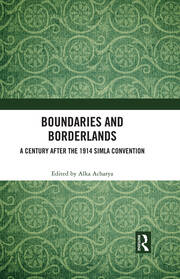
245 00|aBoundaries and borderlands|h[electronic resource] :|ba century after the 1914 Simla Convention /|cedited by Alka Acharya.
260 |a[S.l.] :|bROUTLEDGE,|c2022.
300 |a1 online resource
520 |aThe Simla Convention of 1914, held between Great Britain, China, and Tibet, demarcated the border between India and Tibet and gave birth to the McMahon Line. This volume critically examines the legacy of the 1914 Convention and explores its relevance in scholarly discourse about the status of Tibet and Sino-Indian relations more than a hundred years later. The book discusses the significance of the Simla Convention, both in terms of the geopolitics of boundaries as well as the people and the liminal borderlands they occupy, encapsulating the culture and diversity of the trans-Himalayan regions.The bookexplicates how colonial legacies, namely, the 1914 Simla Convention, have become virtual straitjackets, hardening the positions on the boundaries between India and China. It also looks at the debilitating consequences of the nation-state framework on more substantial investigations of the borderlands. Rich in archival material and drawing from the authors' fieldwork in the Himalayan regions, this book analyses muted voices of the inhabitants of the region to bring into focus the larger question of the political, economic, religious, ecological, and social life of the Himalayan peoples, which has enormous implications for both India and China. This volume will be of interest to students of history, international relations, sociology, strategic studies, Asian studies, and anthropology.
588 |aOCLC-licensed vendor bibliographic record.
611 20|aSimla Convention|d(1914)|xHistory.
650 7|aHISTORY / Asia / India & South Asia|2bisacsh
650 7|aPOLITICAL SCIENCE / International Relations / Diplomacy|2bisacsh
651 0|aIndia|xForeign relations|zChina|zTibet Autonomous Region.
651 0|aTibet Autonomous Region (China)|xForeign relations|zChina.
651 0|aIndia|xBoundaries|zChina|zTibet Autonomous Region.
651 0|aTibet Autonomous Region (China)|xBoundaries|zIndia.
856 40|3Taylor & Francis|uhttps://www.taylorfrancis.com/books/9781003272939
856 42|3OCLC metadata license agreement|uhttp://www.oclc.org/content/dam/oclc/forms/terms/vbrl-201703.pdf
901 |aTaylor & Francis