LEADER 04175cam a2200577M 4500
001 792305
003 TR_AnAIT
005 20260122235900
006 m o d
007 cr |n|||||||||
008 250925s2026 xx o 0|| 0 eng d
020 |a9781040453407|q(electronic bk.)
020 |a1040453406|q(electronic bk.)
020 |a9781003593539|q(electronic bk.)
020 |a1003593534|q(electronic bk.)
020 |a9781040453322|q(electronic bk. : PDF)
020 |a1040453325|q(electronic bk. : PDF)
020 |z103297401X
020 |z9781032974019
024 7 |a10.4324/9781003593539|2doi
024 8 |aCIPO000289030
035 |a(OCoLC)1539294164
035 |a(OCoLC-P)1539294164
040 |aOCoLC-P|beng|cOCoLC-P
041 |aeng
049 |aTürk Tarih Kurumu Kütüphanesi
050 4|aDA47.9.P17
072 7|aHBJF|2bicssc
072 7|aHIS017000|2bisacsh
072 7|aGTB|2bicssc
072 7|aHBJD1|2bicssc
072 7|aHBJK|2bicssc
072 7|aHBLW3|2bicssc
072 7|aHBTQ|2bicssc
072 7|aJPS|2bicssc
072 7|aSOC008020|2bisacsh
082 04|a327.5491073|223/eng/20251022
100 1 |aTalbot, Ian.|1https://id.oclc.org/worldcat/entity/E39PCjwQjd3WmhGhBRv4D4FXFq
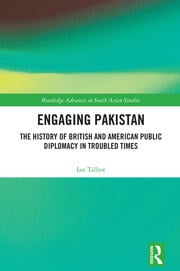
245 10|aENGAGING PAKISTAN|h[electronic resource] :|bthe history of british and american public diplomacy in troubled times.
260 |a[S.l.] :|bROUTLEDGE,|c2026.
300 |a1 online resource
336 |atext|btxt|2rdacontent
337 |acomputer|bc|2rdamedia
338 |aonline resource|bcr|2rdacarrier
490 0 |aRoutledge advances in South Asian studies
520 |aEngaging Pakistan examines the role of British and American public diplomacy in Pakistan. It focuses on case studies located in two periods (1955-1964 and 2008-2012) during which there was both intense public diplomacy activity and increasing public hostility, particularly towards the United States. Putting forth this juxtaposition of the two periods, the study provides an opportunity for a fine-grain analysis to contribute to wider theoretical and comparative studies of public diplomacy as well as provide valuable empirical material.The author argues that limitations in the effectiveness of public diplomacy arise whenever foreign audiences perceive that a state's foreign policy actions are illegitimate and inconsistent with its publicly proclaimed values. US unreliability in the 1960s and unilateralism four decades later undermined its soft power, despite the successes of individual public diplomacy initiatives. Anti-Americanism in Pakistan is usually linked with the aftermath of 9/11, but this volume will reveal that public mistrust stretched as far back as the 1960s. The Pakistani public trusted Britain far more, so that even when unpopular policies were adopted, there was not such a steep decline in its standing. Despite less funding, UK public diplomacy initiatives operated in a more favourable environment than that of the United States. The book focuses on five main areas of public diplomacy activities that generate soft power, namely, communication/information activities, educational exchanges and assistance, volunteering, cultural performances and exhibitions and high-profile visitors' public engagement. These activities are examined in case studies from either a single time frame or covering both periods.A pioneering study of British and American public diplomacy in Pakistan in the early Cold War and later post-9/11 eras, this book will be of interest to researchers on Modern South Asia, international relations, public diplomacy and diplomatic history, as well as those interested in wider subjects ranging from Cold War studies to sports history.
588 |aOCLC-licensed vendor bibliographic record.
651 0|aGreat Britain|xForeign relations|zPakistan.
651 0|aPakistan|xForeign relations|zUnited States.
651 0|aPakistan|xForeign relations|zGreat Britain.
651 0|aUnited States|xForeign relations|zPakistan.
856 40|3Taylor & Francis|uhttps://www.taylorfrancis.com/books/9781003593539
856 42|3OCLC metadata license agreement|uhttp://www.oclc.org/content/dam/oclc/forms/terms/vbrl-201703.pdf
901 |aTaylor & Francis