LEADER 04197cam a22006618i 4500
001 792310
003 TR_AnAIT
005 20260122235904
006 m o d
007 cr |||||||||||
008 250319s2025 enk ob 001 0 eng
020 |a9781003594864|qebook
020 |a1003594867
020 |a9781040338254|q(electronic bk. : PDF)
020 |a1040338259|q(electronic bk. : PDF)
020 |a9781040338315|q(electronic bk. : EPUB)
020 |a1040338313|q(electronic bk. : EPUB)
020 |z9781032976877|qhardback
020 |z9781032976884|qpaperback
024 7 |a10.4324/9781003594864|2doi
035 |a(OCoLC)1510778798
035 |a(OCoLC-P)1510778798
040 |aOCoLC-P|beng|erda|cOCoLC-P
041 |aeng
049 |aTürk Tarih Kurumu Kütüphanesi
050 00|aJQ1805.A55
072 7|aJP|2bicssc
072 7|aPOL040000|2bisacsh
072 7|aHBJF1|2bicssc
072 7|aHBLW3|2bicssc
072 7|aGTB|2bicssc
072 7|aPOL059000|2bisacsh
072 7|aPOL058000|2bisacsh
072 7|aHIS055000|2bisacsh
072 7|aHIS037070|2bisacsh
072 7|aHIS037080|2bisacsh
082 00|a320.9561|223/eng/20250320
100 1 |aYıldırım, Galip Emre,|eauthor.|4aut|4http://id.loc.gov/vocabulary/relators/aut|1http://id.loc.gov/rwo/agents/n2025012651
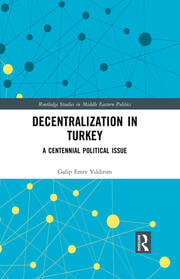
245 10|aDecentralization in Turkey :|ba centennial political issue /|cGalip Emre Yıldırım.
264 1|aAbingdon, Oxon ;|aNew York, NY :|bRoutledge,|c2025.
300 |a1 online resource.
334 |asingle unit|bmono|0http://id.loc.gov/vocabulary/issuance/mono
336 |atext|btxt|2rdacontent
337 |acomputer|bc|2rdamedia
338 |aonline resource|bcr|2rdacarrier
353 |abibliography|bbibliography|0http://id.loc.gov/vocabulary/msupplcont/bibliography
353 |aindex|bindex|0http://id.loc.gov/vocabulary/msupplcont/index
490 1 |aRoutledge studies in Middle Eastern politics
520 |a"This book explores the political dimensions of decentralization and (re)centralization policies in Turkey over the past century. It traces the evolution of these policies, from the late Ottoman Empire's decentralization efforts in the late 19th century, to the centralization under the Kemalist regime in the early 20th century, followed by the limited decentralization of the 1960s and 1980s, and the decentralization and recentralization policies of the Erdoğan governments over the past two decades. The book seeks to answer why and how decentralization efforts have repeatedly failed in Turkey. What sets this work apart is its innovative theoretical and empirical approach to Turkish politics. By framing decentralization as a political rather than a technical issue, the book draws on historical institutionalism, "bringing the state back in" theory, and path dependency to offer fresh insights. It also presents a wealth of empirical data based on archival research from French and Turkish sources, as well as interviews with Turkish local actors. On a broader scale, the book helps readers understand a key paradox in Turkish politics: how ruling elites use centralization as a policy tool while also pursuing limited decentralization. Bringing together a variety of theoretical and empirical perspectives, this work will be of great interest to students and scholars of Turkish studies and serves as a strong example of area studies research"-- Provided by publisher.
588 |aOCLC-licensed vendor bibliographic record.
650 0|aDecentralization in government|zTurkey|xHistory.
650 0|aCentral-local government relations|zTurkey|xHistory.
650 0|aPolitical culture|zTurkey|xHistory.
650 0|aElite (Social sciences)|xPolitical activity|zTurkey.
651 0|aTurkey|xPolitics and government|y1909-
758 |1http://id.loc.gov/resources/instances/24093199
758 |4http://id.loc.gov/ontologies/bibframe/instanceOf|1http://id.loc.gov/resources/works/24093199
830 0|aRoutledge studies in Middle Eastern politics.
856 40|3Taylor & Francis|uhttps://www.taylorfrancis.com/books/9781003594864
856 42|3OCLC metadata license agreement|uhttp://www.oclc.org/content/dam/oclc/forms/terms/vbrl-201703.pdf
901 |aTaylor & Francis