

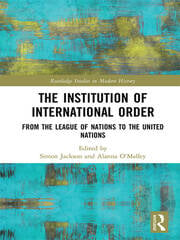
The institution of international order : from the League of Nations to the United Nations / edited by Simon Jackson and Alanna O'Malley.
Erişim Adresi
ISBN
9781315108001 (e-book : PDF)
Dil Kodu
İngilizce
Basım Bildirimi
First edition.
Yayın Bilgisi
Boca Raton, FL : Routledge, an imprint of Taylor and Francis, 2018.
Fiziksel Niteleme
1 online resource (264 pages).
Dizi
Routledge Research in Language Education
İçindekiler Notu
chapter Rocking on its hinges? The League of Nations, the United Nations and the new history of internationalism in the twentieth century / SIMON JACKSON AND ALANNA O’MALLEY -- chapter 1 “He tampers with the source of life itself who tampers with freedom”: Personhood, the state, and the international community in the thought of Charles Malik / ANDREW ARSAN -- chapter 2 From the Tigris to the Amazon: Peripheral expertise, impossible cooperation and economic multilateralism at the League of Nations, 1920–1946 -- chapter 3 Pan-American exceptionalism: Regional international law as a challenge to international institutions / MATS INGULSTAD LUCAS LIXINSKI -- chapter 4 Jewish memory and the human right to petition, 1933–1953 / NATHAN A. KURZ -- chapter 5 The power of the refugees: The 1971 East Pakistan Crisis and the origins of the UN’s engagement with humanitarian aid / FLORIAN HANNIG -- chapter 6 “Women’s point of view was apt to be forgotten”: The Liaison Committee of International Women’s Organizations’ campaign for an International Women’s Convention, 1920–1953 / NOVA ROBINSON -- chapter 7 The League of Nations and the transformation of representation: Sectarianism, consociationalism, and the Middle East / SARAH SHIELDS -- chapter 8 Reimagining the post-war international order: The world federalism of Ozaki Yukio and Kagawa Toyohiko / KONRAD M. LAWSON -- chapter 9 Internationalism and empire: The question of “native labour” in the Portuguese Empire (1919–1962) / MIGUEL BANDEIRA JERÓNIMO AND JOSÉ PEDRO MONTEIRO.
Özet, vb.
This volume delivers a history of internationalism at the League of Nations and the United Nations (UN), with a focus on the period from the 1920s to the 1970s, when the nation-state ascended to global hegemony as a political formation. Combining global, regional and local scaes of analysis, the essays presented here provide an interpretation of the two institutions — and their complex interrelationship — that is planetary in scale but also pioneeringly multi-local. Our central argument is that although the League and the UN shaped internationalism from the centre, they were themselves moulded just as powerfully by internationalisms that welled up globally, far beyond Geneva and New York City. The contributions are organised into three broad thematic sections, the first focused on the production of norms, the second on the development of expertise and the third on the global re-ordering of empire. By showing how the ruptures and continuities between the two international organisations have shaped the content and format of what we now refer to as ‘global governance’, the collection determinedly sets the Cold War and the emergence of the Third World into a single analytical frame alongside the crisis of empire after World War One and the geopolitics of the Great Depression. Each of these essays reveals how the League of Nations and the United Nations provided a global platform for formalising and proliferating political ideas and how the two institutions generated new spectrums of negotiation and dissidence and re-codified norms. As an ensemble, the book shows how the League of Nations and the United Nations constructed and progressively re-fashioned the basic building blocks of international society right across the twentieth century. Developing the new international history’s view of the League and UN as dynamic, complex forces, the book demonstrates that both organisations should be understood to have played an active role, not just in mediating a world of empires and then one of nation-states, but in forging the many principles and tenets by which international society is structured.
Konu
League of Nations __ History.
United Nations __ History.
HISTORY / Asia / India & South Asia. __ bisacsh
HISTORY / Middle East / Israel. __ bisacsh
International organization.
nternational organization __ History __ 20th century.
LAW / International. __ bisacsh
International organization __ History __ 20th century.
United Nations __ History.
HISTORY / Asia / India & South Asia. __ bisacsh
HISTORY / Middle East / Israel. __ bisacsh
International organization.
nternational organization __ History __ 20th century.
LAW / International. __ bisacsh
International organization __ History __ 20th century.
Diğer Yazarlar
Kurum Adı
Veritabanı
Eseri Alıntıla
Referansları kullanmadan önce gözden geçirmeniz ve varsa gerekli düzeltmeleri yapmanız önerilir.
Dijital Kaynak
MARC Görünümü
LEADER 05451nam a2200445Ii 4500
001 792377
003 TR_AnAIT
005 20260123000013
008 180813s2018 flu b ob 001 0 eng d
020 |a9781315108001|q(e-book : PDF)
035 |a(OCoLC)1044734091
040 |aFlBoTFG|cFlBoTFG|erda
041 |aeng
049 |aTürk Tarih Kurumu Kütüphanesi
050 4|aJZ1318|b.I5563 2018
072 7|aHIS|x009000 |2bisacsh
072 7|aHIS|x017000 |2bisacsh
072 7|aHIS|x019000 |2bisacsh
072 7|aJPSD |2bicscc
082 04|a341.22|223
245 04|aThe institution of international order :|bfrom the League of Nations to the United Nations /|cedited by Simon Jackson and Alanna O'Malley.
250 |aFirst edition.
264 1|aBoca Raton, FL :|bRoutledge, an imprint of Taylor and Francis,|c2018.
300 |a1 online resource (264 pages).
336 |atext|2rdacontent
337 |acomputer|2rdamedia
338 |aonline resource|2rdacarrier
490 1 |aRoutledge Research in Language Education
505 00|tchapter Rocking on its hinges? The League of Nations, the United Nations and the new history of internationalism in the twentieth century /|rSIMON JACKSON AND ALANNA O’MALLEY -- |tchapter 1 “He tampers with the source of life itself who tampers with freedom”: Personhood, the state, and the international community in the thought of Charles Malik /|rANDREW ARSAN -- |tchapter 2 From the Tigris to the Amazon: Peripheral expertise, impossible cooperation and economic multilateralism at the League of Nations, 1920–1946 -- |tchapter 3 Pan-American exceptionalism: Regional international law as a challenge to international institutions /|rMATS INGULSTAD LUCAS LIXINSKI -- |tchapter 4 Jewish memory and the human right to petition, 1933–1953 /|rNATHAN A. KURZ -- |tchapter 5 The power of the refugees: The 1971 East Pakistan Crisis and the origins of the UN’s engagement with humanitarian aid /|rFLORIAN HANNIG -- |tchapter 6 “Women’s point of view was apt to be forgotten”: The Liaison Committee of International Women’s Organizations’ campaign for an International Women’s Convention, 1920–1953 /|rNOVA ROBINSON -- |tchapter 7 The League of Nations and the transformation of representation: Sectarianism, consociationalism, and the Middle East /|rSARAH SHIELDS -- |tchapter 8 Reimagining the post-war international order: The world federalism of Ozaki Yukio and Kagawa Toyohiko /|rKONRAD M. LAWSON -- |tchapter 9 Internationalism and empire: The question of “native labour” in the Portuguese Empire (1919–1962) /|rMIGUEL BANDEIRA JERÓNIMO AND JOSÉ PEDRO MONTEIRO.
520 3 |aThis volume delivers a history of internationalism at the League of Nations and the United Nations (UN), with a focus on the period from the 1920s to the 1970s, when the nation-state ascended to global hegemony as a political formation. Combining global, regional and local scaes of analysis, the essays presented here provide an interpretation of the two institutions — and their complex interrelationship — that is planetary in scale but also pioneeringly multi-local. Our central argument is that although the League and the UN shaped internationalism from the centre, they were themselves moulded just as powerfully by internationalisms that welled up globally, far beyond Geneva and New York City. The contributions are organised into three broad thematic sections, the first focused on the production of norms, the second on the development of expertise and the third on the global re-ordering of empire. By showing how the ruptures and continuities between the two international organisations have shaped the content and format of what we now refer to as ‘global governance’, the collection determinedly sets the Cold War and the emergence of the Third World into a single analytical frame alongside the crisis of empire after World War One and the geopolitics of the Great Depression. Each of these essays reveals how the League of Nations and the United Nations provided a global platform for formalising and proliferating political ideas and how the two institutions generated new spectrums of negotiation and dissidence and re-codified norms. As an ensemble, the book shows how the League of Nations and the United Nations constructed and progressively re-fashioned the basic building blocks of international society right across the twentieth century. Developing the new international history’s view of the League and UN as dynamic, complex forces, the book demonstrates that both organisations should be understood to have played an active role, not just in mediating a world of empires and then one of nation-states, but in forging the many principles and tenets by which international society is structured.
610 20|aLeague of Nations|xHistory.
610 20|aUnited Nations|xHistory.
650 7|aHISTORY / Asia / India & South Asia.|2bisacsh
650 7|aHISTORY / Middle East / Israel.|2bisacsh
650 0|aInternational organization.
650 0|anternational organization|xHistory|y20th century.
650 7|aLAW / International.|2bisacsh
650 0|aInternational organization|xHistory|y20th century.
700 1 |aJackson, Simon|q(Simon M. W.),|eeditor.
700 1 |aO'Malley, Alanna,|eeditor.
710 2 |aTaylor and Francis.
776 08|iPrint version: |z9781138091504|w(DLC) 2017052946
830 0|aRoutledge studies in modern history.
856 40|uhttps://www.taylorfrancis.com/books/9781315108001|zClick here to view.
901 |aTaylor & Francis
001 792377
003 TR_AnAIT
005 20260123000013
008 180813s2018 flu b ob 001 0 eng d
020 |a9781315108001|q(e-book : PDF)
035 |a(OCoLC)1044734091
040 |aFlBoTFG|cFlBoTFG|erda
041 |aeng
049 |aTürk Tarih Kurumu Kütüphanesi
050 4|aJZ1318|b.I5563 2018
072 7|aHIS|x009000 |2bisacsh
072 7|aHIS|x017000 |2bisacsh
072 7|aHIS|x019000 |2bisacsh
072 7|aJPSD |2bicscc
082 04|a341.22|223
245 04|aThe institution of international order :|bfrom the League of Nations to the United Nations /|cedited by Simon Jackson and Alanna O'Malley.
250 |aFirst edition.
264 1|aBoca Raton, FL :|bRoutledge, an imprint of Taylor and Francis,|c2018.
300 |a1 online resource (264 pages).
336 |atext|2rdacontent
337 |acomputer|2rdamedia
338 |aonline resource|2rdacarrier
490 1 |aRoutledge Research in Language Education
505 00|tchapter Rocking on its hinges? The League of Nations, the United Nations and the new history of internationalism in the twentieth century /|rSIMON JACKSON AND ALANNA O’MALLEY -- |tchapter 1 “He tampers with the source of life itself who tampers with freedom”: Personhood, the state, and the international community in the thought of Charles Malik /|rANDREW ARSAN -- |tchapter 2 From the Tigris to the Amazon: Peripheral expertise, impossible cooperation and economic multilateralism at the League of Nations, 1920–1946 -- |tchapter 3 Pan-American exceptionalism: Regional international law as a challenge to international institutions /|rMATS INGULSTAD LUCAS LIXINSKI -- |tchapter 4 Jewish memory and the human right to petition, 1933–1953 /|rNATHAN A. KURZ -- |tchapter 5 The power of the refugees: The 1971 East Pakistan Crisis and the origins of the UN’s engagement with humanitarian aid /|rFLORIAN HANNIG -- |tchapter 6 “Women’s point of view was apt to be forgotten”: The Liaison Committee of International Women’s Organizations’ campaign for an International Women’s Convention, 1920–1953 /|rNOVA ROBINSON -- |tchapter 7 The League of Nations and the transformation of representation: Sectarianism, consociationalism, and the Middle East /|rSARAH SHIELDS -- |tchapter 8 Reimagining the post-war international order: The world federalism of Ozaki Yukio and Kagawa Toyohiko /|rKONRAD M. LAWSON -- |tchapter 9 Internationalism and empire: The question of “native labour” in the Portuguese Empire (1919–1962) /|rMIGUEL BANDEIRA JERÓNIMO AND JOSÉ PEDRO MONTEIRO.
520 3 |aThis volume delivers a history of internationalism at the League of Nations and the United Nations (UN), with a focus on the period from the 1920s to the 1970s, when the nation-state ascended to global hegemony as a political formation. Combining global, regional and local scaes of analysis, the essays presented here provide an interpretation of the two institutions — and their complex interrelationship — that is planetary in scale but also pioneeringly multi-local. Our central argument is that although the League and the UN shaped internationalism from the centre, they were themselves moulded just as powerfully by internationalisms that welled up globally, far beyond Geneva and New York City. The contributions are organised into three broad thematic sections, the first focused on the production of norms, the second on the development of expertise and the third on the global re-ordering of empire. By showing how the ruptures and continuities between the two international organisations have shaped the content and format of what we now refer to as ‘global governance’, the collection determinedly sets the Cold War and the emergence of the Third World into a single analytical frame alongside the crisis of empire after World War One and the geopolitics of the Great Depression. Each of these essays reveals how the League of Nations and the United Nations provided a global platform for formalising and proliferating political ideas and how the two institutions generated new spectrums of negotiation and dissidence and re-codified norms. As an ensemble, the book shows how the League of Nations and the United Nations constructed and progressively re-fashioned the basic building blocks of international society right across the twentieth century. Developing the new international history’s view of the League and UN as dynamic, complex forces, the book demonstrates that both organisations should be understood to have played an active role, not just in mediating a world of empires and then one of nation-states, but in forging the many principles and tenets by which international society is structured.
610 20|aLeague of Nations|xHistory.
610 20|aUnited Nations|xHistory.
650 7|aHISTORY / Asia / India & South Asia.|2bisacsh
650 7|aHISTORY / Middle East / Israel.|2bisacsh
650 0|aInternational organization.
650 0|anternational organization|xHistory|y20th century.
650 7|aLAW / International.|2bisacsh
650 0|aInternational organization|xHistory|y20th century.
700 1 |aJackson, Simon|q(Simon M. W.),|eeditor.
700 1 |aO'Malley, Alanna,|eeditor.
710 2 |aTaylor and Francis.
776 08|iPrint version: |z9781138091504|w(DLC) 2017052946
830 0|aRoutledge studies in modern history.
856 40|uhttps://www.taylorfrancis.com/books/9781315108001|zClick here to view.
901 |aTaylor & Francis
Materyaller
Depodan talep edilen materyal sadece kütüphane içerisinde kullanılmaktadır.
Materyal dışarıya ödünç verilmemektedir.
Materyal dışarıya ödünç verilmemektedir.
