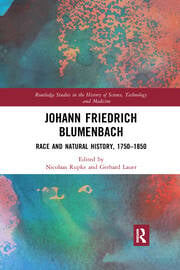
Johann Friedrich Blumenbach : race and natural history, 1750–1850 / edited by Nicolaas Rupke and Gerhard Lauer.
Erişim Adresi
ISBN
9781315184777 (e-book : PDF)
Dil Kodu
İngilizce
Basım Bildirimi
First edition.
Yayın Bilgisi
©2019.
Boca Raton, FL : Routledge, an imprint of Taylor and Francis, [2018].
Fiziksel Niteleme
1 online resource (280 pages) : 29 illustrations.
Dizi
Routledge Revivals
İçindekiler Notu
part, Part I Blumenbach studies -- chapter 1 Introduction: A brief history of Blumenbach representation / NICOLAAS RUPKE GERHARD LAUER -- chapter 2 Johann Friedrich Blumenbach – Online / GERHARD LAUER HEIKO WEBER -- part, Part II Defining human races -- chapter 3 Buffon, Blumenbach, Herder, Lichtenberg, and the origins of modern anthropology / CARL NIEKERK -- chapter 4 Climate change and creolization in French natural history, 1750–1795 / E. C. SPARY -- chapter 5 Blumenbach’s collection of human skulls / WOLFGANG BÖKER -- chapter 6 Blumenbach’s theory of human races and the natural unity of humankind / THOMAS JUNKER -- chapter 7 A defense of human rights: Blumenbach on albinism / RENATO G. MAZZOLINI -- part, Part III Racism, anti-racism, and Eurocentricity -- chapter 8 Blumenbach’s race science in the light of Christian supersessionism / TERENCE KEEL -- chapter 9 The beautiful skulls of Schiller and the Georgian girl: Quantitative and aesthetic scaling of the races, 1770–1850 -- chapter 10 Ethnographic exploration in the Blumenbachian tradition / PETER HANNS REILL -- chapter 11 The rise of paleontology and the historicization of nature: Blumenbach and Deluc / Blumenbach and Deluc JOHN H. ZAMMITO -- chapter 12 The origins of scientific racism and Huxley’s rule / NICOLAAS RUPKE.
Özet, vb.
The major significance of the German naturalist-physician Johann Friedrich Blumenbach (1752–1840) as a topic of historical study is the fact that he was one of the first anthropologists to investigate humankind as part of natural history. Moreover, Blumenbach was, and continues to be, a central figure in debates about race and racism.How exactly did Blumenbach define race and races? What were his scientific criteria? And which cultural values did he bring to bear on his scheme? Little historical work has been done on Blumenbach’s fundamental, influential race work. From his own time till today, several different pronouncements have been made by either followers or opponents, some accusing Blumenbach of being the fountainhead of scientific racism. By contrast, across early nineteenth-century Europe, not least in France, Blumenbach was lionized as an anti-racist whose work supported the unity of humankind and the abolition of slavery.This collection of essays considers how, with Blumenbach and those around him, the study of natural history and, by extension, that of science came to dominate the Western discourse of race.
Konu
Blumenbach, Johann Friedrich, __ 1752-1840.
SCIENCE / History. __ bisacsh
SOCIAL SCIENCE / Discrimination & Race Relations. __ bisacsh
SOCIAL SCIENCE / Minority Studies. __ bisacsh
Anthropology __ Philosophy.
Natural history __ Philosophy.
Race __ Philosophy.
SCIENCE / History. __ bisacsh
SOCIAL SCIENCE / Discrimination & Race Relations. __ bisacsh
SOCIAL SCIENCE / Minority Studies. __ bisacsh
Anthropology __ Philosophy.
Natural history __ Philosophy.
Race __ Philosophy.
Diğer Yazarlar
Kurum Adı
Veritabanı

Eseri Alıntıla
Referansları kullanmadan önce gözden geçirmeniz ve varsa gerekli düzeltmeleri yapmanız önerilir.
Dijital Kaynak
MARC Görünümü
LEADER 04124nam a2200433Ii 4500
001 792422
003 TR_AnAIT
005 20260123000102
008 180813t20182019fluab ob 001 0 eng d
020 |a9781315184777|q(e-book : PDF)
035 |a(OCoLC)1044734213
040 |aFlBoTFG|cFlBoTFG|erda
041 |aeng
049 |aTürk Tarih Kurumu Kütüphanesi
050 4|aGN269|b.J64 2018
072 7|aHIS|x016000 |2bisacsh
072 7|aSCI|x034000 |2bisacsh
072 7|aPDX |2bicscc
082 04|a305.801|223
245 00|aJohann Friedrich Blumenbach :|brace and natural history, 1750–1850 /|cedited by Nicolaas Rupke and Gerhard Lauer.
250 |aFirst edition.
264 4|c©2019.
264 1|aBoca Raton, FL :|bRoutledge, an imprint of Taylor and Francis,|c[2018].
300 |a1 online resource (280 pages) :|b29 illustrations.
336 |atext|2rdacontent
337 |acomputer|2rdamedia
338 |aonline resource|2rdacarrier
490 1 |aRoutledge Revivals
505 00|tpart, Part I Blumenbach studies -- |tchapter 1 Introduction: A brief history of Blumenbach representation /|rNICOLAAS RUPKE GERHARD LAUER -- |tchapter 2 Johann Friedrich Blumenbach – Online /|rGERHARD LAUER HEIKO WEBER -- |tpart, Part II Defining human races -- |tchapter 3 Buffon, Blumenbach, Herder, Lichtenberg, and the origins of modern anthropology /|rCARL NIEKERK -- |tchapter 4 Climate change and creolization in French natural history, 1750–1795 /|rE. C. SPARY -- |tchapter 5 Blumenbach’s collection of human skulls /|rWOLFGANG BÖKER -- |tchapter 6 Blumenbach’s theory of human races and the natural unity of humankind /|rTHOMAS JUNKER -- |tchapter 7 A defense of human rights: Blumenbach on albinism /|rRENATO G. MAZZOLINI -- |tpart, Part III Racism, anti-racism, and Eurocentricity -- |tchapter 8 Blumenbach’s race science in the light of Christian supersessionism /|rTERENCE KEEL -- |tchapter 9 The beautiful skulls of Schiller and the Georgian girl: Quantitative and aesthetic scaling of the races, 1770–1850 -- |tchapter 10 Ethnographic exploration in the Blumenbachian tradition /|rPETER HANNS REILL -- |tchapter 11 The rise of paleontology and the historicization of nature: Blumenbach and Deluc /|rBlumenbach and Deluc JOHN H. ZAMMITO -- |tchapter 12 The origins of scientific racism and Huxley’s rule /|rNICOLAAS RUPKE.
520 3 |aThe major significance of the German naturalist-physician Johann Friedrich Blumenbach (1752–1840) as a topic of historical study is the fact that he was one of the first anthropologists to investigate humankind as part of natural history. Moreover, Blumenbach was, and continues to be, a central figure in debates about race and racism.How exactly did Blumenbach define race and races? What were his scientific criteria? And which cultural values did he bring to bear on his scheme? Little historical work has been done on Blumenbach’s fundamental, influential race work. From his own time till today, several different pronouncements have been made by either followers or opponents, some accusing Blumenbach of being the fountainhead of scientific racism. By contrast, across early nineteenth-century Europe, not least in France, Blumenbach was lionized as an anti-racist whose work supported the unity of humankind and the abolition of slavery.This collection of essays considers how, with Blumenbach and those around him, the study of natural history and, by extension, that of science came to dominate the Western discourse of race.
600 10|aBlumenbach, Johann Friedrich,|d1752-1840.
650 7|aSCIENCE / History.|2bisacsh
650 7|aSOCIAL SCIENCE / Discrimination & Race Relations.|2bisacsh
650 7|aSOCIAL SCIENCE / Minority Studies.|2bisacsh
650 0|aAnthropology|xPhilosophy.
650 0|aNatural history|xPhilosophy.
650 0|aRace|xPhilosophy.
700 1 |aRupke, Nicolaas A.,|eeditor.
700 1 |aLauer, Gerhard,|eeditor.
710 2 |aTaylor and Francis.
776 08|iPrint version: |z9781138738423|w(DLC) 2018005205
830 0|aRoutledge studies in the history of science, technology, and medicine.
856 40|uhttps://www.taylorfrancis.com/books/9781315184777|zClick here to view.
901 |aTaylor & Francis
001 792422
003 TR_AnAIT
005 20260123000102
008 180813t20182019fluab ob 001 0 eng d
020 |a9781315184777|q(e-book : PDF)
035 |a(OCoLC)1044734213
040 |aFlBoTFG|cFlBoTFG|erda
041 |aeng
049 |aTürk Tarih Kurumu Kütüphanesi
050 4|aGN269|b.J64 2018
072 7|aHIS|x016000 |2bisacsh
072 7|aSCI|x034000 |2bisacsh
072 7|aPDX |2bicscc
082 04|a305.801|223
245 00|aJohann Friedrich Blumenbach :|brace and natural history, 1750–1850 /|cedited by Nicolaas Rupke and Gerhard Lauer.
250 |aFirst edition.
264 4|c©2019.
264 1|aBoca Raton, FL :|bRoutledge, an imprint of Taylor and Francis,|c[2018].
300 |a1 online resource (280 pages) :|b29 illustrations.
336 |atext|2rdacontent
337 |acomputer|2rdamedia
338 |aonline resource|2rdacarrier
490 1 |aRoutledge Revivals
505 00|tpart, Part I Blumenbach studies -- |tchapter 1 Introduction: A brief history of Blumenbach representation /|rNICOLAAS RUPKE GERHARD LAUER -- |tchapter 2 Johann Friedrich Blumenbach – Online /|rGERHARD LAUER HEIKO WEBER -- |tpart, Part II Defining human races -- |tchapter 3 Buffon, Blumenbach, Herder, Lichtenberg, and the origins of modern anthropology /|rCARL NIEKERK -- |tchapter 4 Climate change and creolization in French natural history, 1750–1795 /|rE. C. SPARY -- |tchapter 5 Blumenbach’s collection of human skulls /|rWOLFGANG BÖKER -- |tchapter 6 Blumenbach’s theory of human races and the natural unity of humankind /|rTHOMAS JUNKER -- |tchapter 7 A defense of human rights: Blumenbach on albinism /|rRENATO G. MAZZOLINI -- |tpart, Part III Racism, anti-racism, and Eurocentricity -- |tchapter 8 Blumenbach’s race science in the light of Christian supersessionism /|rTERENCE KEEL -- |tchapter 9 The beautiful skulls of Schiller and the Georgian girl: Quantitative and aesthetic scaling of the races, 1770–1850 -- |tchapter 10 Ethnographic exploration in the Blumenbachian tradition /|rPETER HANNS REILL -- |tchapter 11 The rise of paleontology and the historicization of nature: Blumenbach and Deluc /|rBlumenbach and Deluc JOHN H. ZAMMITO -- |tchapter 12 The origins of scientific racism and Huxley’s rule /|rNICOLAAS RUPKE.
520 3 |aThe major significance of the German naturalist-physician Johann Friedrich Blumenbach (1752–1840) as a topic of historical study is the fact that he was one of the first anthropologists to investigate humankind as part of natural history. Moreover, Blumenbach was, and continues to be, a central figure in debates about race and racism.How exactly did Blumenbach define race and races? What were his scientific criteria? And which cultural values did he bring to bear on his scheme? Little historical work has been done on Blumenbach’s fundamental, influential race work. From his own time till today, several different pronouncements have been made by either followers or opponents, some accusing Blumenbach of being the fountainhead of scientific racism. By contrast, across early nineteenth-century Europe, not least in France, Blumenbach was lionized as an anti-racist whose work supported the unity of humankind and the abolition of slavery.This collection of essays considers how, with Blumenbach and those around him, the study of natural history and, by extension, that of science came to dominate the Western discourse of race.
600 10|aBlumenbach, Johann Friedrich,|d1752-1840.
650 7|aSCIENCE / History.|2bisacsh
650 7|aSOCIAL SCIENCE / Discrimination & Race Relations.|2bisacsh
650 7|aSOCIAL SCIENCE / Minority Studies.|2bisacsh
650 0|aAnthropology|xPhilosophy.
650 0|aNatural history|xPhilosophy.
650 0|aRace|xPhilosophy.
700 1 |aRupke, Nicolaas A.,|eeditor.
700 1 |aLauer, Gerhard,|eeditor.
710 2 |aTaylor and Francis.
776 08|iPrint version: |z9781138738423|w(DLC) 2018005205
830 0|aRoutledge studies in the history of science, technology, and medicine.
856 40|uhttps://www.taylorfrancis.com/books/9781315184777|zClick here to view.
901 |aTaylor & Francis
Materyaller
Depodan talep edilen materyal sadece kütüphane içerisinde kullanılmaktadır.
Materyal dışarıya ödünç verilmemektedir.
