

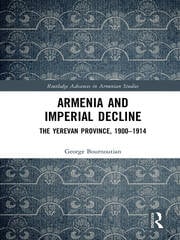
Armenia and imperial decline : the Yerevan Province, 1900-1914 / George A. Bournoutian.
Erişim Adresi
ISBN
9781351062626 (e-book : PDF)
Dil Kodu
İngilizce
Yazar
Yayın Bilgisi
Milton Park, Abingdon, Oxon : Routledge, 2018.
Fiziksel Niteleme
1 online resource (xxix, 382 pages)
Dizi
Routledge advances in Armenian studies
İçindekiler Notu
part, I Socioeconomic Conditions of the Yerevan Province / George A. Bournoutian -- chapter Introduction / George A. Bournoutian -- chapter I Historical Setting / George A. Bournoutian -- chapter II The Land / George A. Bournoutian -- chapter III The People / George A. Bournoutian -- chapter IV Administration and Society / George A. Bournoutian -- chapter V Land Tenure and Agriculture / George A. Bournoutian -- chapter VI The Economy / George A. Bournoutian -- chapter VII Taxes and Revenues / George A. Bournoutian -- chapter Concluding Remarks / George A. Bournoutian -- part, II Tables / George A. Bournoutian -- chapter Table I – Rural Population, Land Tenure and Revenues of the Yerevan District / George A. Bournoutian -- chapter Table II – Rural Population, Land Tenure and Revenues of the Echmiadzin District / George A. Bournoutian -- chapter Table III – Rural Population, Land Tenure and Revenues of the Surmalu District / George A. Bournoutian -- chapter Table IV – Rural Population, Land Tenure and Revenues of the Sharur-Daralagez District / George A. Bournoutian -- chapter Table V – Rural Population, Land Tenure and Revenues of the Nakhichevan District / George A. Bournoutian -- chapter Table VI – Rural Population, Land Tenure and Revenues of the Alexandropol District / George A. Bournoutian -- chapter Table VII – Rural Population, Land Tenure and Revenues of the Novo-Bayazet District / George A. Bournoutian.
Özet, vb.
Unlike in Tiflis and Baku, the Armenian inhabitants of the Yerevan Province were overwhelmingly peasants. They did not play a major role in the political, intellectual or economic life of the South Caucasus. This book seeks, for the first time, to examine the demography and the social and economic conditions in the Yerevan Province during the first decade of the twentieth century, before the great changes that occurred during World War I and the seven decades of Soviet rule. The aim of the book is to prove conclusively that the Armenians of the Yerevan Province not only benefitted from living under the umbrella of imperial security, but, as junior and senior officials, they also acquired important administrative and professional skills. The social and economic changes of the last decade of Russian rule enabled the local Armenians to advance and, following the collapse of the Russian Empire, to occupy posts previously held by Russians. Thus, despite the absence of their most talented individuals and the lack of experienced political leaders, as well as the loss of half their territory to Turkish attacks in 1918, the local Armenian administration, in the face of terrible conditions and great odds, provided the foundation which allowed the Armenian Republic to maintain its independence until December of 1920. In fact, some of the survivors would assist in the modernization and nation building of Soviet Armenia. Providing a detailed overview of the history of the Yerevan Province in the late imperial age, this book will be a valuable resource for students and scholars interested in the History of Armenia, the Russian Empire and the Caucasus.
Konu
Yerevan (Armenia) __ Economic conditions.
Yerevan (Armenia) __ History __ 20th century.
Yerevan (Armenia) __ Social conditions.
Yerevan (Armenia) __ History __ 20th century.
Yerevan (Armenia) __ Social conditions.
Veritabanı
Eseri Alıntıla
Referansları kullanmadan önce gözden geçirmeniz ve varsa gerekli düzeltmeleri yapmanız önerilir.
Dijital Kaynak
MARC Görünümü
LEADER 04316cam a2200313Ii 4500
001 792766
003 TR_AnAIT
005 20260123000631
008 180706s2018 enk ob 001 0 eng d
020 |a9781351062626|q(e-book : PDF)
024 7 |a10.4324/9781351062626 |2doi
035 |a(OCoLC)1029232241
040 |aFlBoTFG|cFlBoTFG|erda
041 |aeng
043 |aa-ai---
049 |aTürk Tarih Kurumu Kütüphanesi
050 4|aDK689.35|b.B68 2018
082 04|a947.56083|bB775
100 1 |aBournoutian, George A.,|eauthor.
245 10|aArmenia and imperial decline :|bthe Yerevan Province, 1900-1914 /|cGeorge A. Bournoutian.
264 1|aMilton Park, Abingdon, Oxon :|bRoutledge,|c2018.
300 |a1 online resource (xxix, 382 pages)
336 |atext|2rdacontent
337 |acomputer|2rdamedia
338 |aonline resource|2rdacarrier
490 0 |aRoutledge advances in Armenian studies
505 00|tpart, I Socioeconomic Conditions of the Yerevan Province /|r George A. Bournoutian -- |tchapter Introduction /|r George A. Bournoutian -- |tchapter I Historical Setting /|r George A. Bournoutian -- |tchapter II The Land /|r George A. Bournoutian -- |tchapter III The People /|r George A. Bournoutian -- |tchapter IV Administration and Society /|r George A. Bournoutian -- |tchapter V Land Tenure and Agriculture /|r George A. Bournoutian -- |tchapter VI The Economy /|r George A. Bournoutian -- |tchapter VII Taxes and Revenues /|r George A. Bournoutian -- |tchapter Concluding Remarks /|r George A. Bournoutian -- |tpart, II Tables /|r George A. Bournoutian -- |tchapter Table I – Rural Population, Land Tenure and Revenues of the Yerevan District /|r George A. Bournoutian -- |tchapter Table II – Rural Population, Land Tenure and Revenues of the Echmiadzin District /|r George A. Bournoutian -- |tchapter Table III – Rural Population, Land Tenure and Revenues of the Surmalu District /|r George A. Bournoutian -- |tchapter Table IV – Rural Population, Land Tenure and Revenues of the Sharur-Daralagez District /|r George A. Bournoutian -- |tchapter Table V – Rural Population, Land Tenure and Revenues of the Nakhichevan District /|r George A. Bournoutian -- |tchapter Table VI – Rural Population, Land Tenure and Revenues of the Alexandropol District /|r George A. Bournoutian -- |tchapter Table VII – Rural Population, Land Tenure and Revenues of the Novo-Bayazet District /|r George A. Bournoutian.
520 |aUnlike in Tiflis and Baku, the Armenian inhabitants of the Yerevan Province were overwhelmingly peasants. They did not play a major role in the political, intellectual or economic life of the South Caucasus. This book seeks, for the first time, to examine the demography and the social and economic conditions in the Yerevan Province during the first decade of the twentieth century, before the great changes that occurred during World War I and the seven decades of Soviet rule. The aim of the book is to prove conclusively that the Armenians of the Yerevan Province not only benefitted from living under the umbrella of imperial security, but, as junior and senior officials, they also acquired important administrative and professional skills. The social and economic changes of the last decade of Russian rule enabled the local Armenians to advance and, following the collapse of the Russian Empire, to occupy posts previously held by Russians. Thus, despite the absence of their most talented individuals and the lack of experienced political leaders, as well as the loss of half their territory to Turkish attacks in 1918, the local Armenian administration, in the face of terrible conditions and great odds, provided the foundation which allowed the Armenian Republic to maintain its independence until December of 1920. In fact, some of the survivors would assist in the modernization and nation building of Soviet Armenia. Providing a detailed overview of the history of the Yerevan Province in the late imperial age, this book will be a valuable resource for students and scholars interested in the History of Armenia, the Russian Empire and the Caucasus.
651 0|aYerevan (Armenia)|xEconomic conditions.
651 0|aYerevan (Armenia)|xHistory|y20th century.
651 0|aYerevan (Armenia)|xSocial conditions.
776 08|iPrint version:|z9781138480575
856 40|uhttps://www.taylorfrancis.com/books/9781351062626|zClick here to view.
901 |aTaylor & Francis
001 792766
003 TR_AnAIT
005 20260123000631
008 180706s2018 enk ob 001 0 eng d
020 |a9781351062626|q(e-book : PDF)
024 7 |a10.4324/9781351062626 |2doi
035 |a(OCoLC)1029232241
040 |aFlBoTFG|cFlBoTFG|erda
041 |aeng
043 |aa-ai---
049 |aTürk Tarih Kurumu Kütüphanesi
050 4|aDK689.35|b.B68 2018
082 04|a947.56083|bB775
100 1 |aBournoutian, George A.,|eauthor.
245 10|aArmenia and imperial decline :|bthe Yerevan Province, 1900-1914 /|cGeorge A. Bournoutian.
264 1|aMilton Park, Abingdon, Oxon :|bRoutledge,|c2018.
300 |a1 online resource (xxix, 382 pages)
336 |atext|2rdacontent
337 |acomputer|2rdamedia
338 |aonline resource|2rdacarrier
490 0 |aRoutledge advances in Armenian studies
505 00|tpart, I Socioeconomic Conditions of the Yerevan Province /|r George A. Bournoutian -- |tchapter Introduction /|r George A. Bournoutian -- |tchapter I Historical Setting /|r George A. Bournoutian -- |tchapter II The Land /|r George A. Bournoutian -- |tchapter III The People /|r George A. Bournoutian -- |tchapter IV Administration and Society /|r George A. Bournoutian -- |tchapter V Land Tenure and Agriculture /|r George A. Bournoutian -- |tchapter VI The Economy /|r George A. Bournoutian -- |tchapter VII Taxes and Revenues /|r George A. Bournoutian -- |tchapter Concluding Remarks /|r George A. Bournoutian -- |tpart, II Tables /|r George A. Bournoutian -- |tchapter Table I – Rural Population, Land Tenure and Revenues of the Yerevan District /|r George A. Bournoutian -- |tchapter Table II – Rural Population, Land Tenure and Revenues of the Echmiadzin District /|r George A. Bournoutian -- |tchapter Table III – Rural Population, Land Tenure and Revenues of the Surmalu District /|r George A. Bournoutian -- |tchapter Table IV – Rural Population, Land Tenure and Revenues of the Sharur-Daralagez District /|r George A. Bournoutian -- |tchapter Table V – Rural Population, Land Tenure and Revenues of the Nakhichevan District /|r George A. Bournoutian -- |tchapter Table VI – Rural Population, Land Tenure and Revenues of the Alexandropol District /|r George A. Bournoutian -- |tchapter Table VII – Rural Population, Land Tenure and Revenues of the Novo-Bayazet District /|r George A. Bournoutian.
520 |aUnlike in Tiflis and Baku, the Armenian inhabitants of the Yerevan Province were overwhelmingly peasants. They did not play a major role in the political, intellectual or economic life of the South Caucasus. This book seeks, for the first time, to examine the demography and the social and economic conditions in the Yerevan Province during the first decade of the twentieth century, before the great changes that occurred during World War I and the seven decades of Soviet rule. The aim of the book is to prove conclusively that the Armenians of the Yerevan Province not only benefitted from living under the umbrella of imperial security, but, as junior and senior officials, they also acquired important administrative and professional skills. The social and economic changes of the last decade of Russian rule enabled the local Armenians to advance and, following the collapse of the Russian Empire, to occupy posts previously held by Russians. Thus, despite the absence of their most talented individuals and the lack of experienced political leaders, as well as the loss of half their territory to Turkish attacks in 1918, the local Armenian administration, in the face of terrible conditions and great odds, provided the foundation which allowed the Armenian Republic to maintain its independence until December of 1920. In fact, some of the survivors would assist in the modernization and nation building of Soviet Armenia. Providing a detailed overview of the history of the Yerevan Province in the late imperial age, this book will be a valuable resource for students and scholars interested in the History of Armenia, the Russian Empire and the Caucasus.
651 0|aYerevan (Armenia)|xEconomic conditions.
651 0|aYerevan (Armenia)|xHistory|y20th century.
651 0|aYerevan (Armenia)|xSocial conditions.
776 08|iPrint version:|z9781138480575
856 40|uhttps://www.taylorfrancis.com/books/9781351062626|zClick here to view.
901 |aTaylor & Francis
Materyaller
Depodan talep edilen materyal sadece kütüphane içerisinde kullanılmaktadır.
Materyal dışarıya ödünç verilmemektedir.
Materyal dışarıya ödünç verilmemektedir.
