LEADER 02674cam a2200277Ii 4500
001 792776
003 TR_AnAIT
005 20260123000643
008 180706s2018 nyu ob 001 0 eng d
020 |a9781351168083|q(e-book : PDF)
020 |a9781351168052|q(e-book: Mobi)
020 |z9780815348092|q(hardback)
024 7 |a10.4324/9781351168083 |2doi
035 |a(OCoLC)1019718191
041 |aeng
043 |ae-it---
049 |aTürk Tarih Kurumu Kütüphanesi
050 4|aBM713|b.A26 2018
082 04|a296.4440820945|bA229
100 1 |aAdelman, Howard Tzvi,|eauthor.
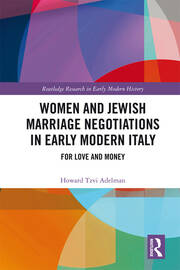
245 10|aWomen and Jewish marriage negotiations in early modern Italy :|bfor love and money /|cby Howard Tzvi Adelman.
264 1|aNew York :|bRoutledge,|c2018.
300 |a1 online resource
490 0 |aRoutledge Research in Early Modern History
505 0 |aPreface: Unwilling to allow his wife a divorce, he marries another -- 1. Introduction: Jews, women, and rabbis in Italy -- 2. Negotiating engagement: anticipating danger -- 3. Breaking betrothals: fleeing danger -- 4. Negotiating in and out of marriage -- 5. Anticipating death: negotiating assets -- 6. Remarriage: negotiations between families.
520 |a"This book examines the role of women in Jewish family negotiations, using the setting of Italy from the end of the Renaissance to the Baroque. In ghettos at night and under the scrutiny of inquisitions, Jews flourished. Life and learning were enriched by Jews from the Iberian Peninsula, the Ottoman Empire, transalpine Europe, west and east, and Catholic neighbors. Rabbinic discourse represented conflicting customs in family formation and dissolution, especially at moments of crisis for women: forced betrothal; physical, mental and financial abuse; polygamy, and abandonment. In this book, case studies illustrate the ambiguity, drama, and danger to which women were exposed, as well as opportunities to make their voices heard and to extricate themselves from situations by forcing a divorce, collecting or seizing assets, and going to Catholic notaries to bequeath their assets outside traditional inheritance, often to other women. Despite intrusion by rabbis, their ability for coercion was limited, and their threats of punishments reflected the rhetoric of weakness rather than realistic options for implementation. The focus of this text is not what the law says, but rather how it enabled individual Jews, especially women, to speak and to act."--Provided by publisher.
650 0|aJewish marriage customs and rites|zItaly|xHistory|y17th century.
650 0|aJudaism|zItaly|xHistory|y17th century.
776 08|iPrint version: |z9780815348092|w(DLC) 2017058194
856 40|uhttps://www.taylorfrancis.com/books/9781351168083|zClick here to view.
901 |aTaylor & Francis