LEADER 03471cam a22005898i 4500
001 793017
003 TR_AnAIT
005 20260123001037
006 m d | |
007 cr |||||||||||
008 191126s2020 nyu ob 001 0 eng
020 |a9781000047332|q(epub)
020 |a1000047334|q(epub)
020 |a9781003005247|q(ebook)
020 |a1003005241|q(ebook)
020 |a9781000047318|q(adobe pdf)
020 |a1000047318|q(adobe pdf)
020 |a9781000047325|q(mobi)
020 |a1000047326|q(mobi)
020 |z9780367437169|q(hardback)
035 |a(OCoLC)1129402761
035 |a(OCoLC-P)1129402761
040 |aOCoLC-P|beng|erda|cOCoLC-P
041 |aeng
049 |aTürk Tarih Kurumu Kütüphanesi
050 00|aF295.A1
072 7|aHIS|x037050|2bisacsh
072 7|aHIS|x037060|2bisacsh
072 7|aHIS|x054000|2bisacsh
072 7|aHBJK|2bicssc
082 00|a305.8009758|223
100 1 |aSpady, James O'Neil,|d1968-|eauthor.
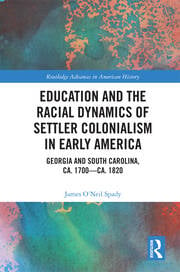
245 10|aEducation and the racial dynamics of settler colonialism in early America :|bGeorgia and South Carolina, ca. 1700-ca. 1820 /|cJames O'Neil Spady.
264 1|aNew York, NY :|bRoutledge,|c2020.
300 |a1 online resource.
336 |atext|btxt|2rdacontent
337 |acomputer|bn|2rdamedia
338 |aonline resource|bnc|2rdacarrier
490 1 |aRoutledge advances in American history;|v16
520 |a"This is the first historical monograph to demonstrate settler colonialism's significance for Early America. Based on a nuanced reading of the archive and using a comparative approach, the book treats settler colonialism as a process rather than a coherent ideology. Spady shows that learning was a central site of colonial struggle in the South, in which Native Americans, Africans, and European settlers acquired and exploited each other's knowledge and practices. Learned skills, attitudes, and ideas shaped the economy and culture of the region and produced challenges to colonial authority. Factions of enslaved people and of Native American communities devised new survival and resistance strategies. Their successful learning challenged settler projects and desires, and white settlers gradually responded. Three developments arose as a pattern of racialization: settlers tried to prohibit literacy for the enslaved, remove indigenous communities, and initiate some of North America's earliest schools for poorer whites. Fully instituted by the end of the 1820s, settler colonization's racialization of learning in the South endured beyond the Civil War and Reconstruction"--|cProvided by publisher.
588 |aOCLC-licensed vendor bibliographic record.
650 0|aWhites|zGeorgia|xRelations with Indians|xHistory.
650 0|aWhites|zSouth Carolina|xRelations with Indians|xHistory.
650 0|aSlaves|xEducation|zGeorgia|xHistory.
650 0|aSlaves|xEducation|zSouth Carolina|xHistory.
650 0|aRacism in education|zGeorgia|xHistory.
650 0|aRacism in education|zSouth Carolina|xHistory.
650 7|aHISTORY / Modern / 18th Century|2bisacsh
650 7|aHISTORY / Modern / 19th Century|2bisacsh
650 7|aHISTORY / Social History|2bisacsh
651 0|aGeorgia|xRace relations|xHistory.
651 0|aSouth Carolina|xRace relations|xHistory.
856 40|3Taylor & Francis|uhttps://www.taylorfrancis.com/books/9781003005247
856 42|3OCLC metadata license agreement|uhttp://www.oclc.org/content/dam/oclc/forms/terms/vbrl-201703.pdf
901 |aTaylor & Francis