LEADER 04285cam a2200589Ki 4500
001 793021
003 TR_AnAIT
005 20260123001041
006 m o d
007 cr |n|||||||||
008 200129s2020 enk ob 001 0 eng d
020 |a9781000764857|q(electronic bk.)
020 |a1000764850|q(electronic bk.)
020 |a9781003005513|q(electronic bk.)
020 |a1003005519|q(electronic bk.)
020 |a9781000764949|q(electronic bk. : Mobipocket)
020 |a100076494X|q(electronic bk. : Mobipocket)
020 |a9781000765038|q(electronic bk. : EPUB)
020 |a1000765032|q(electronic bk. : EPUB)
020 |z9780367435479
020 |z0367435470
020 |z9780367435493
020 |z0367435497
035 |a(OCoLC)1137830590
035 |a(OCoLC-P)1137830590
040 |aOCoLC-P|beng|cOCoLC-P
041 |aeng
049 |aTürk Tarih Kurumu Kütüphanesi
050 4|aHQ799.2.P6
072 7|aHIS|x010000|2bisacsh
072 7|aHIS|x037070|2bisacsh
072 7|aHIS|x000000|2bisacsh
072 7|aJP|2bicssc
082 04|a320.0835/0945|223
100 1 |aFroio, Caterina,|eauthor.
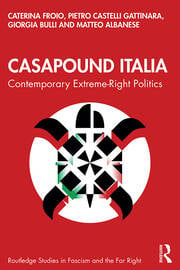
245 10|aCasaPound Italia|h[electronic resource] :|bcontemporary extreme-right politics /|cCaterina Froio, Pietro Castelli Gattinara, Giorgia Bulli, Matteo Albanese.
264 1|aMilton Park, Abingdon, Oxon ;|aNew York, NY :|bRoutledge,|c2020.
300 |a1 online resource.
490 1 |aRoutledge studies in fascism and the far right
520 |aIn 2003, the occupation of a state-owned building in Rome led to the emergence of a new extreme-right youth movement: CasaPound Italia (CPI). Its members described themselves as 'Fascists of the Third Millennium', and were unabashed about their admiration for Benito Mussolini. Over the next 15 years, they would take to the street, contest national elections, open over a hundred centres across Italy, and capture the attention of the Italian public. While CPI can count only on a few thousands votes, it enjoys disproportionate attention in public debates from the media. So what exactly is CasaPound? How can we explain the high profile achieved by such a nostalgic group with no electoral support? In this book, Caterina Froio, Pietro Castelli Gattinara, Giorgia Bulli and Matteo Albanese explore CasaPound Italia and its particular political strategy combining the organization and style of both political parties and social movements and bringing together extreme-right ideas and pop-culture symbols. They contend that this strategy of hybridization allowed a fringe organization like CasaPound to consolidate its position within the Italian far-right milieu, but also, crucially, to make extreme-right ideas routine in public debates. The authors illustrate this argument drawing on unique empirical material gathered during five years of research, including several months of overt observation at concerts and events, face-to-face interviews, and the qualitative and quantitative analysis of online and offline campaigns. By describing how hybridization grants extremist groups the leeway to expand their reach and penetrate mainstream political debates, this book is core reading for anyone concerned about the nature and growth of far-right politics in contemporary democracies. Providing a fresh insight as to how contemporary extreme-right groups organize to capture public attention, this study will also be of interest to students, scholars and activists interested in the complex relationship between party competition and street protest more generally.
588 |aOCLC-licensed vendor bibliographic record.
610 20|aCasaPound Italia.
650 0|aYouth|xPolitical activity|zItaly.
650 0|aRight-wing extremists|zItaly.
650 0|aYouth movements|zItaly.
650 0|aFascism|zItaly|y1945-
650 7|aHISTORY / Europe / General|2bisacsh
650 7|aHISTORY / Modern / 20th Century|2bisacsh
650 7|aHISTORY / General|2bisacsh
700 1 |aCastelli Gattinara, Pietro,|eauthor.
700 1 |aBulli, Giorgia,|eauthor.
700 1 |aAlbanese, Matteo,|d1973-|eauthor.
856 40|3Taylor & Francis|uhttps://www.taylorfrancis.com/books/9781003005513
856 42|3OCLC metadata license agreement|uhttp://www.oclc.org/content/dam/oclc/forms/terms/vbrl-201703.pdf
901 |aTaylor & Francis