

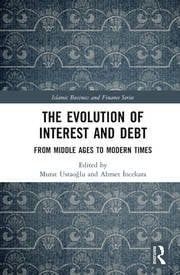
The evolution of interest and debt : from Middle Ages to modern times / edited by Murat Ustaoğlu and Ahmet İncekara.
ISBN
9781003041245 electronic book
1003041248 electronic book
9781000199512 (electronic bk. : EPUB)
1000199517 (electronic bk. : EPUB)
9781000199369 (electronic bk. : Mobipocket)
1000199363 (electronic bk. : Mobipocket)
9781000199215 (electronic bk. : PDF)
1000199215 (electronic bk. : PDF)
9780367484903 hardcover
1003041248 electronic book
9781000199512 (electronic bk. : EPUB)
1000199517 (electronic bk. : EPUB)
9781000199369 (electronic bk. : Mobipocket)
1000199363 (electronic bk. : Mobipocket)
9781000199215 (electronic bk. : PDF)
1000199215 (electronic bk. : PDF)
9780367484903 hardcover
Dil Kodu
İngilizce
Yayın Bilgisi
Milton Park, Abingdon, Oxon ; New York, NY : Routledge, 2021.
©2021
©2021
Fiziksel Niteleme
1 online resource
Dizi
Islamic business and finance series
Özet, vb.
"It would be difficult to examine interest-free alternative financial systems without reviewing the evolution of debt; thus, this book offers a chronological account of the development of interest-bearing debt and contributors offer their take on how the issue of interest has been addressed throughout medieval and modern civilizations. This book provides a review of the impact of these interest-bearing debt and practices upon social relations and institutions, throughout the history of modern economics, observing the relative conditions of the time and, as such, will shed light on the ongoing problems as well. The authors assert that the development of the concept of interest can be traced through three historical periods. The first period covers measures from a more radical stance, as introduced by the Abrahamic religions, with the same foundations and principles at their core. The second period examines the arguments that justify interest-bearing debt and particularly how the stance of major religions has been translated into a basis of support for these transactions. And third and final part offers a chronological account of the development of interest-bearing debt transactions and their disruptive impacts throughout the history of modern economics from medieval to modern era. Initially, the book presents a conceptual framework of terms applicable to the discussions and then examines the consistency and reliability of the theological and philosophical arguments on the restrictions imposed upon the practice of interest and debt, including rigid prohibition. Each period presents its own dynamics and helps analysts better understand the history and roots of interest-bearing debt. While the book is grounded on research that relies heavily on historical sources, it offers a contribution to the literature on economics as well, since the historical findings are analyzed in the context of economic terms and theories. An interdisciplinary effort, the book will attract attention of those who have an interest in finance, economics, history, religion and sociology"-- Provided by publisher.
Konu
Interest.
Debt.
BUSINESS & ECONOMICS / Economic History __ bisacsh
BUSINESS & ECONOMICS / Interest __ bisacsh
Debt.
BUSINESS & ECONOMICS / Economic History __ bisacsh
BUSINESS & ECONOMICS / Interest __ bisacsh
Diğer Yazarlar
Veritabanı
