

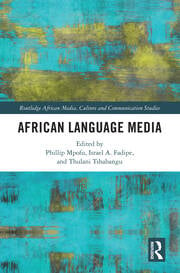
African language media / edited by Phillip Mpofu, Israel A. Fadipe, and Thulani Tshabangu.
ISBN
9781003350194 (ebook)
1003350194
9781000847093 (electronic bk. : PDF)
1000847098 (electronic bk. : PDF)
9781000847123 (electronic bk. : EPUB)
1000847128 (electronic bk. : EPUB)
9781032395272 (hardback)
9781032395302 (paperback)
1003350194
9781000847093 (electronic bk. : PDF)
1000847098 (electronic bk. : PDF)
9781000847123 (electronic bk. : EPUB)
1000847128 (electronic bk. : EPUB)
9781032395272 (hardback)
9781032395302 (paperback)
Dil Kodu
İngilizce
Yayın Bilgisi
New York : Routledge, 2023.
Fiziksel Niteleme
1 online resource
İçindekiler Notu
Section I: Media representations, text, context and African language media -- Introduction: African Language Media: Past, Present and Future / Mpofu Philip, Fadipe Israel A. & Tshabangu Thulani -- A Peek into Afrinet-24 Domestication of Foreign Films in Nigerian Indigenous Languages / Ihuoma Okorie -- Relevance of Cultural Studies' approaches to news media production and consumption analyses in an African context / by Margaret Jjuuko -- Television cinema in indigenous African languages, Are we there yet? The portrayal of Women in Naiza Boom films / by Mabika M. and Moffat B -- Hausa Folk Music and the challenges of Sustainability in the Nigerian Entertainment Industry / by Gideon A. Danja -- Section II: Digital technology and African language media -- (Dis) continuities of indigenous language radio on social media: The case of South Africa's Motsweding FM and Radio Zimbabwe / by Tshepang, B. Molale and Philip Mpofu -- Reinterpreting Technological Language: The Use of Social Media Emojis to Construct New Meanings in IsiXhosa Language / by Quatro Mgogo and Sinoyolo Nokutywa -- The purpose of minority language media and the digital shift: the case of "Der Nordschleswiger" / by Sergiusz Bober and Craig Willis -- Podcasting Covid19 in indigenous languages: Interrogating audio psychology and political anthropomorphism / by Jennings Joy Chibike -- Section III: Health and environmental crisis and African language media -- The Role of Traditional Town Criers: Using Indigenous Yoruba Language in COVID-19 Awareness on Radio for Rural Dwellers in Lagos / Akpan Uwanna -- A Critical Analysis of the Kwayedza newspaper's Ethical Coverage of COVID-19 Crisis in Zimbabwe (March 2020- December 2021) / by Witness Roya -- How does the indigenous language media in Malawi report on health crises such as recent COVD 19 global pandemic and HIV/AIDS? / by Muyanga Ziba -- Trends in Indigenous Language Media Use for Rural Crime Preventions in South African Region / by Bosilong Pearl Kgomotso & Fortune Mahlatse Tsutsa -- Section IV: Audience perception, participation, ethnic, identity formation and African language media -- The importance of audience participation in the success of community radio / by Moffat B., Osunkunle O.O., Mabika M. and Moffat -- Culture de la Paix in Central Africa: Building 'communities of affect' and safe spaces through Sango broadcasts / by Fabíola Ortiz dos Santos -- Marginalised voices: A reception analysis of Omurari FM's Okaruveze Kovaremane radio programme for people living with disabilities / by Marina Matundu and Hatikanganwi Mapudzi -- Women's Participation through Indigenous Language Media and it's Outcomes, An analysis on Community Radio and Women in Northern Ghana / by Manfred Kofi Antwi Asuman and Moodley Subeshini -- Section V: Corporate communication, practice-based studies and African language media -- Reimagining Indigenous African music through the Lens of urban concert halls / by Evans Netshivhambe -- Section VI: Beat analysis, peace journalism and African language media -- Socio-Cultural Issues in Ayinla Omowura's Music: Lessons for Social Decadence-Free Society / by Bakenne, Nureni Aremu and Ogundeyi Olanrewaju John -- Explicatures and Implicatures in Selected abcderian Yoruba Poetry / by Olukemi Bolade Adesina -- The Use of Traditional Communication in Public Protests: Evidence from Nigeria / Moses Ofome Asak and Sunny Mbazie -- In Conclusion: African Language Media / Mpofu Philip, Fadipe Israel A. & Tshabangu Thulani.
Özet, vb.
"This book outlines how African language media is affected by politics, technology, culture, and the economy and how this media is creatively produced and appropriated by audiences across cultures and contexts. African language media can be considered as a tool for communication, socialization, and community that defines the various identities of indigenous people in Africa. This book shows how vernacular media outlets including radio and television, as well as native formats such as festivals, rituals and dance, can be used to influence all facets of local peoples' experience and understanding of community. The book also explores the relationship between African language media sources and contemporary issues including the digitalization conundrum, peace and conflict resolution, identity formation, hate speech and fake news. Furthermore, it shows how local media can be used for development communication purposes during health and environmental crises. The book includes cases studies demonstrating the uses, experiences and activities related to various forms of media available in African languages. This book will be of interest to scholars in the field of communication and media studies, health and environmental communication, journalism, African studies and anthropology"-- Provided by publisher.
Konu
Mass media and language __ Africa, Sub-Saharan.
African languages __ Social aspects.
Indigenous peoples and mass media __ Africa, Sub-Saharan.
Indigenous peoples __ Africa, Sub-Saharan __ Communication.
Local mass media __ Social aspects __ Africa, Sub-Saharan.
FOREIGN LANGUAGE STUDY / African Languages __ bisacsh
BUSINESS & ECONOMICS / Industries / Media & Communications Industries __ bisacsh
SOCIAL SCIENCE / Media Studies __ bisacsh
African languages __ Social aspects.
Indigenous peoples and mass media __ Africa, Sub-Saharan.
Indigenous peoples __ Africa, Sub-Saharan __ Communication.
Local mass media __ Social aspects __ Africa, Sub-Saharan.
FOREIGN LANGUAGE STUDY / African Languages __ bisacsh
BUSINESS & ECONOMICS / Industries / Media & Communications Industries __ bisacsh
SOCIAL SCIENCE / Media Studies __ bisacsh
Diğer Yazarlar
Veritabanı
Eseri Alıntıla
Referansları kullanmadan önce gözden geçirmeniz ve varsa gerekli düzeltmeleri yapmanız önerilir.
Dijital Kaynak
MARC Görünümü
LEADER 07113cam a22005778i 4500
001 793245
003 TR_AnAIT
005 20260123001419
006 m o d
007 cr |||||||||||
008 220913s2023 nyu ob 001 0 eng
020 |a9781003350194|q(ebook)
020 |a1003350194
020 |a9781000847093|q(electronic bk. : PDF)
020 |a1000847098|q(electronic bk. : PDF)
020 |a9781000847123|q(electronic bk. : EPUB)
020 |a1000847128|q(electronic bk. : EPUB)
020 |z9781032395272|q(hardback)
020 |z9781032395302|q(paperback)
024 7 |a10.4324/9781003350194|2doi
035 |a(OCoLC)1344544252
035 |a(OCoLC-P)1344544252
040 |aOCoLC-P|beng|erda|cOCoLC-P
041 |aeng
049 |aTürk Tarih Kurumu Kütüphanesi
050 00|aP96.L342
072 7|aFOR|x001000|2bisacsh
072 7|aBUS|x070060|2bisacsh
072 7|aSOC|x052000|2bisacsh
072 7|aJFD|2bicssc
082 00|a302.23014|223/eng/20220913
245 00|aAfrican language media /|cedited by Phillip Mpofu, Israel A. Fadipe, and Thulani Tshabangu.
264 1|aNew York :|bRoutledge,|c2023.
300 |a1 online resource
336 |atext|btxt|2rdacontent
337 |acomputer|bc|2rdamedia
338 |aonline resource|bcr|2rdacarrier
505 00|gSection I: Media representations, text, context and African language media --|tIntroduction: African Language Media: Past, Present and Future /|rMpofu Philip, Fadipe Israel A. & Tshabangu Thulani --|tA Peek into Afrinet-24 Domestication of Foreign Films in Nigerian Indigenous Languages /|rIhuoma Okorie --|tRelevance of Cultural Studies' approaches to news media production and consumption analyses in an African context /|rby Margaret Jjuuko --|tTelevision cinema in indigenous African languages, Are we there yet? The portrayal of Women in Naiza Boom films /|rby Mabika M. and Moffat B --|tHausa Folk Music and the challenges of Sustainability in the Nigerian Entertainment Industry /|rby Gideon A. Danja --|gSection II: Digital technology and African language media --|t(Dis) continuities of indigenous language radio on social media: The case of South Africa's Motsweding FM and Radio Zimbabwe /|rby Tshepang, B. Molale and Philip Mpofu --|tReinterpreting Technological Language: The Use of Social Media Emojis to Construct New Meanings in IsiXhosa Language /|rby Quatro Mgogo and Sinoyolo Nokutywa --|tThe purpose of minority language media and the digital shift: the case of "Der Nordschleswiger" /|rby Sergiusz Bober and Craig Willis --|tPodcasting Covid19 in indigenous languages: Interrogating audio psychology and political anthropomorphism / by|rJennings Joy Chibike --|gSection III: Health and environmental crisis and African language media --|tThe Role of Traditional Town Criers: Using Indigenous Yoruba Language in COVID-19 Awareness on Radio for Rural Dwellers in Lagos /|rAkpan Uwanna --|tA Critical Analysis of the Kwayedza newspaper's Ethical Coverage of COVID-19 Crisis in Zimbabwe (March 2020- December 2021) /|rby Witness Roya --|tHow does the indigenous language media in Malawi report on health crises such as recent COVD 19 global pandemic and HIV/AIDS? /|rby Muyanga Ziba --|tTrends in Indigenous Language Media Use for Rural Crime Preventions in South African Region /|rby Bosilong Pearl Kgomotso & Fortune Mahlatse Tsutsa --|gSection IV: Audience perception, participation, ethnic, identity formation and African language media --|tThe importance of audience participation in the success of community radio /|rby Moffat B., Osunkunle O.O., Mabika M. and Moffat --|tCulture de la Paix in Central Africa: Building 'communities of affect' and safe spaces through Sango broadcasts /|rby Fabíola Ortiz dos Santos --|tMarginalised voices: A reception analysis of Omurari FM's Okaruveze Kovaremane radio programme for people living with disabilities /|rby Marina Matundu and Hatikanganwi Mapudzi --|tWomen's Participation through Indigenous Language Media and it's Outcomes, An analysis on Community Radio and Women in Northern Ghana /|rby Manfred Kofi Antwi Asuman and Moodley Subeshini --|gSection V: Corporate communication, practice-based studies and African language media --|tReimagining Indigenous African music through the Lens of urban concert halls /|rby Evans Netshivhambe --|gSection VI: Beat analysis, peace journalism and African language media --|tSocio-Cultural Issues in Ayinla Omowura's Music: Lessons for Social Decadence-Free Society /|rby Bakenne, Nureni Aremu and Ogundeyi Olanrewaju John --|tExplicatures and Implicatures in Selected abcderian Yoruba Poetry /|rby Olukemi Bolade Adesina --|tThe Use of Traditional Communication in Public Protests: Evidence from Nigeria /|rMoses Ofome Asak and Sunny Mbazie --|tIn Conclusion: African Language Media /|rMpofu Philip, Fadipe Israel A. & Tshabangu Thulani.
520 |a"This book outlines how African language media is affected by politics, technology, culture, and the economy and how this media is creatively produced and appropriated by audiences across cultures and contexts. African language media can be considered as a tool for communication, socialization, and community that defines the various identities of indigenous people in Africa. This book shows how vernacular media outlets including radio and television, as well as native formats such as festivals, rituals and dance, can be used to influence all facets of local peoples' experience and understanding of community. The book also explores the relationship between African language media sources and contemporary issues including the digitalization conundrum, peace and conflict resolution, identity formation, hate speech and fake news. Furthermore, it shows how local media can be used for development communication purposes during health and environmental crises. The book includes cases studies demonstrating the uses, experiences and activities related to various forms of media available in African languages. This book will be of interest to scholars in the field of communication and media studies, health and environmental communication, journalism, African studies and anthropology"--|cProvided by publisher.
588 |aOCLC-licensed vendor bibliographic record.
650 0|aMass media and language|zAfrica, Sub-Saharan.
650 0|aAfrican languages|xSocial aspects.
650 0|aIndigenous peoples and mass media|zAfrica, Sub-Saharan.
650 0|aIndigenous peoples|zAfrica, Sub-Saharan|xCommunication.
650 0|aLocal mass media|xSocial aspects|zAfrica, Sub-Saharan.
650 7|aFOREIGN LANGUAGE STUDY / African Languages|2bisacsh
650 7|aBUSINESS & ECONOMICS / Industries / Media & Communications Industries|2bisacsh
650 7|aSOCIAL SCIENCE / Media Studies|2bisacsh
700 1 |aMpofu, Phillip,|eeditor,|eauthor.
700 1 |aFadipe, Israel A.,|eeditor,|eauthor.
700 1 |aTshabangu, Thulani,|eeditor,|eauthor.
856 40|3Taylor & Francis|uhttps://www.taylorfrancis.com/books/9781003350194
856 42|3OCLC metadata license agreement|uhttp://www.oclc.org/content/dam/oclc/forms/terms/vbrl-201703.pdf
901 |aTaylor & Francis
001 793245
003 TR_AnAIT
005 20260123001419
006 m o d
007 cr |||||||||||
008 220913s2023 nyu ob 001 0 eng
020 |a9781003350194|q(ebook)
020 |a1003350194
020 |a9781000847093|q(electronic bk. : PDF)
020 |a1000847098|q(electronic bk. : PDF)
020 |a9781000847123|q(electronic bk. : EPUB)
020 |a1000847128|q(electronic bk. : EPUB)
020 |z9781032395272|q(hardback)
020 |z9781032395302|q(paperback)
024 7 |a10.4324/9781003350194|2doi
035 |a(OCoLC)1344544252
035 |a(OCoLC-P)1344544252
040 |aOCoLC-P|beng|erda|cOCoLC-P
041 |aeng
049 |aTürk Tarih Kurumu Kütüphanesi
050 00|aP96.L342
072 7|aFOR|x001000|2bisacsh
072 7|aBUS|x070060|2bisacsh
072 7|aSOC|x052000|2bisacsh
072 7|aJFD|2bicssc
082 00|a302.23014|223/eng/20220913
245 00|aAfrican language media /|cedited by Phillip Mpofu, Israel A. Fadipe, and Thulani Tshabangu.
264 1|aNew York :|bRoutledge,|c2023.
300 |a1 online resource
336 |atext|btxt|2rdacontent
337 |acomputer|bc|2rdamedia
338 |aonline resource|bcr|2rdacarrier
505 00|gSection I: Media representations, text, context and African language media --|tIntroduction: African Language Media: Past, Present and Future /|rMpofu Philip, Fadipe Israel A. & Tshabangu Thulani --|tA Peek into Afrinet-24 Domestication of Foreign Films in Nigerian Indigenous Languages /|rIhuoma Okorie --|tRelevance of Cultural Studies' approaches to news media production and consumption analyses in an African context /|rby Margaret Jjuuko --|tTelevision cinema in indigenous African languages, Are we there yet? The portrayal of Women in Naiza Boom films /|rby Mabika M. and Moffat B --|tHausa Folk Music and the challenges of Sustainability in the Nigerian Entertainment Industry /|rby Gideon A. Danja --|gSection II: Digital technology and African language media --|t(Dis) continuities of indigenous language radio on social media: The case of South Africa's Motsweding FM and Radio Zimbabwe /|rby Tshepang, B. Molale and Philip Mpofu --|tReinterpreting Technological Language: The Use of Social Media Emojis to Construct New Meanings in IsiXhosa Language /|rby Quatro Mgogo and Sinoyolo Nokutywa --|tThe purpose of minority language media and the digital shift: the case of "Der Nordschleswiger" /|rby Sergiusz Bober and Craig Willis --|tPodcasting Covid19 in indigenous languages: Interrogating audio psychology and political anthropomorphism / by|rJennings Joy Chibike --|gSection III: Health and environmental crisis and African language media --|tThe Role of Traditional Town Criers: Using Indigenous Yoruba Language in COVID-19 Awareness on Radio for Rural Dwellers in Lagos /|rAkpan Uwanna --|tA Critical Analysis of the Kwayedza newspaper's Ethical Coverage of COVID-19 Crisis in Zimbabwe (March 2020- December 2021) /|rby Witness Roya --|tHow does the indigenous language media in Malawi report on health crises such as recent COVD 19 global pandemic and HIV/AIDS? /|rby Muyanga Ziba --|tTrends in Indigenous Language Media Use for Rural Crime Preventions in South African Region /|rby Bosilong Pearl Kgomotso & Fortune Mahlatse Tsutsa --|gSection IV: Audience perception, participation, ethnic, identity formation and African language media --|tThe importance of audience participation in the success of community radio /|rby Moffat B., Osunkunle O.O., Mabika M. and Moffat --|tCulture de la Paix in Central Africa: Building 'communities of affect' and safe spaces through Sango broadcasts /|rby Fabíola Ortiz dos Santos --|tMarginalised voices: A reception analysis of Omurari FM's Okaruveze Kovaremane radio programme for people living with disabilities /|rby Marina Matundu and Hatikanganwi Mapudzi --|tWomen's Participation through Indigenous Language Media and it's Outcomes, An analysis on Community Radio and Women in Northern Ghana /|rby Manfred Kofi Antwi Asuman and Moodley Subeshini --|gSection V: Corporate communication, practice-based studies and African language media --|tReimagining Indigenous African music through the Lens of urban concert halls /|rby Evans Netshivhambe --|gSection VI: Beat analysis, peace journalism and African language media --|tSocio-Cultural Issues in Ayinla Omowura's Music: Lessons for Social Decadence-Free Society /|rby Bakenne, Nureni Aremu and Ogundeyi Olanrewaju John --|tExplicatures and Implicatures in Selected abcderian Yoruba Poetry /|rby Olukemi Bolade Adesina --|tThe Use of Traditional Communication in Public Protests: Evidence from Nigeria /|rMoses Ofome Asak and Sunny Mbazie --|tIn Conclusion: African Language Media /|rMpofu Philip, Fadipe Israel A. & Tshabangu Thulani.
520 |a"This book outlines how African language media is affected by politics, technology, culture, and the economy and how this media is creatively produced and appropriated by audiences across cultures and contexts. African language media can be considered as a tool for communication, socialization, and community that defines the various identities of indigenous people in Africa. This book shows how vernacular media outlets including radio and television, as well as native formats such as festivals, rituals and dance, can be used to influence all facets of local peoples' experience and understanding of community. The book also explores the relationship between African language media sources and contemporary issues including the digitalization conundrum, peace and conflict resolution, identity formation, hate speech and fake news. Furthermore, it shows how local media can be used for development communication purposes during health and environmental crises. The book includes cases studies demonstrating the uses, experiences and activities related to various forms of media available in African languages. This book will be of interest to scholars in the field of communication and media studies, health and environmental communication, journalism, African studies and anthropology"--|cProvided by publisher.
588 |aOCLC-licensed vendor bibliographic record.
650 0|aMass media and language|zAfrica, Sub-Saharan.
650 0|aAfrican languages|xSocial aspects.
650 0|aIndigenous peoples and mass media|zAfrica, Sub-Saharan.
650 0|aIndigenous peoples|zAfrica, Sub-Saharan|xCommunication.
650 0|aLocal mass media|xSocial aspects|zAfrica, Sub-Saharan.
650 7|aFOREIGN LANGUAGE STUDY / African Languages|2bisacsh
650 7|aBUSINESS & ECONOMICS / Industries / Media & Communications Industries|2bisacsh
650 7|aSOCIAL SCIENCE / Media Studies|2bisacsh
700 1 |aMpofu, Phillip,|eeditor,|eauthor.
700 1 |aFadipe, Israel A.,|eeditor,|eauthor.
700 1 |aTshabangu, Thulani,|eeditor,|eauthor.
856 40|3Taylor & Francis|uhttps://www.taylorfrancis.com/books/9781003350194
856 42|3OCLC metadata license agreement|uhttp://www.oclc.org/content/dam/oclc/forms/terms/vbrl-201703.pdf
901 |aTaylor & Francis
Materyaller
Depodan talep edilen materyal sadece kütüphane içerisinde kullanılmaktadır.
Materyal dışarıya ödünç verilmemektedir.
Materyal dışarıya ödünç verilmemektedir.
