LEADER 03672cam a22005418i 4500
001 793268
003 TR_AnAIT
005 20260123001442
006 m o d
007 cr |||||||||||
008 230110s2023 nyu ob 001 0 eng
020 |a9781003386193|q(ebook)
020 |a1003386199
020 |a9781000896862|q(electronic bk. : PDF)
020 |a1000896862|q(electronic bk. : PDF)
020 |a9781000896923|q(electronic bk. : EPUB)
020 |a1000896927|q(electronic bk. : EPUB)
020 |z9781032478425|q(hardback)
020 |z9781032478432|q(paperback)
024 7 |a10.4324/9781003386193|2doi
035 |a(OCoLC)1370009112
035 |a(OCoLC-P)1370009112
040 |aOCoLC-P|beng|erda|cOCoLC-P
041 |aeng
049 |aTürk Tarih Kurumu Kütüphanesi
050 00|aBP188.8.M6
072 7|aREL|x090000|2bisacsh
072 7|aPOL|x059000|2bisacsh
072 7|aPOL|x053000|2bisacsh
072 7|aHRA|2bicssc
082 00|a297.40964|223/eng/20230210
100 1 |aThibdeau, John C.,|eauthor.
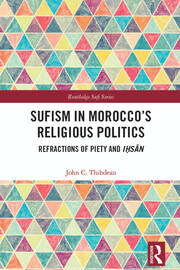
245 10|aSufism in Morocco's religious politics :|brefractions of piety and iḥsān /|cJohn C. Thibdeau.
250 |aFirst.
264 1|aNew York :|bRoutledge,|c2023.
300 |a1 online resource.
336 |atext|btxt|2rdacontent
337 |acomputer|bc|2rdamedia
338 |aonline resource|bcr|2rdacarrier
490 1 |aRoutledge Sufi series
505 0 |a1. Introduction: Iḥsān and Practical Sufism -- 2. Three Histories of Sufism and Politics in Morocco -- 3. A Visionary Order: Shaykh Fawzi and the Karkariyya -- 4. Pilgrimage and Politics in the Karkariyya -- 5. Sufism and the Neoliberal Ethic in the IACSAS -- 6. Bringing the Zawiya into the World with the ʻAlāwiyya -- 7. Lenses of Refraction: Conclusion.
520 |a"This book outlines the role of Sufism in Moroccan politics in the twenty-first century through a comparative study of contemporary Sufi organizations. The author begins his analysis by highlighting the strategies employed by the Moroccan state over the past twenty years, aimed at regulating and producing an authorized 'Moroccan Islam' in the kingdom. Despite these policies of spiritual security and spiritual diplomacy, including the state sponsorship of Sufi organizations, the author argues that this has not decreased diversity nor produced a banal interpretation of Islam, but rather given rise to diverse articulations and performances of this religiosity. Through a comparative analysis of three Sufi organizations based on eighteen months of fieldwork - two of which have never before been studied - the author brings into relief the spaces of creative enactment of Sufism as an ethical tradition. Ultimately, it is argued that each Sufi organization reflects a different refraction of iḥsān, a concept emphasising the cultivation of public piety which underpins the Moroccan state's formulation of Islam. Focused on both theoretical contributions to Islamic studies and topical treatments of geopolitical issues like spiritual diplomacy, the Western Sahara, and Morocco-Algeria, the book spans multiple disciplines, including anthropology, religious studies, sociology, and political science"--|cProvided by publisher.
588 |aOCLC-licensed vendor bibliographic record.
650 0|aSufism|zMorocco.
650 0|aSufism|xPolitical aspects|zMorocco.
650 0|aIslam and politics|zMorocco.
650 7|aRELIGION / Islam / Sufism|2bisacsh
830 0|aRoutledge Sufi series.
856 40|3Taylor & Francis|uhttps://www.taylorfrancis.com/books/9781003386193
856 42|3OCLC metadata license agreement|uhttp://www.oclc.org/content/dam/oclc/forms/terms/vbrl-201703.pdf
901 |aTaylor & Francis