

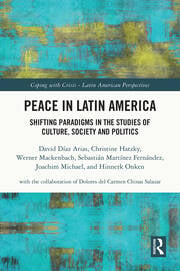
Shifting the paradigm from violence to peace : culture, arts, state and civil society in Latin America / David Díaz-Arias, Christine Hatzky, Werner Mackenbach, Sebastián Martínez Fernández, Joachim Michael, Hinnerk Onken ; with the collaboration of Dolores del Carmen Chinas Salazar.
ISBN
9781003519515 (ebk)
1003519512
9781040153932 (electronic bk. : PDF)
1040153933 (electronic bk. : PDF)
9781040153956 (electronic bk. : EPUB)
104015395X (electronic bk. : EPUB)
9781032857190 (hbk)
1003519512
9781040153932 (electronic bk. : PDF)
1040153933 (electronic bk. : PDF)
9781040153956 (electronic bk. : EPUB)
104015395X (electronic bk. : EPUB)
9781032857190 (hbk)
Dil Kodu
İngilizce
Yazar
Yayın Bilgisi
New York : Routledge, 2024.
© 2025
© 2025
Fiziksel Niteleme
1 online resource.
Dizi
Coping with crisis - Latin American perspectives
Özet, vb.
"This volume shifts the focus from violence to peace studies in Latin America, and it sheds light on how social groups and individuals resist to violence and strive to create peaceful or at least less violent conditions of conviviality. Drawing on social sciences, history, and anthropology, but also on cultural, literary, and film studies, the book examines the role of social mobilizations, civic activism, and cultural/artistic initiatives as responses to the crisis of violence, which the state is unable or unwilling to address. In this sense, it debates what a culture of peace could mean in Latin America. Divided into four parts, Part One discusses peace from an epistemological and philosophical perspective. In Part Two, the authors discuss the contours of a culture of peace with a particular focus on literary and cinematic narratives. Part Three analyzes the public debate about the role of the state in peace processes in the case of Costa Rica/Central America. Part Four examines the importance of civil society activities in peace processes. Peace Studies in Latin America is written for a wide and diverse audience that includes researchers, professors, specialists, students, civil society activists, and political actors not only from Latin America but from all over the world"-- Provided by publisher.
Konu
Peace-building __ Latin America.
Violence __ Latin America.
Politics and culture __ Latin America.
Arts, Latin American.
Civil society __ Latin America.
Social movements __ Latin America.
Political participation __ Latin America.
State governments __ Latin America.
POLITICAL SCIENCE / General __ bisacsh
Violence __ Latin America.
Politics and culture __ Latin America.
Arts, Latin American.
Civil society __ Latin America.
Social movements __ Latin America.
Political participation __ Latin America.
State governments __ Latin America.
POLITICAL SCIENCE / General __ bisacsh
Diğer Yazarlar
Veritabanı
