

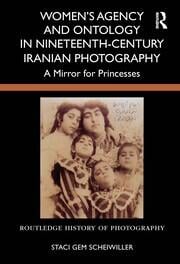
Women's agency and ontology in nineteenth-century Iranian photography / Staci Gem Scheiwiller.
ISBN
9781003543190 ebook
1003543197
9781040351536 (electronic bk. : PDF)
1040351530 (electronic bk. : PDF)
9781040351543 (electronic bk. : EPUB)
1040351549 (electronic bk. : EPUB)
9781032884202 hardback
9781032895086 paperback
1003543197
9781040351536 (electronic bk. : PDF)
1040351530 (electronic bk. : PDF)
9781040351543 (electronic bk. : EPUB)
1040351549 (electronic bk. : EPUB)
9781032884202 hardback
9781032895086 paperback
Dil Kodu
İngilizce
Yazar
Yayın Bilgisi
New York, NY : Routledge, 2025.
Fiziksel Niteleme
1 online resource.
Dizi
Routledge history of photography
İçindekiler Notu
Introduction -- Myths and origins of women in Qajar photography -- Mahd e Olya : the photography queen part I -- Mahd e Olya : the photography queen part II -- To be seen or not to seen : photography and the queen of Iran, Anis al Dowleh -- Within the realm of a dying harem : the photographs of Khanom Bashi -- A mother of the hearth : the photographs of Princess Esmat al Dowleh -- A mother of the revolution : the photographs of Taj Alsaltaneh -- Outside the harem : celebrity and modernity in the photographs of public women -- Conclusion : photographs of sublimation: from harem to girls schools.
Özet, vb.
"This study argues that photographs from Qajar Iran (1785-1925) of harem women, royal women, and public women, such as sex workers, musicians, singers, and dancers, make profound statements on the institution of the harem in a time of flux and modernization. Depictions of the harem in photographs shifted the scopic regime of power and made visible an Iranian "Sultanate of Women," which produced a short succession of formidable, driven women. These photographs became instrumental as a "mirror for princesses," in which women consolidated their political control by fashioning their images, constructing pictures of female rule, leaving a legacy and blueprint for future heads of harem, and bolstering their positions within the harem, the court, the state, and the global arena. Thus, photography played a major role as an ontic condition that would further reformulate perceptions of harem women's ontological Being in the world, resulting in photographic evidence of their perceived agency. By the late nineteenth century, however, the institution of the harem began to wane, and women's search for political influence had to shift to photographs that were marked distinctly and visibly as "anti-harem." The book will be of interest to scholars working in art history, history of photography, gender studies, and Iranian studies"-- Provided by publisher.
Konu
Photography of women __ Iran __ History.
Photography __ Iran __ History.
Women __ Iran __ History.
Harems __ Iran __ History.
Photography __ Iran __ History.
Women __ Iran __ History.
Harems __ Iran __ History.
Veritabanı
Eseri Alıntıla
Referansları kullanmadan önce gözden geçirmeniz ve varsa gerekli düzeltmeleri yapmanız önerilir.
Dijital Kaynak
MARC Görünümü
LEADER 04567cam a22006738i 4500
001 793342
003 TR_AnAIT
005 20260123001554
006 m o d
007 cr |||||||||||
008 241220s2025 nyu ob 001 0 eng
020 |a9781003543190|qebook
020 |a1003543197
020 |a9781040351536|q(electronic bk. : PDF)
020 |a1040351530|q(electronic bk. : PDF)
020 |a9781040351543|q(electronic bk. : EPUB)
020 |a1040351549|q(electronic bk. : EPUB)
020 |z9781032884202|qhardback
020 |z9781032895086|qpaperback
024 7 |a10.4324/9781003543190|2doi
035 |a(OCoLC)1517658499
035 |a(OCoLC-P)1517658499
040 |aOCoLC-P|beng|erda|cOCoLC-P
041 |aeng
049 |aTürk Tarih Kurumu Kütüphanesi
050 00|aTR681.W6
050 4|aTR681.W6
072 7|aAC|2bicssc
072 7|aART015000|2bisacsh
072 7|aAJ|2bicssc
072 7|aJFSJ|2bicssc
072 7|aAB|2bicssc
072 7|aHB|2bicssc
072 7|aAF|2bicssc
072 7|aGTB|2bicssc
072 7|aJHB|2bicssc
072 7|aPHO010000|2bisacsh
072 7|aSOC032000|2bisacsh
082 00|a779/.240955|223/eng/20250515
100 1 |aScheiwiller, Staci Gem,|eauthor.|4aut|4http://id.loc.gov/vocabulary/relators/aut|1https://id.oclc.org/worldcat/entity/E39PCjv7r6xgPVbcHrD97HxJWC|1http://id.loc.gov/rwo/agents/n2013003079
245 10|aWomen's agency and ontology in nineteenth-century Iranian photography /|cStaci Gem Scheiwiller.
264 1|aNew York, NY :|bRoutledge,|c2025.
300 |a1 online resource.
334 |asingle unit|bmono|0http://id.loc.gov/vocabulary/issuance/mono
336 |atext|btxt|2rdacontent
337 |acomputer|bc|2rdamedia
338 |aonline resource|bcr|2rdacarrier
353 |abibliography|bbibliography|0http://id.loc.gov/vocabulary/msupplcont/bibliography
353 |aindex|bindex|0http://id.loc.gov/vocabulary/msupplcont/index
490 0 |aRoutledge history of photography
505 0 |aIntroduction -- Myths and origins of women in Qajar photography -- Mahd e Olya : the photography queen part I -- Mahd e Olya : the photography queen part II -- To be seen or not to seen : photography and the queen of Iran, Anis al Dowleh -- Within the realm of a dying harem : the photographs of Khanom Bashi -- A mother of the hearth : the photographs of Princess Esmat al Dowleh -- A mother of the revolution : the photographs of Taj Alsaltaneh -- Outside the harem : celebrity and modernity in the photographs of public women -- Conclusion : photographs of sublimation: from harem to girls schools.
520 |a"This study argues that photographs from Qajar Iran (1785-1925) of harem women, royal women, and public women, such as sex workers, musicians, singers, and dancers, make profound statements on the institution of the harem in a time of flux and modernization. Depictions of the harem in photographs shifted the scopic regime of power and made visible an Iranian "Sultanate of Women," which produced a short succession of formidable, driven women. These photographs became instrumental as a "mirror for princesses," in which women consolidated their political control by fashioning their images, constructing pictures of female rule, leaving a legacy and blueprint for future heads of harem, and bolstering their positions within the harem, the court, the state, and the global arena. Thus, photography played a major role as an ontic condition that would further reformulate perceptions of harem women's ontological Being in the world, resulting in photographic evidence of their perceived agency. By the late nineteenth century, however, the institution of the harem began to wane, and women's search for political influence had to shift to photographs that were marked distinctly and visibly as "anti-harem." The book will be of interest to scholars working in art history, history of photography, gender studies, and Iranian studies"-- Provided by publisher.
588 |aOCLC-licensed vendor bibliographic record.
650 0|aPhotography of women|zIran|xHistory.
650 0|aPhotography|zIran|xHistory.
650 0|aWomen|zIran|xHistory.
650 0|aHarems|zIran|xHistory.
758 |1http://id.loc.gov/resources/instances/23959808
758 |4http://id.loc.gov/ontologies/bibframe/instanceOf|1http://id.loc.gov/resources/works/23959808
856 40|3Taylor & Francis|uhttps://www.taylorfrancis.com/books/9781003543190
856 42|3OCLC metadata license agreement|uhttp://www.oclc.org/content/dam/oclc/forms/terms/vbrl-201703.pdf
901 |aTaylor & Francis
001 793342
003 TR_AnAIT
005 20260123001554
006 m o d
007 cr |||||||||||
008 241220s2025 nyu ob 001 0 eng
020 |a9781003543190|qebook
020 |a1003543197
020 |a9781040351536|q(electronic bk. : PDF)
020 |a1040351530|q(electronic bk. : PDF)
020 |a9781040351543|q(electronic bk. : EPUB)
020 |a1040351549|q(electronic bk. : EPUB)
020 |z9781032884202|qhardback
020 |z9781032895086|qpaperback
024 7 |a10.4324/9781003543190|2doi
035 |a(OCoLC)1517658499
035 |a(OCoLC-P)1517658499
040 |aOCoLC-P|beng|erda|cOCoLC-P
041 |aeng
049 |aTürk Tarih Kurumu Kütüphanesi
050 00|aTR681.W6
050 4|aTR681.W6
072 7|aAC|2bicssc
072 7|aART015000|2bisacsh
072 7|aAJ|2bicssc
072 7|aJFSJ|2bicssc
072 7|aAB|2bicssc
072 7|aHB|2bicssc
072 7|aAF|2bicssc
072 7|aGTB|2bicssc
072 7|aJHB|2bicssc
072 7|aPHO010000|2bisacsh
072 7|aSOC032000|2bisacsh
082 00|a779/.240955|223/eng/20250515
100 1 |aScheiwiller, Staci Gem,|eauthor.|4aut|4http://id.loc.gov/vocabulary/relators/aut|1https://id.oclc.org/worldcat/entity/E39PCjv7r6xgPVbcHrD97HxJWC|1http://id.loc.gov/rwo/agents/n2013003079
245 10|aWomen's agency and ontology in nineteenth-century Iranian photography /|cStaci Gem Scheiwiller.
264 1|aNew York, NY :|bRoutledge,|c2025.
300 |a1 online resource.
334 |asingle unit|bmono|0http://id.loc.gov/vocabulary/issuance/mono
336 |atext|btxt|2rdacontent
337 |acomputer|bc|2rdamedia
338 |aonline resource|bcr|2rdacarrier
353 |abibliography|bbibliography|0http://id.loc.gov/vocabulary/msupplcont/bibliography
353 |aindex|bindex|0http://id.loc.gov/vocabulary/msupplcont/index
490 0 |aRoutledge history of photography
505 0 |aIntroduction -- Myths and origins of women in Qajar photography -- Mahd e Olya : the photography queen part I -- Mahd e Olya : the photography queen part II -- To be seen or not to seen : photography and the queen of Iran, Anis al Dowleh -- Within the realm of a dying harem : the photographs of Khanom Bashi -- A mother of the hearth : the photographs of Princess Esmat al Dowleh -- A mother of the revolution : the photographs of Taj Alsaltaneh -- Outside the harem : celebrity and modernity in the photographs of public women -- Conclusion : photographs of sublimation: from harem to girls schools.
520 |a"This study argues that photographs from Qajar Iran (1785-1925) of harem women, royal women, and public women, such as sex workers, musicians, singers, and dancers, make profound statements on the institution of the harem in a time of flux and modernization. Depictions of the harem in photographs shifted the scopic regime of power and made visible an Iranian "Sultanate of Women," which produced a short succession of formidable, driven women. These photographs became instrumental as a "mirror for princesses," in which women consolidated their political control by fashioning their images, constructing pictures of female rule, leaving a legacy and blueprint for future heads of harem, and bolstering their positions within the harem, the court, the state, and the global arena. Thus, photography played a major role as an ontic condition that would further reformulate perceptions of harem women's ontological Being in the world, resulting in photographic evidence of their perceived agency. By the late nineteenth century, however, the institution of the harem began to wane, and women's search for political influence had to shift to photographs that were marked distinctly and visibly as "anti-harem." The book will be of interest to scholars working in art history, history of photography, gender studies, and Iranian studies"-- Provided by publisher.
588 |aOCLC-licensed vendor bibliographic record.
650 0|aPhotography of women|zIran|xHistory.
650 0|aPhotography|zIran|xHistory.
650 0|aWomen|zIran|xHistory.
650 0|aHarems|zIran|xHistory.
758 |1http://id.loc.gov/resources/instances/23959808
758 |4http://id.loc.gov/ontologies/bibframe/instanceOf|1http://id.loc.gov/resources/works/23959808
856 40|3Taylor & Francis|uhttps://www.taylorfrancis.com/books/9781003543190
856 42|3OCLC metadata license agreement|uhttp://www.oclc.org/content/dam/oclc/forms/terms/vbrl-201703.pdf
901 |aTaylor & Francis
Materyaller
Depodan talep edilen materyal sadece kütüphane içerisinde kullanılmaktadır.
Materyal dışarıya ödünç verilmemektedir.
Materyal dışarıya ödünç verilmemektedir.
