

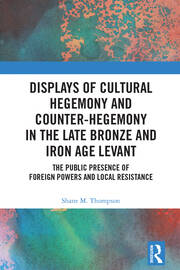
Displays of cultural hegemony and counter-hegemony in the late Bronze and Iron age Levant : the public presence of foreign powers and local resistance / Shane M. Thompson.
ISBN
9781032250557 (ebook)
1032250550
9781000846263 (electronic bk. : EPUB)
1000846261 (electronic bk. : EPUB)
9781000846232 (electronic bk. : PDF)
1000846237 (electronic bk. : PDF)
9781032250533 (hardback)
9781032250564 (paperback)
1032250550
9781000846263 (electronic bk. : EPUB)
1000846261 (electronic bk. : EPUB)
9781000846232 (electronic bk. : PDF)
1000846237 (electronic bk. : PDF)
9781032250533 (hardback)
9781032250564 (paperback)
Dil Kodu
İngilizce
Yazar
Yayın Bilgisi
Abingdon, Oxon ; New York, NY : Routledge, 2023.
Fiziksel Niteleme
1 online resource
İçindekiler Notu
Epigraphic evidence for cultural hegemony and counter-hegemony from Emar -- Epigraphic evidence for cultural hegemony and counter-hegemony from Ugarit -- Archaeological evidence from Syria -- Egyptian conceptions and manifestations of border in the Southern Levant -- Egyptian temples in the Southern Levant -- Neo-Assyrian conceptions and manifestations of borders in the Iron Age Southern Levant -- Counter-hegemony in the Iron Age Southern Levant -- The Neo-Babylonians in the Levant -- The Neo-Babylonians in the Iron Age prophets.
Özet, vb.
"This volume examines the power relationships between the rulers of the Late Bronze and Iron Age and their subjects in the Levant through the lens of "cultural hegemony". It explores the impact of these foreign powers on all social classes and reconstructs the public presence of cultural control. The book serves to determine the impact of foreign control on the daily lives of those living in the ancient Levant, and offers a means by which to attempt to discuss non-elites in the ancient Near East. It examines expressions of foreign ideology within public performance such as religious expressions and in public places, observable by all social classes, which assert control or dominance over local identity markers. In utilizing textual, epigraphic, and archaeological records, it paints a more complete picture of Levantine society during this time while also drawing upon evidence from neighbouring Anatolia, Egypt, and Mesopotamia. This is a fascinating resource for students and scholars of the ancient Near East, particularly the Levant but also Anatolia, Egypt, and Mesopotamia in the Late Bronze and Iron Age periods. It is also useful for scholars working on power and imperialism across history"-- Provided by publisher.
Konu
Iron age __ Middle East.
Bronze age __ Middle East.
Hegemony __ Middle East __ History __ To 622.
Dependency.
HISTORY / Ancient / General __ bisacsh
Middle East __ Foreign relations.
Bronze age __ Middle East.
Hegemony __ Middle East __ History __ To 622.
Dependency.
HISTORY / Ancient / General __ bisacsh
Middle East __ Foreign relations.
Veritabanı
