

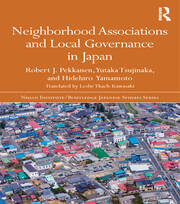
Neighborhood associations and local governance in Japan / Robert J. Pekkanen, Yutaka Tsujinaka and Hidehiro Yamamoto ; translated by Leslie Tkach-Kawasaki.
Erişim Adresi
ISBN
9781315797731 (e-book : PDF)
9781317754411 (e-book: Mobi)
9781317754428 (e-book: ePub)
9780415745734 (hardback)
9781138089488 (paperback)
9781317754411 (e-book: Mobi)
9781317754428 (e-book: ePub)
9780415745734 (hardback)
9781138089488 (paperback)
Dil Kodu
İngilizce
İngilizce
İngilizce
Yazar
Tekbiçim Eser Adı
Gendai Nihon no jichikai, chonaikai. English
Yayın Bilgisi
Abingdon, Oxon ; New York, N.Y. : Routledge, 2014.
Fiziksel Niteleme
1 online resource (xxiv, 255 pages)
Dizi
Nissan Institute/Routledge Japanese studies series
Genel Not
Translation of: Gendai Nihon no jichikai, chonaikai / Tsujinaka Yutaka, Robato Pekkanen, Yamamoto Hidehiro.
İçindekiler Notu
1. Neighborhood associations in Japan's civil society -- 2. Profiles of neighborhood association organizations -- 3. Internal governance and leadership -- 4. Social capital and participation -- 5. Working with other organizations -- 6. Neighborhood associations and social services -- 7. Cooperation and collaboration with local government -- 8. Neighborhood associations and political participation -- 9. Conclusion.
Özet, vb.
"Although local neighborhood associations are found in many countries, Japan's are distinguished by their very high participation rates, making them important for the study of society and politics, as well as the blurring of the state-society boundary. Most Japanese belong to one local neighborhood association or another, making them Japan's most numerous civil society organization, and one that powerfully shapes policy outcomes in the country. Neighborhood Associations and Local Governance in Japan draws on a strong body of empirical data derived from the first national survey of neighborhood associations carried out in 2007 and provides a multifaceted empirical portrait of Japan's neighborhood associations. It examines how local associational structures affect the quality of local governance, and thus the quality of life for Japan's citizens and residents, and illuminates the way in which these ambiguous associations can help us refine civil society theory and show how they contribute to governance. As well as outlining the key features of neighbourhood associations, the book goes on to examine in detail the way in which neighbourhood associations contribute to governance, in terms of social capital, networks with other community organizations, social service provision, cooperation with local governments and political participation. This book will be welcomed by students and scholars of Japanese politics, Japanese society, anthropology, urban studies as well as those interested in social capital and civil society"-- Provided by publisher.
Konu
Neighborhood government __ Japan.
Civil society __ Japan.
Civil society __ Japan.
Veritabanı
