LEADER 04032cam a22005538i 4500
001 794249
003 TR_AnAIT
005 20260123003020
006 m o d
007 cr |||||||||||
008 220926s2023 nyu ob 001 0 eng
020 |a9781003351627|q(ebk)
020 |a100335162X
020 |z9781032398365|q(hbk)
020 |z9781032398396|q(pbk)
020 |a9781000838329|qelectronic book
020 |a1000838323|qelectronic book
020 |a9781000838282|qelectronic book
020 |a1000838285|qelectronic book
020 |z1032398361
024 7 |a10.4324/9781003351627|2doi
035 |a(OCoLC)1351894751
035 |a(OCoLC-P)1351894751
040 |aOCoLC-P|beng|erda|cOCoLC-P
041 |aeng
049 |aTürk Tarih Kurumu Kütüphanesi
050 00|aHC175
072 7|aBUS|x023000|2bisacsh
072 7|aKCZ|2bicssc
082 00|a330.982|223/eng/20230315
100 1 |aRougier, Marcelo,|eauthor.
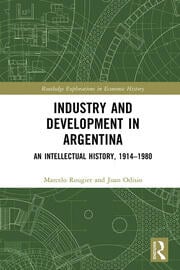
245 10|aIndustry and development in Argentina :|ban intellectual history, 1914-1980 /|cMarcelo Rougier and Juan Odisio ; Translated by James Brennan.
264 1|aAbingdon, Oxon ;|aNew York, NY :|bRoutledge,|c2023.
300 |a1 online resource.
336 |atext|btxt|2rdacontent
337 |acomputer|bc|2rdamedia
338 |aonline resource|bcr|2rdacarrier
490 1 |aRoutledge explorations in economic history
505 0 |aIntroduction -- Why a History of Ideas on Industry? 1. Post Bellum. The Beginnings of 'Industrialism' and the Revista de Economía Argentina (1914-1930) 2. Post Crisis: The Construction of a Consensus: State Intervention and Industrialization (1930-1940) 3. In bello. Wartime Alternatives (1940-1945) 4. Post Bellum. The Beginnings of Industrial Policy and Postwar Dilemmas (1945-1950) 5. Foreign Capital as a Response to External Constraints (1950-1962) 6. The Renewed Heyday of the Industrial Debate (1962-1965) 7. Consolidation of the "Industrial-Export" Consensus (1965-1969) 8. From Dependency to Peronist Nationalism (1970-1975) 9. Alea iacta est. The End of the Industrial Consensus (1975-1980).
520 |a"This book explores the twists and turns in Argentina's modern economic history and the debates that raged there around a problem common to all former colonies: how to achieve a level of economic growth for its population in a world characterized by unequal economic relations between the industrialized nations of the north and the commodity producers of the south. This pathbreaking book on the history of ideas on industrialization and economic development in Argentina draws on a rigorous investigation of multiple sources which demonstrates Argentina's role as a laboratory for and disseminator of ideas that would eventually become the common property of all the developing world. Influential thinkers such as Raúl Prebisch and Aldo Ferrer, leading figures in twentieth century Latin American economic thought, developed important ideas such as unequal international trade relations, the promise and limits of Import Substitution Industrialization, the role of the state in the development of a national capitalism. These were the forerunners of similar concerns in other countries in Latin America and elsewhere in the world. The book will be of interest to historians, economists, sociologists of economic development and related disciplines concerned with questions of global economic inequality"--|cProvided by publisher.
588 |aOCLC-licensed vendor bibliographic record.
650 0|aEconomic development|zArgentina.
650 0|aEquality|xEconomic aspects.
650 0|aEconomic history.
650 7|aBUSINESS & ECONOMICS / Economic History|2bisacsh
651 0|aArgentina|xHistory.
651 0|aArgentina|xEconomic conditions.
700 1 |aOdisio, Juan,|eauthor.
830 0|aRoutledge explorations in economic history.
856 40|3Taylor & Francis|uhttps://www.taylorfrancis.com/books/9781003351627
856 42|3OCLC metadata license agreement|uhttp://www.oclc.org/content/dam/oclc/forms/terms/vbrl-201703.pdf
901 |aTaylor & Francis