

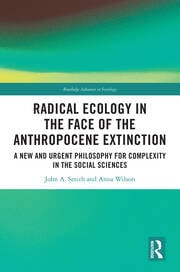
Radical ecology in the face of the anthropocene extinction : a new and urgent philosophy for complexity in the social sciences / John A. Smith and Anna Wilson.
ISBN
9781003399742 (ebook)
1003399746
9781040050293 (electronic bk.)
1040050298 (electronic bk.)
9781040050507 (electronic bk. : EPUB)
1040050506 (electronic bk. : EPUB)
9781032508115 (hardback)
9781032508139 (paperback)
1032508116
1003399746
9781040050293 (electronic bk.)
1040050298 (electronic bk.)
9781040050507 (electronic bk. : EPUB)
1040050506 (electronic bk. : EPUB)
9781032508115 (hardback)
9781032508139 (paperback)
1032508116
Dil Kodu
İngilizce
Yayın Bilgisi
Abingdon, Oxon ; New York, NY : Routledge, 2024.
Fiziksel Niteleme
1 online resource.
Dizi
Routledge advances in sociology
İçindekiler Notu
Part one: a radical ecological philosophy -- Reforming the enlightenment: chance as a second- order phenomenon and post-humanism -- Auto-eco-organisation as ontology: the sciences of emergence -- Auto-exo-reference as epistemology: a bio-semiotic approach -- Materialist Darwinism and its discontents: debates in the modern synthesis, the ecology of physical and semantic causality; end-directedness and its consequences for an ecological social science -- The evolutionary ecology of the social: the adaptive unconscious, the mammalian emotions, the significance of approximation and end-directed dynamics -- Part two: the anthropocene extinction -- Summary of part one and methodology for part two -- Three case studies -- The anthropocene extinction: explicit evidence and implicit epistemology -- Global governance and its discontents "in practice": radically incompatible perspectives: political, economic, cultural and scientific conflicts -- In place of a conclusion: imperatives and ambiguities.
Özet, vb.
"This book has two interlocking ambitions. The first is to steer what we purposefully call the idioms of critical philosophy towards a more ecologically-informed paradigm. The second is to recognise that what has rightly come to be called the Anthropocene Extinction is not and cannot be treated as simply a scientific fact but is rather a socio-political and ecological dispute of immense complexity. We start with an exploration of the consequences of a critical tradition which, under the name Enlightenment, has placed humanity at its centre and chance as its most general -and problematic - characteristic. We argue that this leads to a schizophrenic relationship between radical critique and science which can be avoided if we take the implications of biosemiotics seriously and develop a new, ecologically-informed social science. We argue that in practice this means that for science to be practical in addressing to the Anthropocene extinction, we have to recognise that it operates in a historically emergent, highly differentiated techno-political ecology. Science, as it is currently commonly understood and used, is not ecological enough. This book will interest social scientists interested in not only describing and critiquing but also understanding and responding to the complex problems facing humanity; scientists wanting to make sense of social phenomena; those educating the next generation of social scientists; and climate activists and policy makers"-- Provided by publisher.
Konu
Social ecology.
Human ecology.
Critical theory.
Sociology __ Philosophy.
Mass extinctions.
SOCIAL SCIENCE / Sociology / General __ bisacsh
Human ecology.
Critical theory.
Sociology __ Philosophy.
Mass extinctions.
SOCIAL SCIENCE / Sociology / General __ bisacsh
Diğer Yazarlar
Veritabanı
Eseri Alıntıla
Referansları kullanmadan önce gözden geçirmeniz ve varsa gerekli düzeltmeleri yapmanız önerilir.
Dijital Kaynak
MARC Görünümü
LEADER 04479cam a22005418i 4500
001 794294
003 TR_AnAIT
005 20260123003115
006 m o d
007 cr |||||||||||
008 240405s2024 enk ob 001 0 eng
020 |a9781003399742|q(ebook)
020 |a1003399746
020 |a9781040050293|q(electronic bk.)
020 |a1040050298|q(electronic bk.)
020 |a9781040050507|q(electronic bk. : EPUB)
020 |a1040050506|q(electronic bk. : EPUB)
020 |z9781032508115|q(hardback)
020 |z9781032508139|q(paperback)
020 |z1032508116
024 7 |a10.4324/9781003399742|2doi
035 |a(OCoLC)1430193581
035 |a(OCoLC-P)1430193581
040 |aOCoLC-P|beng|erda|cOCoLC-P
041 |aeng
049 |aTürk Tarih Kurumu Kütüphanesi
050 00|aHM861
072 7|aSOC|x026000|2bisacsh
072 7|aJHB|2bicssc
082 00|a304.2|223/eng/20240416
100 1 |aSmith, John A.,|d1947 April 16-|eauthor.
245 10|aRadical ecology in the face of the anthropocene extinction :|ba new and urgent philosophy for complexity in the social sciences /|cJohn A. Smith and Anna Wilson.
264 1|aAbingdon, Oxon ;|aNew York, NY :|bRoutledge,|c2024.
300 |a1 online resource.
336 |atext|btxt|2rdacontent
337 |acomputer|bc|2rdamedia
338 |aonline resource|bcr|2rdacarrier
490 0 |aRoutledge advances in sociology
505 0 |aPart one: a radical ecological philosophy -- Reforming the enlightenment: chance as a second- order phenomenon and post-humanism -- Auto-eco-organisation as ontology: the sciences of emergence -- Auto-exo-reference as epistemology: a bio-semiotic approach -- Materialist Darwinism and its discontents: debates in the modern synthesis, the ecology of physical and semantic causality; end-directedness and its consequences for an ecological social science -- The evolutionary ecology of the social: the adaptive unconscious, the mammalian emotions, the significance of approximation and end-directed dynamics -- Part two: the anthropocene extinction -- Summary of part one and methodology for part two -- Three case studies -- The anthropocene extinction: explicit evidence and implicit epistemology -- Global governance and its discontents "in practice": radically incompatible perspectives: political, economic, cultural and scientific conflicts -- In place of a conclusion: imperatives and ambiguities.
520 |a"This book has two interlocking ambitions. The first is to steer what we purposefully call the idioms of critical philosophy towards a more ecologically-informed paradigm. The second is to recognise that what has rightly come to be called the Anthropocene Extinction is not and cannot be treated as simply a scientific fact but is rather a socio-political and ecological dispute of immense complexity. We start with an exploration of the consequences of a critical tradition which, under the name Enlightenment, has placed humanity at its centre and chance as its most general -and problematic - characteristic. We argue that this leads to a schizophrenic relationship between radical critique and science which can be avoided if we take the implications of biosemiotics seriously and develop a new, ecologically-informed social science. We argue that in practice this means that for science to be practical in addressing to the Anthropocene extinction, we have to recognise that it operates in a historically emergent, highly differentiated techno-political ecology. Science, as it is currently commonly understood and used, is not ecological enough. This book will interest social scientists interested in not only describing and critiquing but also understanding and responding to the complex problems facing humanity; scientists wanting to make sense of social phenomena; those educating the next generation of social scientists; and climate activists and policy makers"--|cProvided by publisher.
588 |aOCLC-licensed vendor bibliographic record.
650 0|aSocial ecology.
650 0|aHuman ecology.
650 0|aCritical theory.
650 0|aSociology|xPhilosophy.
650 0|aMass extinctions.
650 7|aSOCIAL SCIENCE / Sociology / General|2bisacsh
700 1 |aWilson, Anna|c(Lecturer in lifelong learning),|eauthor.
856 40|3Taylor & Francis|uhttps://www.taylorfrancis.com/books/9781003399742
856 42|3OCLC metadata license agreement|uhttp://www.oclc.org/content/dam/oclc/forms/terms/vbrl-201703.pdf
901 |aTaylor & Francis
001 794294
003 TR_AnAIT
005 20260123003115
006 m o d
007 cr |||||||||||
008 240405s2024 enk ob 001 0 eng
020 |a9781003399742|q(ebook)
020 |a1003399746
020 |a9781040050293|q(electronic bk.)
020 |a1040050298|q(electronic bk.)
020 |a9781040050507|q(electronic bk. : EPUB)
020 |a1040050506|q(electronic bk. : EPUB)
020 |z9781032508115|q(hardback)
020 |z9781032508139|q(paperback)
020 |z1032508116
024 7 |a10.4324/9781003399742|2doi
035 |a(OCoLC)1430193581
035 |a(OCoLC-P)1430193581
040 |aOCoLC-P|beng|erda|cOCoLC-P
041 |aeng
049 |aTürk Tarih Kurumu Kütüphanesi
050 00|aHM861
072 7|aSOC|x026000|2bisacsh
072 7|aJHB|2bicssc
082 00|a304.2|223/eng/20240416
100 1 |aSmith, John A.,|d1947 April 16-|eauthor.
245 10|aRadical ecology in the face of the anthropocene extinction :|ba new and urgent philosophy for complexity in the social sciences /|cJohn A. Smith and Anna Wilson.
264 1|aAbingdon, Oxon ;|aNew York, NY :|bRoutledge,|c2024.
300 |a1 online resource.
336 |atext|btxt|2rdacontent
337 |acomputer|bc|2rdamedia
338 |aonline resource|bcr|2rdacarrier
490 0 |aRoutledge advances in sociology
505 0 |aPart one: a radical ecological philosophy -- Reforming the enlightenment: chance as a second- order phenomenon and post-humanism -- Auto-eco-organisation as ontology: the sciences of emergence -- Auto-exo-reference as epistemology: a bio-semiotic approach -- Materialist Darwinism and its discontents: debates in the modern synthesis, the ecology of physical and semantic causality; end-directedness and its consequences for an ecological social science -- The evolutionary ecology of the social: the adaptive unconscious, the mammalian emotions, the significance of approximation and end-directed dynamics -- Part two: the anthropocene extinction -- Summary of part one and methodology for part two -- Three case studies -- The anthropocene extinction: explicit evidence and implicit epistemology -- Global governance and its discontents "in practice": radically incompatible perspectives: political, economic, cultural and scientific conflicts -- In place of a conclusion: imperatives and ambiguities.
520 |a"This book has two interlocking ambitions. The first is to steer what we purposefully call the idioms of critical philosophy towards a more ecologically-informed paradigm. The second is to recognise that what has rightly come to be called the Anthropocene Extinction is not and cannot be treated as simply a scientific fact but is rather a socio-political and ecological dispute of immense complexity. We start with an exploration of the consequences of a critical tradition which, under the name Enlightenment, has placed humanity at its centre and chance as its most general -and problematic - characteristic. We argue that this leads to a schizophrenic relationship between radical critique and science which can be avoided if we take the implications of biosemiotics seriously and develop a new, ecologically-informed social science. We argue that in practice this means that for science to be practical in addressing to the Anthropocene extinction, we have to recognise that it operates in a historically emergent, highly differentiated techno-political ecology. Science, as it is currently commonly understood and used, is not ecological enough. This book will interest social scientists interested in not only describing and critiquing but also understanding and responding to the complex problems facing humanity; scientists wanting to make sense of social phenomena; those educating the next generation of social scientists; and climate activists and policy makers"--|cProvided by publisher.
588 |aOCLC-licensed vendor bibliographic record.
650 0|aSocial ecology.
650 0|aHuman ecology.
650 0|aCritical theory.
650 0|aSociology|xPhilosophy.
650 0|aMass extinctions.
650 7|aSOCIAL SCIENCE / Sociology / General|2bisacsh
700 1 |aWilson, Anna|c(Lecturer in lifelong learning),|eauthor.
856 40|3Taylor & Francis|uhttps://www.taylorfrancis.com/books/9781003399742
856 42|3OCLC metadata license agreement|uhttp://www.oclc.org/content/dam/oclc/forms/terms/vbrl-201703.pdf
901 |aTaylor & Francis
Materyaller
Depodan talep edilen materyal sadece kütüphane içerisinde kullanılmaktadır.
Materyal dışarıya ödünç verilmemektedir.
Materyal dışarıya ödünç verilmemektedir.
