LEADER 03890cam a2200541 i 4500
001 794354
003 TR_AnAIT
005 20260123003223
006 m o d
007 cr cnu---unuuu
008 250904t20262026enka ob 001 0 eng d
020 |a9781040683255|qelectronic book
020 |a1040683258|qelectronic book
020 |a9781003496908|qelectronic book
020 |a1003496903|qelectronic book
020 |a9781040530825|q(electronic bk. : PDF)
020 |a1040530826|q(electronic bk. : PDF)
020 |z9781032804446|qhardcover
024 8 |aCIPO000289114
024 7 |a10.4324/9781003496908|2doi
035 |a(OCoLC)1545081357
035 |a(OCoLC-P)1545081357
040 |aOCoLC-P|beng|erda|epn|cOCoLC-P
041 |aeng
049 |aTürk Tarih Kurumu Kütüphanesi
050 4|aGN666|b.T56 2026
072 7|aGL|2bicssc
072 7|aLAN025020|2bisacsh
072 7|aJHM|2bicssc
072 7|aSOC062000|2bisacsh
072 7|aLAN025000|2bisacsh
082 04|a027.094|223/eng/20260109
100 1 |aThorpe, Kirsten,|eauthor.
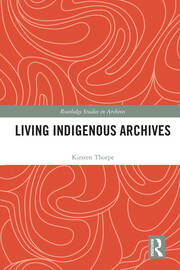
245 10|aLiving indigenous archives /|cKirsten Thorpe.
264 1|aAbingdon, Oxon ;|aNew York, NY :|bRoutledge,|c2026.
264 4|c??2026
300 |a1 online resource (208 pages) :|billustrations.
336 |atext|btxt|2rdacontent
337 |acomputer|bc|2rdamedia
338 |aonline resource|bcr|2rdacarrier
490 1 |aRoutledge studies in archives
520 |aLiving Indigenous Archives invites readers to consider new pathways for developing and sustaining archival landscapes that are embedded with respect for Indigenous worldviews and cultural flows of knowledge.Drawing on First Nations experiences in Australia, the book considers the need to reframe archives in order to rebalance power and restore dignity to the Aboriginal and Torres Strait Islander people captured in the archives. Contributing to research on the contested nature of archives and the need for archival decolonisation, the book examines whether current, dominant approaches to archiving and managing Aboriginal and Torres Strait Islander knowledges support Indigenous people's wellbeing and recognize Indigenous sovereignty in an archival context. Drawing on autoethnographical research and a series of yarning sessions with First Nations people, the book shares a number of case studies that discuss themes related to Indigenous archiving. These include: community engagement approaches to facilitate reciprocal relationships and counter-storytelling; archival reparations; enacting protocols to support archives' spiritual and emotional care; and the support for Indigenous language revitalization in archives.Living Indigenous Archives highlights the need for Indigenous reclamation of archives and the dismantling of colonial archiving models that are harmful to Indigenous people's wellbeing. The book's theoretical and practical underpinnings will be relevant to academics and students working in archival studies, as well as those engaged in the study of library and information science, Indigenous peoples and history.
532 1 |3EBSCOhost|a"EBSCO evaluates our products based on the Web Content Accessibility Guidelines (WCAG) and the related Section 508 and EN 301 549 regulations in the US and EU. Most EBSCO products are substantially conformant with WCAG 2.2 level AA." Source: https://connect.ebsco.com/s/article/EBSCO-VPATs?language=en_US. Last accessed April 22, 2025.
588 |aOCLC-licensed vendor bibliographic record.
650 0|aAboriginal Australians|xArchives.
650 0|aArchives|zAustralia.
830 0|aRoutledge studies in archives.
856 40|uhttps://www.taylorfrancis.com/books/9781003496908|3Taylor & Francis
856 40|3Taylor & Francis|uhttps://www.taylorfrancis.com/books/9781003496908
856 42|3OCLC metadata license agreement|uhttp://www.oclc.org/content/dam/oclc/forms/terms/vbrl-201703.pdf
901 |aTaylor & Francis