

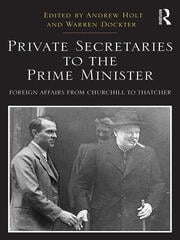
Private Secretaries to the Prime Minister : Foreign Affairs from Churchill to Thatcher / Andrew Holt.
Erişim Adresi
ISBN
9781315602233 (e-book : PDF)
9781317075622 (e-book: Mobi)
9781409441809 (hardback)
9781317075622 (e-book: Mobi)
9781409441809 (hardback)
Dil Kodu
İngilizce
Basım Bildirimi
First edition.
Yayın Bilgisi
London : Taylor and Francis, 2017.
Fiziksel Niteleme
1 online resource
Dizi
Routledge Studies in Modern British History
İçindekiler Notu
chapter Introduction / CHARLES POWELL -- chapter 1 Managing a giant: Jock Colville and Winston Churchill / WARREN DOCKTER -- chapter 2 Advising the un-advisable: The Number 10 Private Office and the Suez Crisis / KEVIN RUANE -- chapter 3 Philip de Zulueta / PETER CATTERALL -- chapter 4 Oliver Wright / ANDREW HOLT -- chapter 5 Michael Palliser / JOHN W. YOUNG -- chapter 6 ‘Sound and comfortable men’: Peter Moon, Lord Bridges and Britain’s entry into the EEC / NICK THOMAS -- chapter 7 Patrick Wright and Bryan Cartledge / JOHN SHEPHERD -- chapter 8 Margaret Thatcher’s Private Secretaries for Foreign Affairs, 1979–1984.
Özet, vb.
"The importance of the Prime Minister in British foreign policy decision-making has long been noted by historians. However, while much attention has been given to high-level contacts between leaders and to the roles played by the premiers themselves, much less is known about the people advising and influencing them. In providing day-to-day assistance to the Prime Minister, a Private Secretary could wield significant influence on policy outcomes. This book examines the activities of those who advised prime ministers from Winston Churchill (1951-55) to Margaret Thatcher during her first administration (1979-83). Each chapter considers British foreign policy and assesses the influence of the specific advisers. For each office holder, particular attention is paid to a number of key themes. Firstly, their relationship with the Prime Minister is considered. A strong personal relationship of trust and respect could lead to an official wielding much greater influence. This could be especially relevant when an adviser served under two different leaders, often from different political parties. It also helps to shed light on the conduct of foreign policy by each premier. Secondly, the attitudes towards the adviser from the Foreign Office are examined. The Foreign Office traditionally enjoyed great autonomy in the making of British foreign policy and was sensitive to encroachments by Downing Street. Finally, each chapter explores the role of the adviser in the key foreign policy events and discussions of the day. Covering a fascinating 30-year period in post-war British political history, this collection broadens our understanding of the subject, and underlines the different ways influence could be brought to bear on government policy."--Provided by publisher.
Konu
Private secretaries __ Great Britain.
Prime ministers __ Great Britain.
Prime ministers __ Great Britain.
Diğer Yazarlar
Veritabanı
