LEADER 03946cam a2200553Ma 4500
001 794774
003 TR_AnAIT
005 20260123003845
006 m o d
007 cr |||||||||||
008 160909s2016 enka fo 000 0 eng d
020 |a9781317662778|q(ebk)
020 |a1317662776
020 |a9781138786622|q(hbk.)
020 |a1138786624
020 |a9781317662761|q(ePub ebook)
020 |a1317662768|q(ePub ebook)
020 |a9781315767215|q(ebook)
020 |a131576721X|q(ebook)
020 |a9781317662754|q(Mobipocket ebook)
020 |a131766275X|q(Mobipocket ebook)
035 |a(OCoLC)1076636662
035 |a(OCoLC-P)1076636662
040 |aOCoLC-P|beng|epn|cOCoLC-P
041 |aeng
049 |aTürk Tarih Kurumu Kütüphanesi
050 4|aHG2525|b.K656 2016eb
072 7|aBUS|x000000|2bisacsh
072 7|aBUS|x023000|2bisacsh
072 7|aBUS|x069000|2bisacsh
072 7|aKFFK|2bicssc
082 04|a332.11097309034|223
100 1 |aKnodell, Jane Ellen,|eauthor.
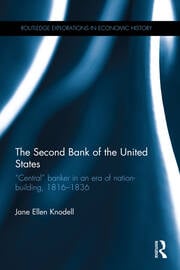
245 14|aThe Second Bank of the United States :|b'Central' banker in an era of nation-building, 1816-1836 /|cJane Ellen Knodell.
260 |aLondon :|bRoutledge,|c2016.
300 |a1 online resource (188 pages) :|billustrations (black and white)
336 |atext|btxt|2rdacontent
336 |astill image|bsti|2rdacontent
337 |acomputer|bc|2rdamedia
338 |aonline resource|bcr|2rdacarrier
490 1 |aRoutledge explorations in economic history.
500 |a
Chapter One: Introduction
Chapter Two: Origin and purposes of the Second Bank
Chapter Three: The Second Bank's branch network and the state banking system
Chapter Four: The Second Bank and the "exchanges": conquering space
Chapter Five: The "production" of monetary stability
Chapter Six: The Second Bank's specie market operations
Chapter Seven: Conclusion
520 8 |aThe year 2016 marks the 200th anniversary of the founding of the Second Bank of the United States (1816-1836). This book is an economic history of an early central bank, the Second Bank of the United States (1816-36). After US President Andrew Jackson vetoed the re-chartering of the Bank in 1832, the US would go without a central bank for the rest of the nineteenth century, unlike Europe and England. This book takes a fresh look at the role and legacy of the Second Bank. The Second Bank of the United States shows how the Bank developed a business model that allowed it to make a competitive profit while providing integrating fiscal services to the national government for free. The model revolved around the strategic use of its unique ability to establish a nationwide system of branches. This book shows how the Bank used its branch network to establish dominance in select money markets: frontier money markets and markets for bills of exchange and specie. These lines of business created synergies with the Bank's fiscal duties, and profits that helped cover their costs. The Bank's branch in New Orleans, Louisiana, became its geographic centre of gravity, in contrast with the state-chartered banking system, which was already, by the 1820s, centred around New York. This book is of great interest to those who study banking and American history, as well as economic students who have a great interest in economic history.
588 |aOCLC-licensed vendor bibliographic record.
610 20|aBank of the United States (1816-1836)
650 0|aBanks and banking|zUnited States|xHistory|y19th century.
650 7|aBUSINESS & ECONOMICS / General|2bisacsh
650 7|aBUSINESS & ECONOMICS / Economic History|2bisacsh
650 7|aBUSINESS & ECONOMICS / Economics / General|2bisacsh
856 40|3Taylor & Francis|uhttps://www.taylorfrancis.com/books/9781315767215
856 42|3OCLC metadata license agreement|uhttp://www.oclc.org/content/dam/oclc/forms/terms/vbrl-201703.pdf
901 |aTaylor & Francis